 Back
BackCellular Respiration and Alternative Energy Sources: Structured Study Notes
Study Guide - Smart Notes
 Tailored notes based on your materials, expanded with key definitions, examples, and context.
Cellular Respiration
Overview of Cellular Respiration
Cellular respiration is the process by which cells break down organic compounds to produce ATP, the main energy currency of the cell. It is a fundamental aspect of cellular metabolism and occurs in both aerobic and anaerobic conditions.
Definition: Cellular respiration is the set of metabolic reactions used by cells to convert biochemical energy from nutrients into ATP.
Importance: Provides energy for cellular processes.
Types: Aerobic (requires oxygen) and anaerobic (does not require oxygen).
General Equation:
Example: Breakdown of glucose in muscle cells during exercise.
Major Steps of Cellular Respiration
The process of cellular respiration consists of several key stages, each occurring in specific cellular locations and involving distinct biochemical pathways.
Glycolysis: Occurs in the cytoplasm; breaks down glucose into pyruvate, producing ATP and NADH.
Pyruvate Decarboxylation: Converts pyruvate to acetyl-CoA in the mitochondrial matrix.
Citric Acid Cycle (Krebs Cycle): Acetyl-CoA enters the cycle, producing NADH, FADH2, and CO2.
Electron Transport Chain (ETC): Located in the inner mitochondrial membrane; uses NADH and FADH2 to generate ATP via oxidative phosphorylation.
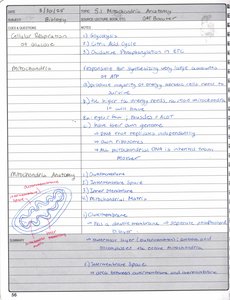
Mitochondrial Anatomy
Structure and Function
The mitochondrion is the organelle responsible for aerobic respiration. Its structure is specialized to maximize ATP production.
Outer Membrane: Permeable to small molecules.
Inner Membrane: Contains proteins for the ETC and ATP synthesis; highly folded into cristae to increase surface area.
Intermembrane Space: Space between the inner and outer membranes; important for proton gradient formation.
Mitochondrial Matrix: Contains enzymes for the citric acid cycle and pyruvate decarboxylation.
Glycolysis
Pathway and Regulation
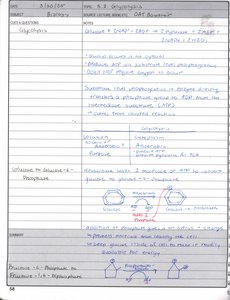
Glycolysis is the first step in cellular respiration, converting glucose into pyruvate and generating ATP and NADH.
Location: Cytoplasm
Key Steps: Glucose is phosphorylated, split into two 3-carbon molecules, and converted to pyruvate.
Net Yield: 2 ATP, 2 NADH per glucose molecule
Regulation: Controlled by enzymes such as hexokinase and phosphofructokinase.
Example: Rapid ATP production in muscle cells during anaerobic exercise.
Pyruvate Decarboxylation
Conversion to Acetyl-CoA
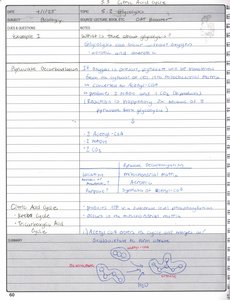
Pyruvate produced from glycolysis is transported into the mitochondria and converted to acetyl-CoA, which enters the citric acid cycle.
Location: Mitochondrial matrix
Reaction: Pyruvate + NAD+ + CoA → Acetyl-CoA + NADH + CO2
Importance: Links glycolysis to the citric acid cycle.
Citric Acid Cycle (Krebs Cycle)
Cycle Overview
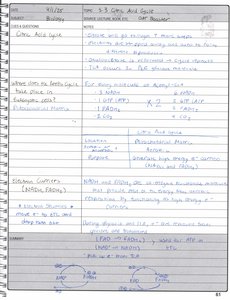
The citric acid cycle is a series of reactions that further oxidize acetyl-CoA, producing NADH, FADH2, and CO2.
Location: Mitochondrial matrix
Key Products: 3 NADH, 1 FADH2, 1 GTP (converted to ATP), 2 CO2 per acetyl-CoA
Importance: Supplies electrons to the ETC for ATP production.
Electron Transport Chain (ETC) and Oxidative Phosphorylation
Mechanism and ATP Production
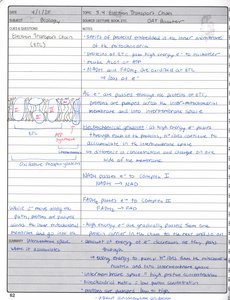
The ETC is a series of protein complexes in the inner mitochondrial membrane that transfer electrons from NADH and FADH2 to oxygen, generating a proton gradient used to synthesize ATP.
Location: Inner mitochondrial membrane
Process: Electrons are passed through complexes, pumping protons into the intermembrane space.
ATP Synthase: Uses the proton gradient to convert ADP to ATP.
Yield: Up to 34 ATP per glucose molecule (aerobic respiration)
Anaerobic Respiration and Fermentation
Types and Pathways
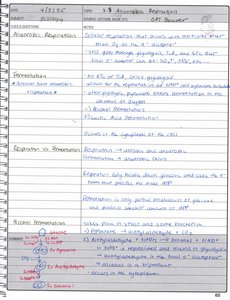
Anaerobic respiration occurs when oxygen is unavailable, leading to fermentation pathways that regenerate NAD+ for glycolysis.
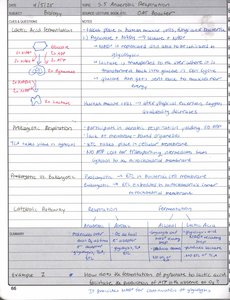
Lactic Acid Fermentation: Pyruvate is reduced to lactate; occurs in muscle cells.
Alcohol Fermentation: Pyruvate is converted to ethanol and CO2; occurs in yeast.
Yield: 2 ATP per glucose (from glycolysis)
Example: Muscle fatigue during intense exercise due to lactic acid buildup.
Alternative Energy Sources
Carbohydrates
Carbohydrates are the primary energy source for most cells. Glycogen is stored in the liver and muscles and can be broken down to glucose for glycolysis.
Glycogenolysis: Breakdown of glycogen to glucose.
Glycogenesis: Formation of glycogen from glucose.
Regulation: Controlled by hormones such as insulin and glucagon.
Lipids
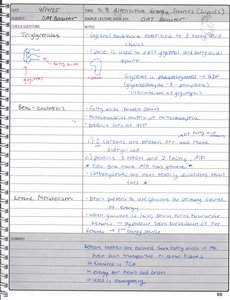
Lipids, mainly triglycerides, are broken down via beta-oxidation to produce acetyl-CoA, which enters the citric acid cycle.
Beta-Oxidation: Fatty acids are converted to acetyl-CoA.
Yield: High ATP yield per molecule compared to carbohydrates.
Example: Utilization of fat stores during prolonged exercise.
Proteins
Proteins are used as an energy source only when carbohydrates and lipids are insufficient. Amino acids undergo deamination and enter metabolic pathways as intermediates.
Deamination: Removal of amino group from amino acids.
Entry Points: Amino acids enter glycolysis or the citric acid cycle.
Example: Starvation or extreme exercise leading to protein catabolism.
Summary Table: Aerobic vs. Anaerobic Respiration
This table compares the main features of aerobic and anaerobic respiration.
Feature | Aerobic Respiration | Anaerobic Respiration |
|---|---|---|
Oxygen Requirement | Required | Not required |
ATP Yield (per glucose) | ~36-38 ATP | 2 ATP |
End Products | CO2, H2O | Lactate or Ethanol, CO2 |
Location | Mitochondria | Cytoplasm |
Regulation of Cellular Respiration
Hormonal and Enzymatic Control
Cellular respiration is tightly regulated by hormones and enzymes to meet the energy demands of the cell.
Insulin: Promotes glucose uptake and glycolysis.
Glucagon: Stimulates glycogen breakdown and gluconeogenesis.
Enzyme Regulation: Key enzymes such as phosphofructokinase are regulated by ATP, ADP, and other metabolites.
Key Equations
Glycolysis:
Citric Acid Cycle:
Electron Transport Chain:
Additional info: These notes expand on the handwritten material by providing definitions, context, and examples for each process, as well as including relevant diagrams and equations for clarity.
