 Back
BackChemical Components of Life and Macromolecules: Cell Biology Study Guide
Study Guide - Smart Notes
 Tailored notes based on your materials, expanded with key definitions, examples, and context.
Chemical Components of Life
Overview of Matter and Chemical Bonds
The chemical basis of life is founded on the properties of atoms and molecules, which interact through various types of chemical bonds. Understanding these bonds is essential for grasping the structure and function of biological molecules.
Matter: Anything that takes up space and has mass (e.g., organisms, rocks, gases).
Atoms: The smallest units of matter, composed of protons, neutrons, and electrons.
Molecules: Groups of atoms bonded together, forming the chemical basis of life.
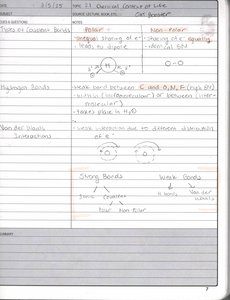
Electronegativity: The tendency of an atom to attract electrons. High electronegativity (e.g., O, N) leads to polar bonds; low electronegativity (e.g., C, H) leads to nonpolar bonds.
Types of Chemical Bonds
Chemical bonds are classified based on their strength and the sharing or transfer of electrons.
Covalent Bonds: Strong bonds formed by sharing electrons between atoms. Can be polar (unequal sharing, e.g., H2O) or nonpolar (equal sharing, e.g., O2).
Hydrogen Bonds: Weak bonds between a hydrogen atom and an electronegative atom (e.g., O or N). Important in water and biological macromolecules.
Van der Waals Interactions: Weak attractions due to transient local partial charges.
Bond Type | Strength | Example |
|---|---|---|
Covalent | Strong | H2O, O2 |
Hydrogen | Weak | Between water molecules |
Van der Waals | Weakest | Temporary dipoles |
Water: Properties and Biological Importance
Structure and Properties of Water
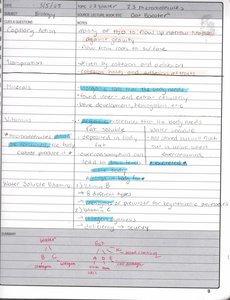
Water is a polar molecule with unique properties that make it essential for life. Its structure allows for hydrogen bonding, which gives rise to cohesion, adhesion, and high specific heat.
Cohesion: Water molecules stick together due to hydrogen bonding.
Adhesion: Water molecules stick to other surfaces.
High Specific Heat: Water resists temperature changes, stabilizing environments.
Solvent Properties: Water dissolves many substances, facilitating biochemical reactions.
Capillary Action
Capillary action is the movement of water through narrow spaces, driven by cohesion and adhesion. It is vital for transport in plants.
Macromolecules: Structure and Function
Carbohydrates
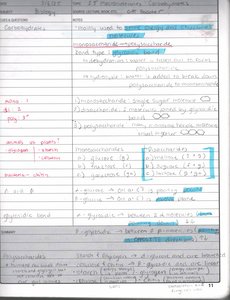
Carbohydrates are organic molecules composed of carbon, hydrogen, and oxygen. They serve as energy sources and structural components.
Monosaccharides: Simple sugars (e.g., glucose, fructose).
Disaccharides: Two monosaccharides joined by glycosidic bonds (e.g., sucrose, lactose).
Polysaccharides: Long chains of monosaccharides (e.g., starch, glycogen, cellulose).
Type | Example | Function |
|---|---|---|
Monosaccharide | Glucose | Energy |
Disaccharide | Sucrose | Transport |
Polysaccharide | Starch | Storage |
Lipids
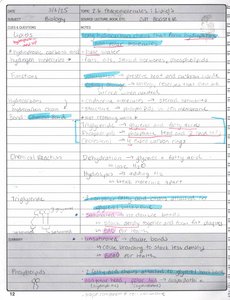
Lipids are hydrophobic molecules, including fats, oils, and steroids. They are important for energy storage, membrane structure, and signaling.
Triglycerides: Composed of glycerol and three fatty acids. Used for energy storage.
Phospholipids: Major component of cell membranes, with hydrophilic heads and hydrophobic tails.
Steroids: Include cholesterol and hormones.
Proteins
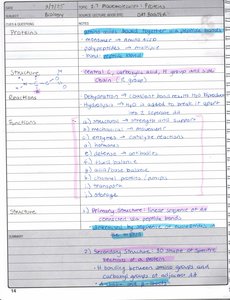
Proteins are polymers of amino acids, performing diverse functions such as catalysis, transport, and structural support.
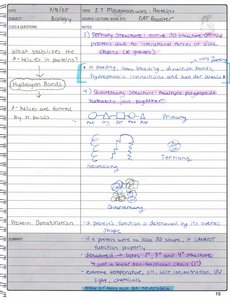
Structure: Four levels—primary (sequence), secondary (α-helix, β-sheet), tertiary (3D folding), quaternary (multiple polypeptides).
Functions: Enzymes, transport, signaling, structure, defense.
Denaturation: Loss of structure due to heat, pH, or chemicals.
Nucleic Acids
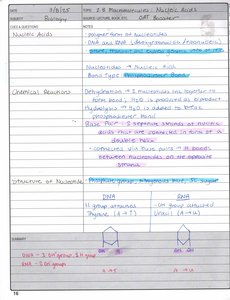
Nucleic acids (DNA and RNA) store and transmit genetic information. They are polymers of nucleotides, each consisting of a sugar, phosphate, and nitrogenous base.
DNA: Double helix, stores genetic information.
RNA: Single-stranded, involved in protein synthesis.
Nitrogenous Bases: Purines (adenine, guanine), pyrimidines (cytosine, thymine, uracil).
Type | Structure | Function |
|---|---|---|
DNA | Double helix | Genetic storage |
RNA | Single strand | Protein synthesis |
Chargaff's Rule
Chargaff's rule states that in DNA, the amount of adenine equals thymine, and the amount of guanine equals cytosine.
Formula:
Micronutrients and Vitamins
Minerals and Vitamins
Micronutrients are essential for various biochemical processes. Minerals (e.g., calcium, iron) and vitamins (e.g., A, D, E, K, B, C) play critical roles in metabolism, enzyme function, and cellular health.
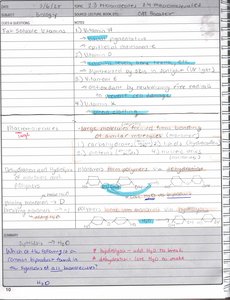
Water-Soluble Vitamins: B and C, important for metabolism and enzyme function.
Fat-Soluble Vitamins: A, D, E, K, stored in body fat and involved in vision, bone health, and antioxidant activity.
Vitamin | Solubility | Function |
|---|---|---|
A | Fat-soluble | Vision |
B | Water-soluble | Metabolism |
C | Water-soluble | Antioxidant |
D | Fat-soluble | Bone health |
Summary Table: Macromolecules
Macromolecule | Monomer | Bond Type | Function |
|---|---|---|---|
Carbohydrate | Monosaccharide | Glycosidic | Energy, structure |
Lipid | Fatty acid, glycerol | Ester | Energy storage, membrane |
Protein | Amino acid | Peptide | Catalysis, structure |
Nucleic Acid | Nucleotide | Phosphodiester | Genetic information |
Additional info: Academic context was added to clarify definitions, functions, and examples for each macromolecule and chemical bond type. Diagrams were included only when directly relevant to the explanation.
