 Back
BackChemotrophic Energy Metabolism: Glycolysis and Fermentation
Study Guide - Smart Notes
 Tailored notes based on your materials, expanded with key definitions, examples, and context.
Chemotrophic Energy Metabolism
Metabolic Pathways
Metabolism encompasses all chemical reactions within a cell, organized into specific metabolic pathways. These pathways are classified as either anabolic or catabolic:
Anabolic Pathways: Synthesize cellular components, often polymers such as starch and glycogen. These reactions increase order and decrease entropy, making them endergonic (energy-requiring).
Catabolic Pathways: Break down cellular constituents, such as the hydrolysis of glucose. These reactions decrease order and increase entropy, making them exergonic (energy-liberating).
ATP: The Primary Energy Molecule in Cells
Adenosine triphosphate (ATP) is the most common energy intermediate in cells, serving as the primary energy currency. Other high-energy molecules, such as GTP and creatine phosphate, also store chemical energy that can be converted to ATP. Reduced coenzymes like NADH represent chemical potential energy and can be transferred to other molecules or used to power endergonic reactions.
ATP Structure and Energy-Rich Bonds
ATP consists of adenine (aromatic base), ribose (five-carbon sugar), and three phosphate groups. The phosphate groups are linked by phosphoanhydride bonds and to ribose by a phosphoester bond.
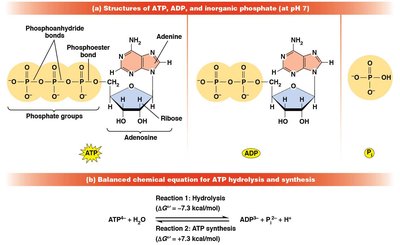
Phosphoanhydride Bonds
Phosphoanhydride bonds are termed "energy-rich" because free energy is released upon hydrolysis. The energy is a property of the reaction, not the bond itself.
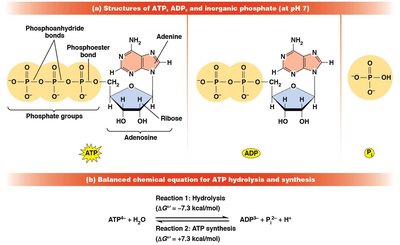
ATP Hydrolysis
Hydrolysis of ATP to ADP and Pi is highly exergonic due to:
Charge repulsion between adjacent negatively charged phosphate groups
Resonance stabilization of hydrolysis products
Increased entropy and solubility of products
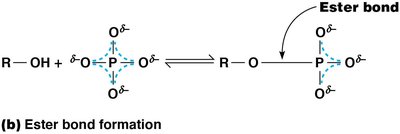
Energetics of ATP, ADP, and AMP Hydrolysis
ATP and ADP are higher-energy compounds than AMP. The hydrolysis of AMP is less energetically favorable due to reduced charge repulsion and resonance stabilization.
Reaction | ΔGºʹ (kcal/mol) |
|---|---|
ATP + H2O → ADP + Pi + H+ | -7.3 |
ADP + H2O → AMP + Pi + H+ | -7.3 |
AMP + H2O → adenosine + Pi | -3.6 |



Cellular Free Energy Change
The biological standard free energy change (ΔGºʹ) is an underestimate because it assumes equal concentrations of ATP and ADP. In cells, the ATP/ADP ratio is typically about 5:1, making the actual ΔGʹ more negative.

Chemotrophic Energy Metabolism: Oxidation and Reduction
Chemotrophic energy metabolism involves catabolic reactions that conserve released energy as ATP. Most reactions are oxidative, involving the removal of hydrogen ions (protons) and electrons (dehydrogenation).


Reduction and Hydrogenation
Reduction is the addition of electrons, often accompanied by protons (hydrogenation), making it an endergonic process.

Coenzymes in Biological Oxidations
Coenzymes such as NAD+ serve as electron acceptors in biological oxidations. They function with enzymes as carriers of electrons or small functional groups and are recycled within the cell.

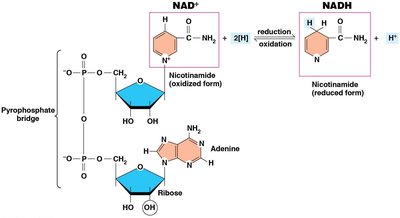
Glucose Catabolism and Glycolysis
Most chemotrophs oxidize organic food molecules, with glucose being the main energy source. The oxidation of glucose is highly exergonic, with a ΔGºʹ of –686 kcal/mol for complete conversion to CO2 and H2O.
Organisms and Oxygen Requirement
Obligate aerobes: Require oxygen
Obligate anaerobes: Cannot use oxygen; it is toxic
Facultative organisms: Can function with or without oxygen
Glycolysis: ATP Generation by Catabolizing Glucose
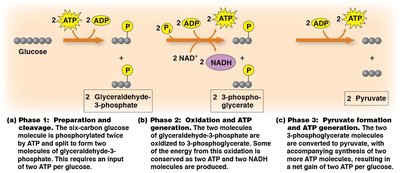
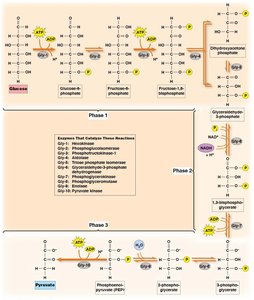
Glycolysis is a highly conserved pathway that converts glucose to pyruvate, generating ATP and NADH. The pathway consists of three phases:
Phase 1: Preparation and cleavage (Gly-1 to Gly-5)
Phase 2: Oxidation and ATP generation (Gly-6 to Gly-7)
Phase 3: Pyruvate formation and ATP generation (Gly-8 to Gly-10)

Key Features of Glycolysis
Initial input of 2 ATP (Gly-1 and Gly-3)
Splitting of glucose into two three-carbon molecules (Gly-4)
Oxidative event generating NADH (Gly-6)
ATP generation steps (Gly-7 and Gly-10)
Summary of Glycolysis
The net yield of glycolysis is two ATP per glucose. The pathway is highly exergonic in the direction of pyruvate formation (ΔGʹ ≈ –20 kcal/mol).

Fermentation: Regeneration of NAD+
In the absence of oxygen, pyruvate undergoes fermentation to regenerate NAD+ from NADH, allowing glycolysis to continue. Cells stabilize the NAD+/NADH ratio, which reflects the cell’s redox state.
Types of Fermentation
Lactate fermentation: Pyruvate is reduced to lactate
Ethanol fermentation: Pyruvate is converted to ethanol and CO2
Other pathways: Include proprionate, butylene glycol, acetone, isopropyl alcohol, and butyrate fermentation
Pathway | Overall Reaction |
|---|---|
Glycolysis + Lactate Fermentation | glucose + 2 NAD+ + 2 ADP + 2 Pi → 2 pyruvate + 2 NADH + 2 H+ + 2 ATP |
Glycolysis + Ethanol Fermentation | glucose + 2 ADP + 2 Pi + 2 H+ → 2 ethanol + 2 CO2 + 2 ATP |
Efficiency of Fermentation
Fermentation yields only two ATP per glucose, with most free energy remaining in lactate or ethanol. No external electron acceptor is involved, and no net oxidation occurs.
Aerobic Glycolysis in Cancer Cells
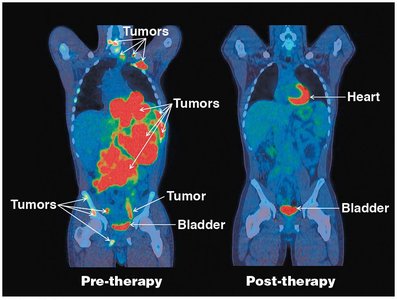
Cancer cells ferment glucose to lactate even in the presence of oxygen (aerobic glycolysis), consuming glucose rapidly and increasing nutrient transporter activity. This process supports biosynthesis for cell proliferation rather than energy production.
Positron Emission Tomography (PET)
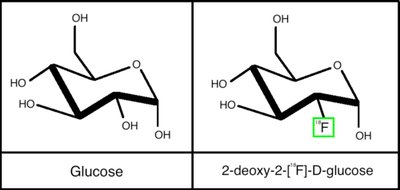
PET uses fluorodeoxyglucose, a radioactive glucose analogue, to image glucose accumulation in cancer cells. Radiotracers and isotopic labeling are used to follow biochemical intermediates in metabolic studies.
Catabolism of Other Sugars and Glycerol
Cells can catabolize various monosaccharides and disaccharides by converting them into glycolytic intermediates. Glucose and fructose enter most directly after phosphorylation on carbon atom 6, while mannose and fructose require additional steps.
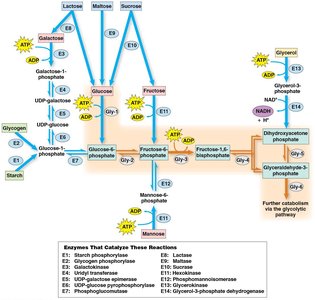
Summary Table: Entry Points of Sugars into Glycolysis
Sugar | Entry Point | Enzyme |
|---|---|---|
Glucose | Glucose-6-phosphate | Hexokinase |
Fructose | Fructose-6-phosphate | Fructokinase |
Mannose | Mannose-6-phosphate | Mannokinase |
Glycerol | Dihydroxyacetone phosphate | Glycerol kinase |
Lactose, Maltose, Sucrose | Various intermediates | Specific hydrolases |
Additional info: The glycolytic pathway is highly conserved across all domains of life, and its regulation is critical for cellular energy homeostasis. Cancer cell metabolism is a major area of research in cell biology and medicine.
