 Back
Chemotrophic Energy Metabolism: Glycolysis and Fermentation
Study Guide - Smart Notes
 Tailored notes based on your materials, expanded with key definitions, examples, and context.
Chemotrophic Energy Metabolism: Glycolysis and Fermentation
Metabolic Pathways
Metabolism encompasses all chemical reactions occurring within a cell, organized into specific metabolic pathways. These pathways are classified as either anabolic or catabolic, each serving distinct cellular functions.
Anabolic Pathways: Synthesize cellular components, often forming polymers such as starch and glycogen. These reactions increase molecular order and decrease entropy, making them endergonic (energy-requiring).
Catabolic Pathways: Break down cellular constituents, such as the hydrolysis of glucose. These reactions decrease molecular order and increase entropy, making them exergonic (energy-liberating).
ATP: The Primary Energy Molecule in Cells
Adenosine triphosphate (ATP) is the principal energy currency in biological systems. It stores and transfers energy required for cellular processes.
ATP contains adenine (aromatic base), ribose (five-carbon sugar), and three phosphate groups.
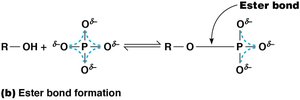
Phosphate groups are linked by phosphoanhydride bonds (energy-rich) and to ribose by a phosphoester bond.
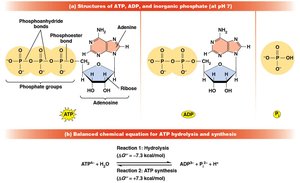
Phosphoanhydride Bonds and ATP Hydrolysis
Phosphoanhydride bonds are termed "energy-rich" because their hydrolysis releases free energy. The energy is a property of the reaction, not the bond itself.
ATP hydrolysis to ADP and Pi is highly exergonic due to charge repulsion, resonance stabilization, and increased entropy/solubility of products.
ATP and ADP Are Higher-Energy than AMP
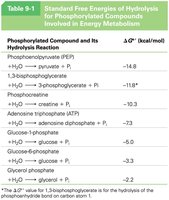
ATP and ADP possess more energy than AMP, as shown by their hydrolysis free energy changes.
Hydrolysis reactions:



Cellular Free Energy Change ()
The biological standard free energy change () underestimates the actual free energy change in cells, as it assumes equal concentrations of ATP and ADP. In reality, the ATP/ADP ratio is typically about 5:1, making more negative.

In cells, ranges from –10 to –14 kcal/mol.
ATP’s Position Among Phosphorylated Compounds
ATP occupies an intermediate position among phosphorylated compounds in terms of bond energy. It can be synthesized from ADP by transfer of a phosphate group from higher-energy compounds (e.g., PEP), and can phosphorylate lower-energy compounds (e.g., glucose).
ATP synthesis and hydrolysis are central to energy transfer in cells.
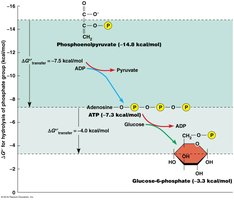
ATP Synthesis and Hydrolysis Cycle
The ATP/ADP pair provides a reversible mechanism for conserving, transferring, and releasing energy. Catabolic processes generate ATP, which is then hydrolyzed to power cellular work.
ATP couples nutrient breakdown to cellular work (synthetic, mechanical, electrical, etc.).
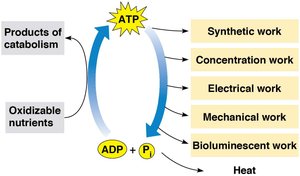
Chemotrophic Energy Metabolism
Chemotrophic energy metabolism refers to the catabolic reactions and pathways by which cells extract energy from nutrients and conserve it as ATP. Most of these reactions are oxidative, involving the removal of electrons and hydrogen ions.
Oxidation and Reduction in Biological Chemistry
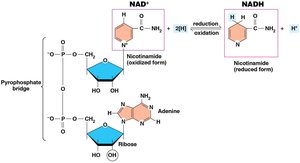
Oxidation in biological systems involves the removal of hydrogen ions (protons) and electrons, often termed dehydrogenation. Reduction is the addition of electrons, frequently accompanied by protons (hydrogenation).
Enzymes called dehydrogenases catalyze these reactions.



Coenzymes as Electron Acceptors
Coenzymes such as NAD+ serve as electron acceptors in biological oxidations. They are present in low concentrations and are recycled within the cell.
NAD+ accepts two electrons and a proton, forming NADH and a proton.

Glucose Catabolism and Energy Yield
Most chemotrophs oxidize organic food molecules (carbohydrates, fats, proteins) to meet energy needs. Glucose is the primary energy source for most cells, and its oxidation is highly exergonic.
Complete oxidation of glucose (aerobic respiration):
In the absence of oxygen, cells extract limited energy via glycolysis and fermentation.
Aerobic vs. Anaerobic Respiration
Cells differ in their oxygen requirements:
Obligate aerobes: Require oxygen for energy metabolism.
Obligate anaerobes: Cannot use oxygen; it is toxic to them.
Facultative organisms: Can function under both aerobic and anaerobic conditions.
Glycolysis: ATP Generation by Catabolizing Glucose to Pyruvate
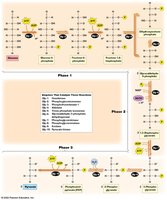
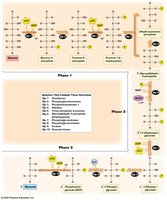
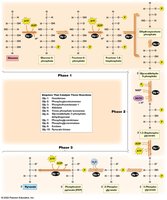
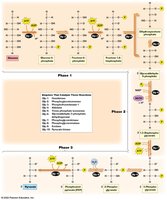
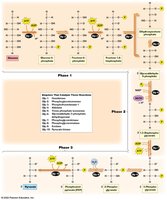
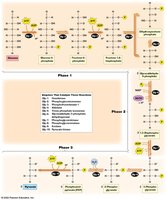
Glycolysis is a highly conserved pathway that converts glucose to pyruvate, generating ATP and NADH. It consists of ten enzyme-catalyzed steps, grouped into three phases.
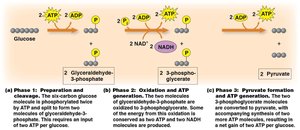
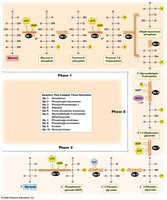
Phase 1: Preparation and Cleavage
In this phase, glucose is phosphorylated and split into two three-carbon molecules. Two ATP molecules are consumed.
Gly-1: Phosphorylation (1 ATP required)
Gly-2: Isomerization
Gly-3: Phosphorylation (1 ATP required)
Gly-4: Lysis (splitting 6-carbon glucose to 2 3-carbon molecules)
Phase 2: Oxidation and ATP Generation
During this phase, the three-carbon molecules are oxidized, NAD+ is reduced to NADH, and ATP is generated.
Gly-5: Isomerization
Gly-6: Oxidation (NAD+ is reduced to NADH)
Gly-7: Dephosphorylation (generation of 1 ATP)
Phase 3: Pyruvate Formation and ATP Generation
Final steps result in the formation of pyruvate and additional ATP production.
Gly-8: Isomerization
Gly-9: Dehydration
Gly-10: Dephosphorylation (generation of 1 ATP)
Important Features of the Glycolytic Pathway
Initial input of 2 ATP (Gly-1 and Gly-3)
Sugar-splitting reaction (Gly-4)
Oxidative event generating NADH (Gly-6)
ATP generation steps (Gly-7 and Gly-10)
Summary of Glycolysis
The net yield of glycolysis is 2 ATP per glucose molecule. The pathway is highly exergonic in the direction of pyruvate formation ().
Overall reaction:

Conservation of Glycolysis
The glycolytic pathway is one of the most conserved metabolic pathways, present in virtually all cells. The fate of pyruvate depends on oxygen availability, leading to either aerobic respiration or fermentation.
Additional info: These notes are based on Becker’s World of the Cell, Chapter 9 (pg 215-226), and provide a comprehensive overview of glycolysis and chemotrophic energy metabolism for cell biology students.
