 Back
BackCh 9 - Chemotropic Energy Metabolism: Glycolysis and Fermentation
Study Guide - Smart Notes
 Tailored notes based on your materials, expanded with key definitions, examples, and context.
Chapter 9: Chemotropic Energy Metabolism – Glycolysis and Fermentation
Learning Objectives
Apply the laws of thermodynamics to bioenergetics in cell biology.
Classify metabolic pathways as anabolic or catabolic.
Describe ATP structure and function as a universal energy coupler.
Summarize the breakdown of glucose by glycolysis and its molecular outputs.
Explain the fate of pyruvate under aerobic and anaerobic conditions.
Define fermentation, its occurrence, and biological importance.
Analyze the roles of glycolytic enzymes in metabolism and regulation.
Metabolic Pathways
Anabolic and Catabolic Pathways
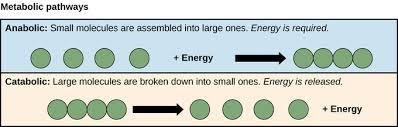
Metabolic pathways in cells are classified as either anabolic (synthetic) or catabolic (degradative). Catabolic reactions release energy by breaking down complex molecules, which is then used to drive anabolic reactions that build complex molecules from simpler ones.
Anabolic pathways: Require energy input to synthesize large molecules from small precursors.
Catabolic pathways: Release energy by breaking down large molecules into smaller units.
ATP: The Primary Energy Molecule in Cells
Structure and Function of ATP
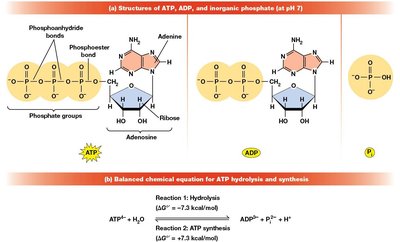
Adenosine triphosphate (ATP) is the main energy currency of the cell. Its terminal phosphoanhydride bond has an intermediate free energy of hydrolysis, making ATP an effective donor and acceptor of phosphate groups in cellular reactions.
ATP hydrolysis is exergonic due to charge repulsion, resonance stabilization, and increased entropy of products.
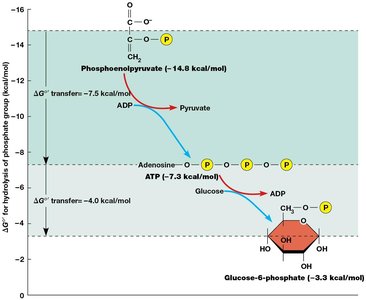
ATP can donate phosphate groups to molecules like glucose, while ADP can accept phosphate from high-energy intermediates such as phosphoenolpyruvate (PEP).
ATP/ADP Energy Intermediacy
The ATP/ADP pair acts as a reversible system for conserving, transferring, and releasing energy within the cell. Compounds with higher and lower bond energies than ATP/ADP allow for both phosphorylation and dephosphorylation reactions.
Chemotropic Energy Metabolism
Overview
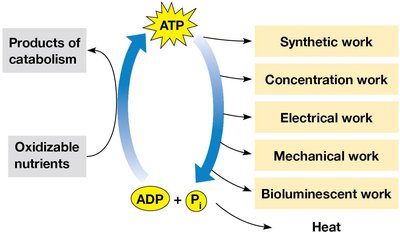
Most chemotrophs generate ATP by catabolizing organic nutrients (carbohydrates, fats, proteins) via fermentation (anaerobic) or aerobic respiration. Glycolysis is a central pathway that degrades glucose, conserving energy as ATP.
Oxidation and Reduction in Biological Chemistry
Oxidation
Oxidation is the removal of electrons (often with protons as hydrogen atoms) from a molecule, making it an energy source for cells. Most cellular oxidations are dehydrogenation reactions.

Reduction
Reduction is the gain of electrons (and usually protons), often described as hydrogenation. Oxidation and reduction always occur together as coupled half-reactions.

Coenzymes as Electron Acceptors
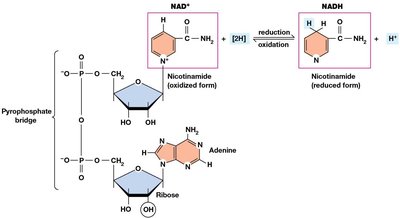
Coenzymes such as NAD+ (nicotinamide adenine dinucleotide) serve as electron acceptors in biological oxidations. They are present in low concentrations and are recycled during metabolism.
Glucose Catabolism and Energy Yield
Glucose as an Energy Source
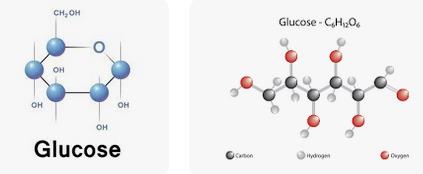
Glucose is the primary energy source for most cells. Its complete oxidation to CO2 and H2O is highly exergonic:
kcal/mol
Aerobic vs. Anaerobic Respiration
Aerobic respiration: Complete oxidation of glucose with O2 as the final electron acceptor.
Anaerobic respiration: Uses alternative electron acceptors (e.g., S, H+, Fe3+).
Fermentation: In the absence of oxygen, glycolysis is coupled to fermentation, regenerating NAD+ and producing end-products like lactate or ethanol.
Glycolysis: ATP Generation Without Oxygen
Overview of Glycolysis
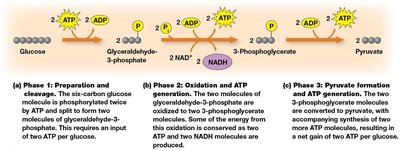
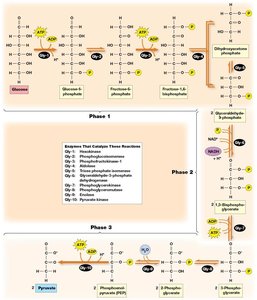
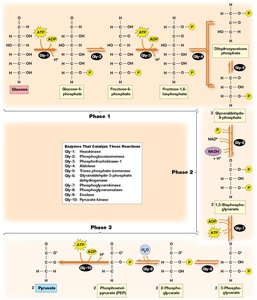
Glycolysis is a ten-step pathway converting glucose to pyruvate, producing ATP and NADH. It operates under both aerobic and anaerobic conditions and is divided into three phases:
Phase I: Preparatory and cleavage steps (Gly-1 to Gly-5)
Phase II: Oxidative sequence and first ATP-generating event (Gly-6 and Gly-7)
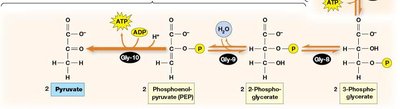
Phase III: Second ATP-generating event and pyruvate formation (Gly-8 to Gly-10)
Key Features of Glycolysis
Initial investment of 2 ATP (Gly-1 and Gly-3)
Splitting of glucose into two three-carbon molecules (Gly-4)
Oxidative event generating NADH (Gly-6)
ATP generation by substrate-level phosphorylation (Gly-7 and Gly-10)
Summary Equations
Phase I:
Phase II:
Phase III:
Overall Glycolysis Reaction
The net reaction for glycolysis is:
Fate of Pyruvate: Fermentation
Fermentation Pathways
In the absence of oxygen, pyruvate is reduced to regenerate NAD+, allowing glycolysis to continue. Two main types of fermentation are:
Lactate fermentation: Pyruvate is reduced to lactate (common in animals and some bacteria).
Alcoholic fermentation: Pyruvate is converted to ethanol and CO2 (common in yeast and plants).
Importance of NAD+ Regeneration
Fermentation regenerates NAD+ from NADH, maintaining the redox balance and enabling continuous ATP production via glycolysis.
Alternative Substrates for Glycolysis
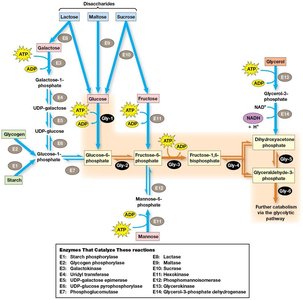
Glycolysis can metabolize sugars other than glucose, such as fructose, galactose, and mannose. It also processes glucose-1-phosphate from glycogen or starch breakdown.
Gluconeogenesis
Overview
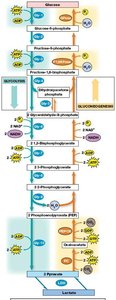
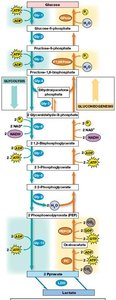
Gluconeogenesis is the synthesis of glucose from non-carbohydrate precursors (e.g., pyruvate, lactate, amino acids). It is not a simple reversal of glycolysis; three highly exergonic steps in glycolysis are bypassed by alternative reactions in gluconeogenesis, requiring ATP and GTP input.
Regulation of Glycolysis and Gluconeogenesis
Key Regulatory Enzymes
Glycolysis: Hexokinase, phosphofructokinase-1 (PFK-1), pyruvate kinase
Gluconeogenesis: Fructose-1,6-bisphosphatase, pyruvate carboxylase
These enzymes are regulated by allosteric effectors such as ATP, ADP, AMP, acetyl CoA, and citrate, allowing reciprocal regulation of the two pathways.
Allosteric Regulation and Hormonal Control
AMP activates glycolysis and inhibits gluconeogenesis.
Acetyl CoA activates gluconeogenesis and inhibits glycolysis.
Fructose-2,6-bisphosphate (F2,6BP) is a key regulator, activating PFK-1 (glycolysis) and inhibiting FBPase (gluconeogenesis).
PFK-2, a bifunctional enzyme, controls F2,6BP levels and is regulated by hormones (glucagon, epinephrine) via cAMP.
Additional Roles of Glycolytic Enzymes
Some glycolytic enzymes have regulatory functions beyond metabolism, such as gene expression regulation, programmed cell death, and cancer cell migration. For example, hexokinase-2 in yeast can localize to the nucleus and regulate gene expression in response to glucose levels.
