Back
BackComprehensive Study Notes on Enzymes
Study Guide - Smart Notes
 Tailored notes based on your materials, expanded with key definitions, examples, and context.
Introduction to Enzymes
Definition and Importance
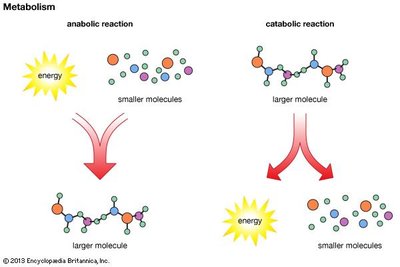
Enzymes are biological catalysts that accelerate the rate of biochemical reactions in living organisms without being consumed in the process. Most enzymes are globular proteins, though some, such as ribozymes, are RNA molecules with catalytic activity. Enzymes are essential for processes such as respiration, photosynthesis, digestion, and biosynthesis of macromolecules. They enable metabolic reactions to occur rapidly enough to sustain life.
Classification of Enzymes
Enzymes are classified based on the type of reaction they catalyze. The table below summarizes the main classes:
Class of Enzyme | Type of Reaction Catalysed | Examples |
|---|---|---|
Oxidoreductase | Transfers electrons, oxygen, or hydrogen atoms (oxidation-reduction reactions) | Dehydrogenases, Oxidases |
Transferase | Transfers functional groups between molecules | Kinases, Phosphorylases |
Hydrolase | Hydrolysis reactions | Sucrase, Lipases, Proteases |
Lyase | Removes groups without hydrolysis | Decarboxylases |
Isomerase | Rearranges atoms within a molecule | Isomerases |
Ligase | Forms bonds using ATP energy | Synthetases, Ligases |
Note: Enzyme names typically end with '-ase'.
Characteristics of Enzymes
General Properties
Specificity: Enzymes are highly specific for their substrates due to the unique structure of their active sites.
High Turnover Rate: A small amount of enzyme can convert a large amount of substrate to product in a short time.
Chemically Unchanged: Enzymes are not consumed or permanently altered during reactions.
Affected by Environmental Factors: Enzyme activity is influenced by substrate concentration, enzyme concentration, temperature, and pH.
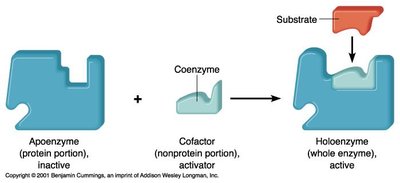
Cofactor Requirement: Some enzymes require non-protein cofactors (inorganic ions, coenzymes, or prosthetic groups) to function. The enzyme-cofactor complex is called a holoenzyme, while the protein part alone is an apoenzyme.
Regulation: Enzyme activity is tightly regulated by activators and inhibitors.
Equilibrium: Enzymes accelerate the attainment of equilibrium but do not alter the equilibrium position.
Types of Cofactors
Inorganic ions: e.g., Zn2+ for carbonic anhydrase.
Coenzymes: Organic molecules that bind loosely, e.g., NAD+ for dehydrogenases.
Prosthetic groups: Organic molecules tightly bound, e.g., haem in catalases.
Mode of Action of Enzymes
Active Site Structure
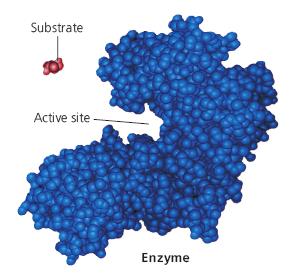
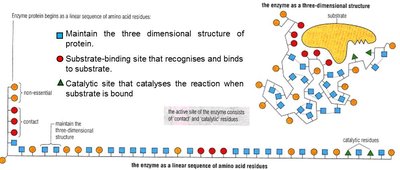
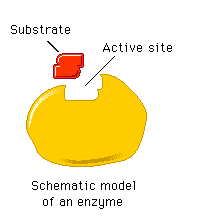
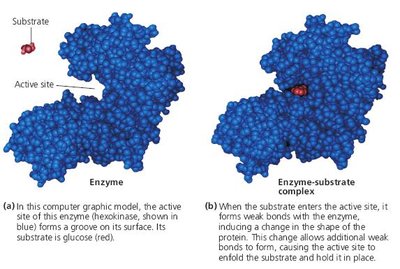
The active site is a specific region of the enzyme where substrate binding and catalysis occur. It is formed by a unique three-dimensional arrangement of amino acids, stabilized by hydrogen bonds, ionic bonds, disulfide bridges, and hydrophobic interactions. The active site consists of:
Substrate-binding site: Recognizes and binds the substrate, determining specificity.
Catalytic site: Facilitates the chemical reaction.
Enzyme Specificity
Enzyme specificity arises from the precise fit between the active site and the substrate, involving shape, size, charge, and orientation. This specificity is determined by the enzyme's amino acid sequence and three-dimensional conformation.
Enzyme-Substrate Complex
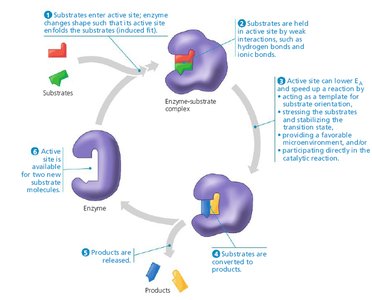
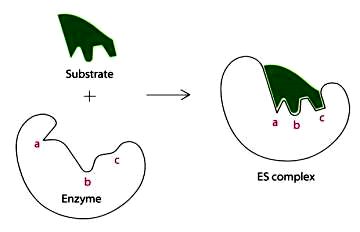
When a substrate binds to the enzyme's active site, an enzyme-substrate (E-S) complex forms. The substrate is held by weak interactions, and the catalytic site facilitates its conversion to product. After the reaction, the product is released, and the enzyme is free to catalyze another reaction.
Lock-and-Key vs. Induced Fit Hypotheses
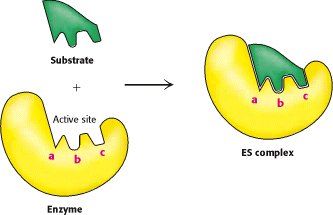
Lock-and-Key Hypothesis: The active site is perfectly complementary to the substrate, allowing precise binding. This model explains high specificity for a single substrate.
Induced Fit Hypothesis: The active site is flexible and molds itself around the substrate upon binding, allowing for a broader substrate range and enhanced catalysis.
Activation Energy
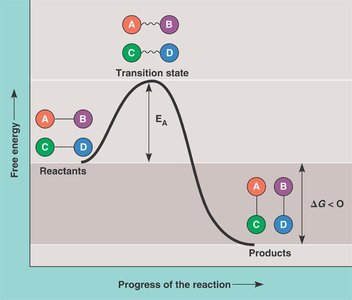
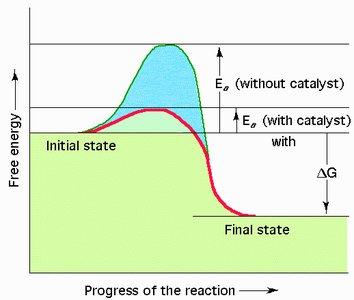
Activation energy (EA) is the minimum energy required for reactants to reach the transition state and undergo a chemical reaction. Enzymes lower the activation energy, providing an alternative pathway and increasing the reaction rate without raising the temperature.
Enzymes promote the transition state by:
Bringing reactants into close proximity
Orienting substrates correctly
Destabilizing bonds in reactants
Providing a conducive microenvironment
Enzyme Kinetics
Measurement of Enzyme Kinetics
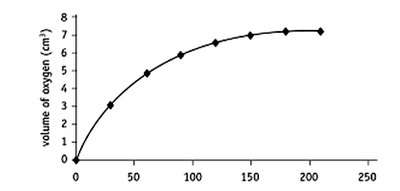
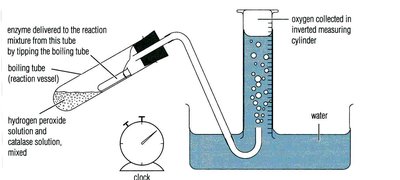
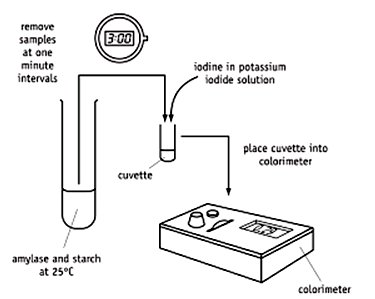
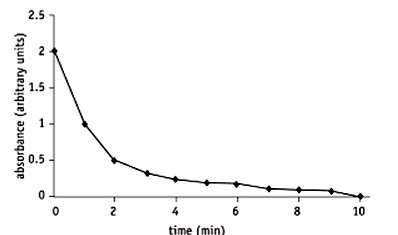
Enzyme kinetics studies the rates of enzyme-catalyzed reactions. Reaction rates can be measured by the amount of product formed or substrate depleted over time. The initial rate is determined from the linear portion of the reaction curve.
Product Formation: Example: Catalase catalyzing hydrogen peroxide breakdown, measured by oxygen evolution.
Substrate Disappearance: Example: Amylase hydrolyzing starch, measured by decrease in absorbance with iodine.
Measurement of Enzyme Affinity (Michaelis Constant, Km)
The Michaelis constant (Km) is the substrate concentration at which the reaction rate is half its maximum (Vmax). It indicates enzyme-substrate affinity:
Low Km: High affinity
High Km: Low affinity
Equation: $V_i = \frac{V_{max} [S]}{K_m + [S]}$
Factors Affecting Enzyme Activity
Substrate Concentration
At low substrate concentration, rate increases proportionally with substrate.
At high substrate concentration, all active sites are saturated, and the rate plateaus (Vmax).
Enzyme Concentration
At low enzyme concentration, rate increases with enzyme amount.
At high enzyme concentration, substrate becomes limiting, and the rate plateaus.
Temperature
Increasing temperature raises kinetic energy and reaction rate up to an optimum.
Above the optimum, enzymes denature, losing activity.
Q10 coefficient: $Q_{10} = \frac{\text{rate at } (x+10)^b0C}{\text{rate at } x^b0C}$ (typically Q10 = 2 for enzymes)
pH
Each enzyme has an optimum pH; deviations can reduce activity or denature the enzyme.
pH changes affect ionic and hydrogen bonds, altering active site conformation.
Enzyme Inhibition
Reversible Inhibition
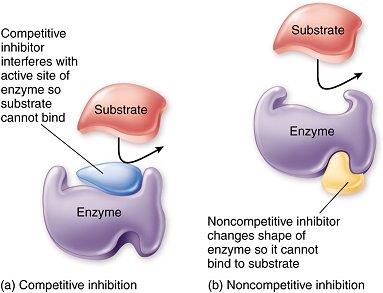
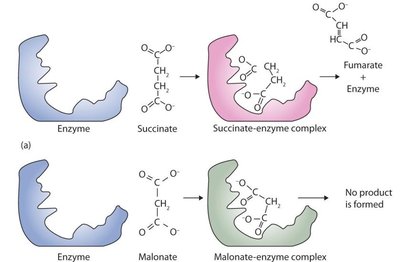
Competitive Inhibition: Inhibitor resembles substrate and binds to the active site, blocking substrate access. Increases Km, Vmax unchanged.
Non-competitive Inhibition: Inhibitor binds elsewhere, altering enzyme conformation. Km unchanged, Vmax decreased.
Irreversible Inhibition
Inhibitor binds permanently (often covalently), causing permanent loss of enzyme activity. Examples include heavy metals disrupting disulfide bonds.
Allosteric Regulation of Enzymes
Allosteric Activation and Inhibition
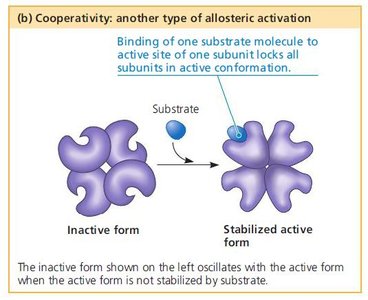
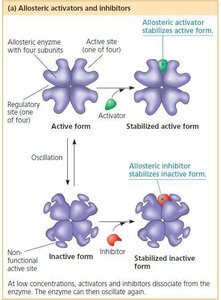
Allosteric enzymes have multiple subunits and regulatory sites. Binding of activators or inhibitors at allosteric sites induces conformational changes, stabilizing either the active or inactive form of the enzyme. This regulation can enhance or inhibit enzyme activity and is crucial for metabolic control.
End-Product (Feedback) Inhibition
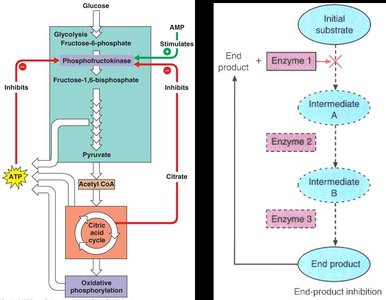
In metabolic pathways, the end product can inhibit an earlier enzyme, preventing overproduction. This is a form of negative feedback regulation.
Cooperativity
Cooperativity is a special form of allosteric regulation where substrate binding to one active site increases the affinity of other active sites for the substrate, enhancing overall enzyme activity. This is common in multi-subunit enzymes.