 Back
BackDNA, Chromosomes, and the Nucleus: The Structural Basis of Cellular Information
Study Guide - Smart Notes
 Tailored notes based on your materials, expanded with key definitions, examples, and context.
DNA as the Genetic Material
Historical Background and Key Experiments
The identification of DNA as the genetic material was a pivotal moment in cell biology. Early theories favored proteins due to their complexity, but a series of experiments overturned this view.
Griffith's Transformation Experiment: Demonstrated that a "transforming principle" from dead pathogenic bacteria could convert non-pathogenic bacteria into a virulent form, suggesting the transfer of genetic information.
Avery, MacLeod, and McCarty: Identified DNA as the transforming substance, confirming its role as the genetic material in bacteria.
Hershey-Chase Experiment: Used bacteriophages labeled with radioactive isotopes to show that DNA, not protein, is injected into bacteria during viral infection, establishing DNA as the genetic material in viruses.
Significance: These findings established DNA as the primary carrier of genetic information in both prokaryotes and eukaryotes.
Structure of DNA
The Double Helix Model
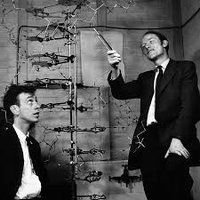
The structure of DNA was elucidated by Watson and Crick, who built upon X-ray diffraction data from Rosalind Franklin. Their model explained how DNA could store and replicate genetic information.
Nucleotide Components: Each nucleotide consists of a phosphate group, deoxyribose sugar, and a nitrogenous base (adenine, thymine, guanine, cytosine).
Base Pairing: Adenine pairs with thymine (A-T), and guanine pairs with cytosine (G-C), forming complementary strands.
Antiparallel Strands: The two DNA strands run in opposite directions (5’ to 3’ and 3’ to 5’), which is essential for replication and transcription.
Chargaff’s Rules: The amount of adenine equals thymine, and guanine equals cytosine in DNA samples, supporting the base pairing model.
Replication: The double helix allows each strand to serve as a template for the synthesis of a new complementary strand, ensuring accurate transmission of genetic information.
The Flow of Genetic Information
Transcription and Translation
Genetic instructions stored in DNA are expressed through a two-stage process:
Transcription: RNA is synthesized from a DNA template by RNA polymerase.
Translation: The sequence of bases in RNA directs the synthesis of a polypeptide (protein).
This flow of information is often summarized as the "central dogma" of molecular biology: DNA → RNA → Protein.
DNA Denaturation and Hybridization
Denaturation and Renaturation
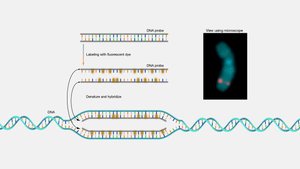
DNA strands are held together by hydrogen bonds and can be separated (denatured) by heat or pH changes. The process is reversible (renaturation), and the melting temperature (Tm) reflects DNA stability, influenced by GC content.
Nucleic Acid Hybridization: Single-stranded DNA or RNA can bind to complementary sequences, forming hybrids. This principle is used in techniques like fluorescence in situ hybridization (FISH) to detect specific DNA sequences.
DNA Packaging: Chromatin and Chromosomes
Chromatin Structure and Nucleosomes
In eukaryotes, DNA is packaged with proteins to form chromatin, which condenses further into chromosomes during cell division.
Histones: Small, basic proteins (H1, H2A, H2B, H3, H4) that bind DNA and form nucleosomes, the basic unit of chromatin structure.
Nucleosomes: Consist of a histone octamer wrapped by 146 bp of DNA, with linker DNA and histone H1 facilitating higher-order packing.
Chromatin Packing: Nucleosomes are packed into 30-nm fibers and further folded into loops, stabilized by scaffold proteins.
Transcriptionally active DNA is less tightly packed (euchromatin), while inactive DNA is highly compacted (heterochromatin).
Histone Modification and Chromatin Remodeling
Histone tails can be modified by methylation, acetylation, and other tags, affecting chromatin structure and gene expression. Chromatin remodeling proteins can reposition nucleosomes, making DNA more accessible for transcription. These changes can be inherited (epigenetics).
Chromosomal Structural Elements
Centromeres: Maintain sister chromatid cohesion and serve as attachment sites for spindle microtubules during cell division.
Telomeres: Protect chromosome ends from degradation and contain repetitive DNA sequences.
Types of DNA in the Genome
Repeated and Unique DNA Sequences
The human genome contains both unique and repeated DNA sequences. Repeated sequences can be tandemly repeated or interspersed, and their concentration affects the rate of DNA renaturation.
Exons: Make up the smallest portion of the human genome; these are coding regions.
Introns, Repeated DNA: Noncoding regions and repeated sequences constitute a larger fraction.
The Nucleus
Structure and Function
The nucleus is the site where chromosomes are localized, replicated, and transcribed. It is bounded by a double-membrane nuclear envelope, which separates nuclear and cytoplasmic constituents and regulates molecular traffic.
Nuclear Envelope: Consists of inner and outer membranes, with the outer membrane continuous with the endoplasmic reticulum.
Nuclear Pores: Specialized channels lined by the nuclear pore complex (NPC), allowing selective transport of proteins, RNA, and other molecules.
Nuclear Localization Signal (NLS): Sequence that targets proteins for import into the nucleus.
Nuclear Export Signal (NES): Sequence that targets proteins for export out of the nucleus.
Chromatin Organization in the Nucleus
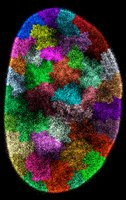
Chromatin fibers are extended and dispersed, with each chromosome occupying a distinct territory. In situ hybridization techniques demonstrate this nonrandom organization.
Nuclear Lamina and Matrix
The nuclear lamina is a meshwork of intermediate filaments (lamins) lining the inner nuclear membrane, providing structural support. The nuclear matrix (nucleoskeleton) may help maintain nuclear shape and organization.
The Nucleolus
The nucleolus is the site of ribosome assembly, where rRNA genes are transcribed and ribosomal subunits are formed. It is not bounded by a membrane and can be associated with multiple chromosomes.
Summary Table: DNA and Chromatin Structure
Component | Structure | Function |
|---|---|---|
DNA | Double helix, antiparallel strands | Genetic information storage |
Histones | Basic proteins (H1, H2A, H2B, H3, H4) | DNA packaging, nucleosome formation |
Nucleosome | Histone octamer + 146 bp DNA | Basic unit of chromatin |
Chromatin | DNA + proteins, 10-30 nm fibers | Gene regulation, chromosome structure |
Centromere | Constricted region, protein complex | Chromatid cohesion, spindle attachment |
Telomere | Repetitive DNA at chromosome ends | Protection from degradation |
Nuclear Envelope | Double membrane, nuclear pores | Compartmentalization, selective transport |
Nucleolus | Dense nuclear region | Ribosome assembly |
Key Definitions
Gene: A segment of DNA that codes for a functional product, usually a protein.
Chromosome: A highly condensed structure of chromatin visible during cell division.
Epigenetics: Heritable changes in gene expression not caused by changes in DNA sequence, often involving chromatin remodeling.
Important Equations
DNA Melting Temperature (Tm):
Base Pair Measurement:
Sample Exam Questions
Griffith's experiments with Streptococcus pneumoniae suggested that heat-killed bacteria could "transform" live bacteria.
Heterochromatin is highly compacted; constitutive heterochromatin plays a structural role, and facultative heterochromatin functions in regulation of gene expression.
The nuclear envelope functions as a selective barrier that separates nuclear and cytoplasmic constituents, localizes chromosomes within the cell, and sequesters many mRNA processing activities from the cytosol.
Exons make up the smallest portion of the human genome.
DNA is different from RNA in that RNA contains an additional oxygen atom on the ribose sugar.
Additional info: Epigenetic regulation, chromatin remodeling, and nuclear organization are increasingly recognized as central to gene expression and cellular function. The nucleus integrates mechanical and regulatory signals, connecting chromatin structure to cellular activity.
