 Back
DNA Replication: Structure, Function, and Mechanisms
Study Guide - Smart Notes
 Tailored notes based on your materials, expanded with key definitions, examples, and context.
DNA: The Instruction Manual of Life
General Function of DNA
DNA serves as the molecular blueprint for all cellular functions, encoding the instructions for protein synthesis and cell regulation. - Key Point 1: DNA contains genes that direct the synthesis of proteins, such as glucose transporters and insulin. - Key Point 2: DNA must be accurately copied before cell division to ensure genetic continuity. - Example: The human genome contains instructions for thousands of proteins essential for metabolism and growth. 
Structure of DNA
Nucleotides and Their Components
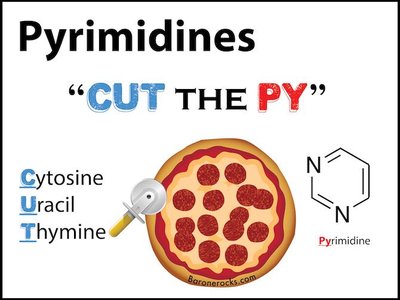
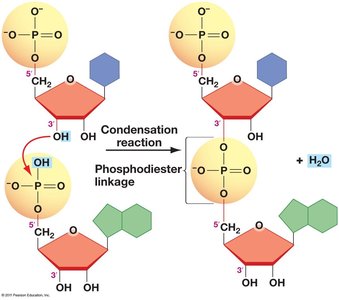
DNA is composed of nucleotide monomers, each consisting of a deoxyribose sugar, a phosphate group, and a nitrogenous base. - Key Point 1: The phosphate group and sugar form the backbone via phosphodiester bonds. - Key Point 2: Nitrogenous bases are classified as purines (adenine, guanine) or pyrimidines (cytosine, thymine). - Example: The sequence of bases determines genetic information. 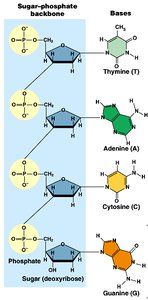
Phosphodiester and Hydrogen Bonds
- Phosphodiester bonds: Link nucleotides between the 5' phosphate and 3' hydroxyl groups. - Hydrogen bonds: Connect complementary bases (A-T: 2 bonds, G-C: 3 bonds). - Example: The double helix is stabilized by these bonds. 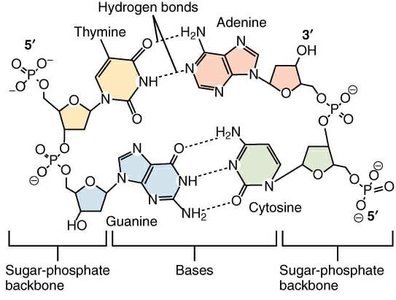
Antiparallel Structure and Functional Groups
DNA strands are antiparallel, with one running 5' to 3' and the other 3' to 5'. - Key Point 1: The 5' end has a phosphate group; the 3' end has a hydroxyl group. - Key Point 2: New nucleotides are added only to the 3' end during replication. 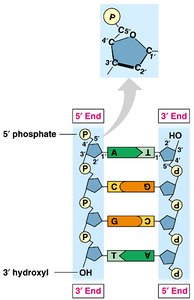
Human Genome Organization
Chromosomes and Karyotype
The human genome is organized into 23 pairs of chromosomes: 22 autosomes and 1 pair of sex chromosomes. - Key Point 1: Autosomes carry most genes for body functions; sex chromosomes determine biological sex. - Key Point 2: Chromosomes are coiled DNA around histone proteins. 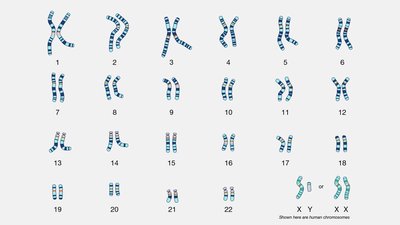
Chargaff’s Rule and Complementarity
Base Pairing Rules
Chargaff’s Rule states that in double-stranded DNA, A = T and C = G. - Key Point 1: Complementary strands allow prediction of one strand from the other. - Key Point 2: The double helix is formed by antiparallel, complementary strands. 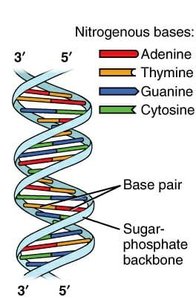
Historical Experiments: DNA as Hereditary Material
Griffith’s Experiment
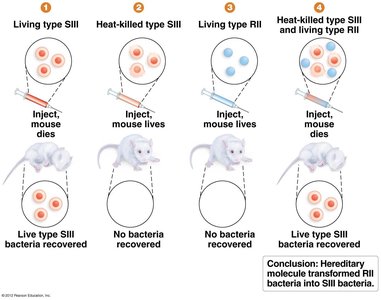
Frederick Griffith demonstrated that genetic information could be transferred between bacteria, suggesting the existence of a "transforming principle." - Key Point 1: Heat-killed pathogenic bacteria could transform non-pathogenic bacteria. - Key Point 2: This experiment laid the foundation for identifying DNA as the hereditary molecule. 
Avery-MacLeod-McCarty Experiment
This experiment identified DNA as the transforming agent by selectively destroying DNA, RNA, proteins, and lipids and observing transformation. - Key Point 1: Only destruction of DNA prevented transformation, confirming DNA as the hereditary material.
DNA Replication: Mechanism and Enzymes
Semiconservative Replication
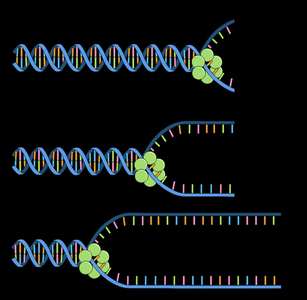
DNA replication produces two double helices, each with one parental and one daughter strand. - Key Point 1: Both strands serve as templates for new DNA. - Key Point 2: Ensures genetic fidelity across generations. 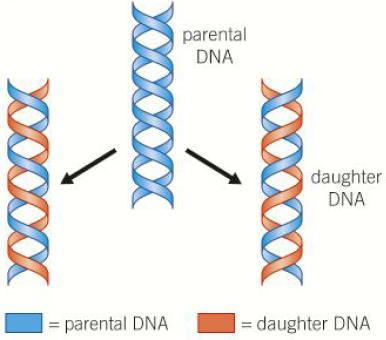
Origins of Replication, Bubbles, and Forks
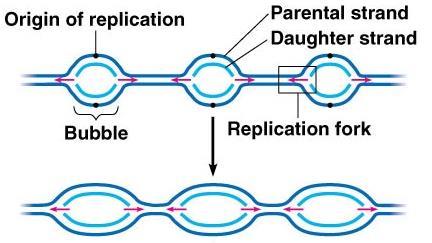
Replication begins at origins of replication (ORIs), forming bubbles and forks. - Key Point 1: Bacterial chromosomes have one ORI; human chromosomes have many. - Key Point 2: Replication bubbles expand as forks move outward, eventually fusing. 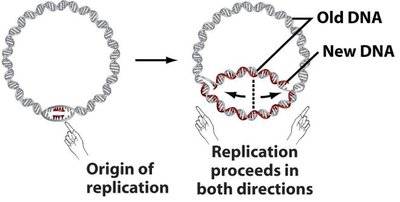
Major Enzymes in DNA Replication
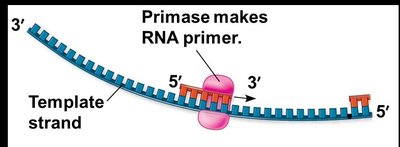
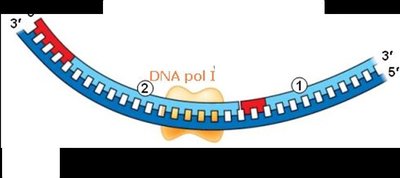
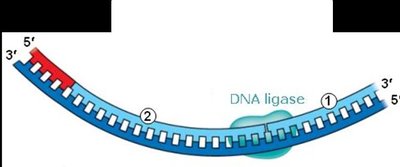
Several enzymes coordinate DNA replication: - Topoisomerase: Relieves strain ahead of helicase by making small cuts. - DNA helicase: Unwinds the double helix by breaking hydrogen bonds. - Primase: Synthesizes RNA primers to provide a starting point for DNA polymerase. - DNA Polymerase III: Synthesizes new DNA by adding nucleotides to the 3' end. - DNA Polymerase I: Removes RNA primers and fills gaps with DNA. - DNA Ligase: Joins Okazaki fragments on the lagging strand. 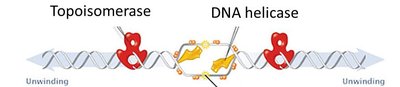
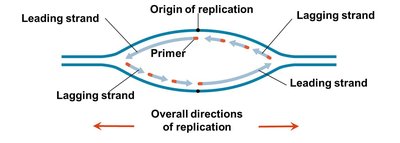
Leading vs. Lagging Strand Synthesis
- Leading strand: Synthesized continuously toward the replication fork. - Lagging strand: Synthesized discontinuously in Okazaki fragments, each requiring a new primer. 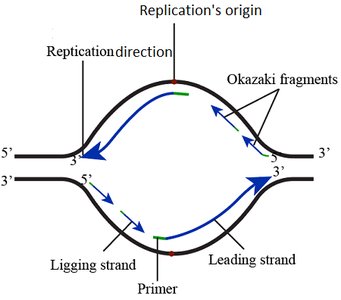
DNA Proofreading and Quality Control
DNA Polymerase III Proofreading
DNA Polymerase III checks its work, removing and replacing incorrect bases during synthesis. - Key Point 1: Ensures high fidelity in DNA replication.
Nucleotide Excision Repair
Nucleotide excision enzymes remove large errors, allowing DNA Polymerase III to resynthesize the correct sequence.
DNA Replication vs. PCR
Comparison Table
Feature | DNA Replication | PCR |
|---|---|---|
Location | Inside living cells | Laboratory test tube |
Scope | Entire genome | Specific DNA region |
Strand Separation | Helicase | Heat |
Primer Synthesis | Primase (RNA) | Scientist-made (DNA) |
Polymerase | DNA polymerase | Taq polymerase |
PCR Applications
PCR is used for ancestry testing, pathogen detection, crime scene analysis, and genetic disease testing. - Key Point 1: PCR amplifies specific DNA regions rapidly and efficiently.
PCR Process Steps
- Step 1: Heat separates DNA strands. - Step 2: Primers anneal to target sequence. - Step 3: Taq polymerase extends DNA. - Step 4: Repeat 30-35 cycles to produce millions of copies. Additional info: PCR uses heat-stable Taq polymerase to withstand high temperatures during strand separation.
Summary Table: Major Enzymes in DNA Replication
Enzyme | Function |
|---|---|
Topoisomerase | Relieves supercoiling ahead of replication fork |
DNA helicase | Unwinds DNA double helix |
Primase | Synthesizes RNA primers |
DNA Polymerase III | Synthesizes new DNA strand |
DNA Polymerase I | Removes RNA primers, fills gaps with DNA |
DNA Ligase | Joins Okazaki fragments |
