 Back
DNA Replication: Structure, Function, and Mechanisms
Study Guide - Smart Notes
 Tailored notes based on your materials, expanded with key definitions, examples, and context.
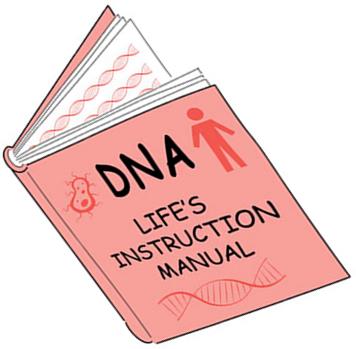
DNA: The Instruction Manual of Life
General Function of DNA
DNA (deoxyribonucleic acid) serves as the molecular blueprint for all cellular functions, encoding the instructions for protein synthesis and cell regulation. It is essential for inheritance, cell division, and the maintenance of life.
Key Point 1: DNA contains genes that direct the synthesis of proteins, such as glucose transporters and insulin.
Key Point 2: DNA must be accurately copied before cell division to ensure genetic continuity.
Example: The human genome contains instructions for thousands of proteins required for cellular metabolism and structure.
Structure of DNA and Chromosomes
Nucleotides and DNA Structure
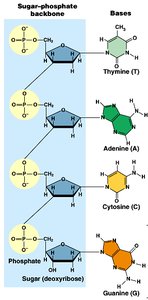
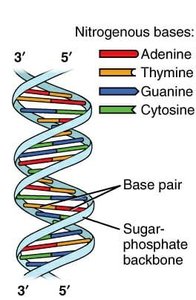
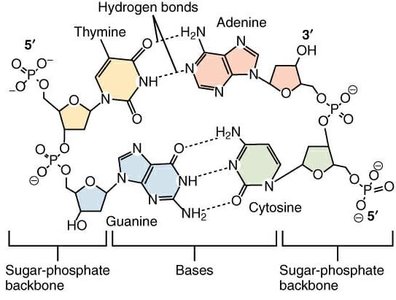
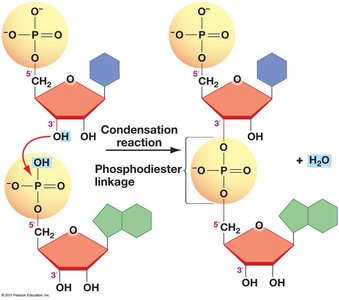
DNA is composed of nucleotide monomers, each consisting of a deoxyribose sugar, a phosphate group, and a nitrogenous base. Nucleotides are linked by phosphodiester bonds, forming a sugar-phosphate backbone.
Key Point 1: Nitrogenous bases are classified as purines (adenine, guanine) and pyrimidines (cytosine, thymine).
Key Point 2: The double helix structure is stabilized by hydrogen bonds between complementary bases: A-T (2 bonds), C-G (3 bonds).
Example: The sequence of bases determines genetic information, while the backbone provides structural integrity.
Chromosomes and the Human Genome
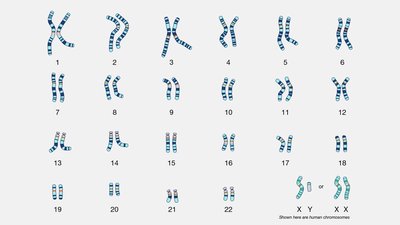
DNA is packaged into chromosomes, which are coiled around histone proteins. The human genome consists of 23 pairs of chromosomes: 22 autosomes and 1 pair of sex chromosomes (XX or XY).
Key Point 1: Autosomes carry genes for most cellular functions; sex chromosomes determine biological sex and other traits.
Key Point 2: Chromosomes are identical in most cells, ensuring consistent genetic instructions throughout the body.
Example: Karyotyping reveals the complete set of chromosomes in a cell.
DNA Base Pairing and Chargaff's Rule
Complementary Base Pairing
Chargaff’s Rule states that in double-stranded DNA, the amount of adenine equals thymine, and the amount of cytosine equals guanine. This ensures accurate base pairing and genetic fidelity.
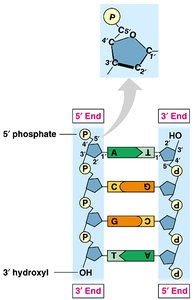
Key Point 1: DNA strands are antiparallel, oriented in opposite directions (5’ to 3’ and 3’ to 5’).
Key Point 2: Complementary base pairing allows prediction of one strand from the other.
Example: If a DNA strand is 27% adenine, it must also be 27% thymine; the remaining 46% is split equally between cytosine and guanine.
DNA Strand Orientation: 5’ and 3’ Ends
Functional Groups and Directionality
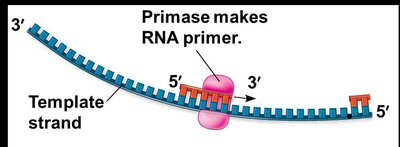
Each DNA strand has a 5’ end (phosphate group) and a 3’ end (hydroxyl group). DNA polymerases can only add nucleotides to the 3’ end, making strand directionality crucial for replication.
Key Point 1: The 3’ hydroxyl group is essential for forming phosphodiester bonds during DNA synthesis.
Key Point 2: DNA strands are built in the 5’ to 3’ direction.
Example: During replication, new nucleotides are added to the 3’ end of the growing strand.
Experiments Revealing DNA's Role
Griffith’s Experiment
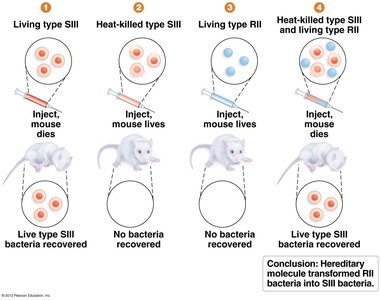
Frederick Griffith demonstrated that genetic information could be transferred between bacteria, a process known as transformation. His experiment used two strains of Pneumococcus: a virulent S strain and a non-virulent R strain.
Key Point 1: Heat-killed S strain combined with live R strain caused disease, indicating transfer of hereditary material.
Key Point 2: This experiment suggested that DNA is the molecule responsible for inheritance.
Example: Transformation of R strain to S strain in mice.
Avery-MacLeod-McCarty Experiment
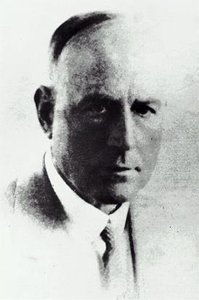
This experiment identified DNA as the transforming agent by selectively destroying DNA, protein, RNA, and lipids in bacteria and observing which component was necessary for transformation.
Key Point 1: Only destruction of DNA prevented transformation, confirming DNA as the hereditary molecule.
Key Point 2: This laid the foundation for understanding DNA’s central role in genetics.
DNA Replication: Mechanism and Enzymes
Semiconservative Replication
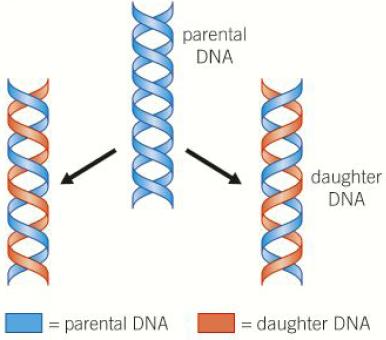
DNA replication is semiconservative: each new double helix contains one parental strand and one newly synthesized strand. This ensures genetic fidelity across generations.
Key Point 1: Both strands serve as templates for new DNA synthesis.
Key Point 2: Replication prepares cells for mitosis and division.
Example: After replication, each daughter cell receives a complete set of DNA.
Origins of Replication, Bubbles, and Forks
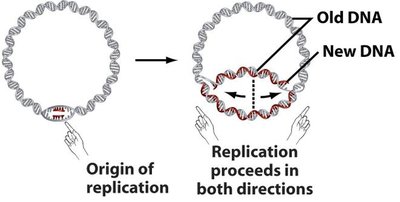
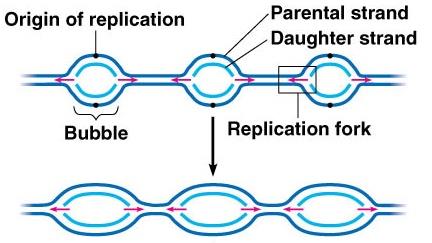
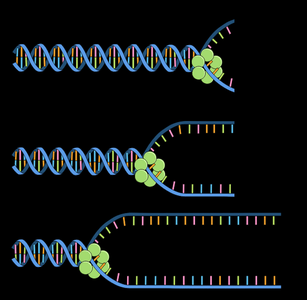
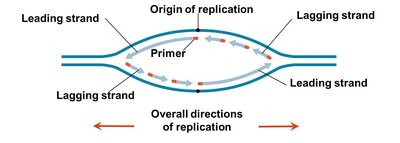
Replication begins at origins of replication (ORIs). In bacteria, there is typically one ORI; in humans, there are multiple. As DNA unwinds, replication bubbles and forks form, allowing enzymes to copy DNA.
Key Point 1: Replication bubbles expand as DNA is copied.
Key Point 2: Replication forks are the sites where DNA synthesis occurs.
Example: Multiple bubbles fuse to complete replication in large chromosomes.
Major Enzymes in DNA Replication
Several enzymes coordinate DNA replication:
Topoisomerase: Relieves strain ahead of the replication fork by making small cuts in DNA.
DNA Helicase: Unwinds the double helix by breaking hydrogen bonds.
Primase: Synthesizes RNA primers to provide a starting point for DNA polymerase.
DNA Polymerase III: Synthesizes new DNA by adding nucleotides to the 3’ end.
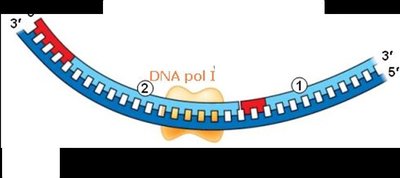
DNA Polymerase I: Removes RNA primers and replaces them with DNA.
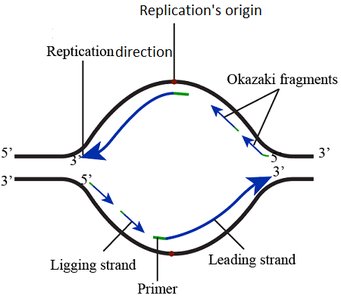
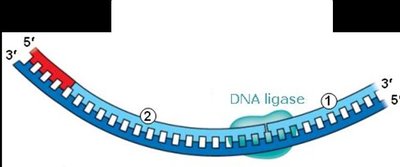
DNA Ligase: Joins Okazaki fragments on the lagging strand by forming phosphodiester bonds.

Leading vs. Lagging Strand Synthesis
The leading strand is synthesized continuously toward the replication fork, while the lagging strand is synthesized discontinuously in short segments called Okazaki fragments.
Key Point 1: The lagging strand requires multiple primers; each fragment is later joined by DNA ligase.
Key Point 2: DNA Polymerase III moves 3’ to 5’ on the template, synthesizing the new strand 5’ to 3’.
Example: Okazaki fragments are joined to form a complete lagging strand.
DNA Proofreading and Quality Control
Ensuring Accurate DNA Replication
DNA Polymerase III proofreads newly synthesized DNA, removing and replacing incorrect bases. Nucleotide excision enzymes remove larger errors, allowing DNA Polymerase III to resynthesize the correct sequence.
Key Point 1: Proofreading ensures high fidelity in DNA replication.
Key Point 2: Errors are corrected before cell division, preventing mutations.
Example: DNA repair mechanisms are essential for maintaining genetic stability.
DNA Replication vs. PCR (Polymerase Chain Reaction)
Comparison and Applications
PCR is a laboratory technique that mimics DNA replication to amplify specific DNA regions. Unlike cellular replication, PCR uses heat to separate strands and Taq polymerase to synthesize DNA.
Key Point 1: DNA replication copies the entire genome in cells; PCR targets specific sequences in vitro.
Key Point 2: PCR is used in genetic testing, disease detection, and forensic analysis.
Example: PCR enables rapid identification of pathogens and genetic variants.
Feature | DNA Replication | PCR |
|---|---|---|
Location | Inside cells | Laboratory test tube |
Scope | Entire genome | Specific DNA region |
Strand Separation | Helicase | Heat |
Primers | RNA primers (primase) | DNA primers (added by scientists) |
Polymerase | DNA polymerase | Taq polymerase |
Summary
DNA replication is a highly regulated, semiconservative process essential for cell division and genetic inheritance. The structure and function of DNA, the roles of key enzymes, and the mechanisms of replication and proofreading ensure the fidelity of genetic information. Laboratory techniques like PCR harness these principles for practical applications in science and medicine.
