 Back
BackEukaryotic Organelle Structure and Function: Isolation, Endomembrane System, and Protein Sorting
Study Guide - Smart Notes
 Tailored notes based on your materials, expanded with key definitions, examples, and context.
Eukaryotic Organelle Structure and Function
Methods for Isolation of Organelles
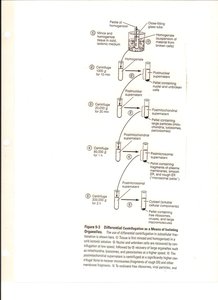
Isolation of cellular organelles is essential for studying their structure and function. The most common method is centrifugation, which separates cellular components based on size and density.
Centrifugation: Utilizes centrifugal force to sediment particles in a solution.
Differential Centrifugation: Sequentially separates cell components by spinning homogenized cells at increasing speeds, resulting in pellets of decreasing size and density.
Density Gradient Centrifugation: Separates organelles based on their buoyant density in a gradient medium (e.g., sucrose or cesium chloride).
Example: Differential centrifugation is used to isolate nuclei, mitochondria, lysosomes, and ribosomes from cell homogenates.
Principles of Centrifugation
Centrifugation relies on the balance between centripetal force and the tendency of macromolecules to move toward the bottom of the tube. Larger and denser molecules overcome the centripetal force more readily, sedimenting faster.
Supernatant: The liquid above the pellet after centrifugation, containing smaller or less dense components.
Pellet: The sedimented material at the bottom of the tube, containing larger or denser components.
Cellular Organelles and Their Structure
Main Cellular Structures
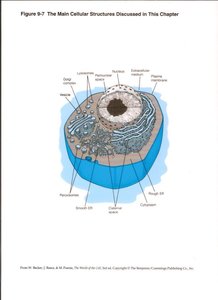
Eukaryotic cells contain a variety of organelles, each with specialized functions. The endomembrane system includes the nucleus, endoplasmic reticulum (ER), Golgi apparatus, lysosomes, and vacuoles.
Nucleus: Contains genetic material and is surrounded by a nuclear envelope.
Endoplasmic Reticulum (ER): Divided into rough (with ribosomes) and smooth (without ribosomes) regions.
Golgi Apparatus: Processes and sorts proteins and lipids.
Lysosomes: Digest cellular waste and foreign material.
Vacuoles: Storage and maintenance of cell turgor in plants.
The Nucleus
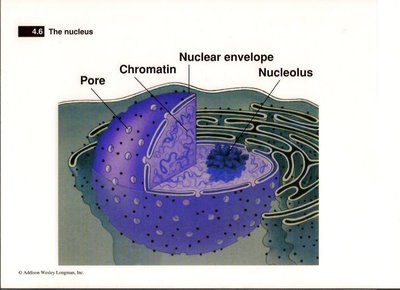
The nucleus is the control center of the cell, housing DNA and coordinating activities such as growth, metabolism, and reproduction. It is surrounded by a double membrane called the nuclear envelope, which contains nuclear pores for transport.
Chromatin: DNA-protein complex within the nucleus.
Nucleolus: Site of ribosomal RNA synthesis.
Nuclear Pore Complex: Regulates transport of molecules between nucleus and cytoplasm.
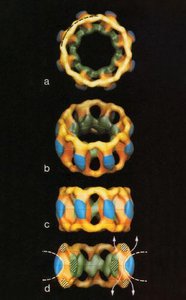
Nuclear Envelope and Pore Complex
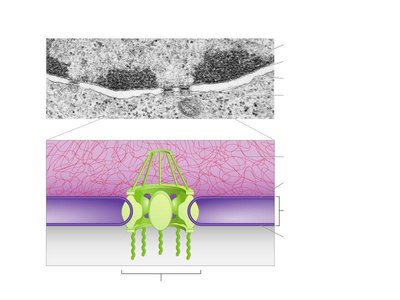
The nuclear envelope consists of inner and outer membranes, with nuclear pores facilitating selective transport. The nuclear pore complex is a large protein assembly that allows passage of ions, proteins, and RNA.
Symmetry: Nuclear pore complexes exhibit structural symmetry, aiding in efficient transport.
Endoplasmic Reticulum (ER)
Rough and Smooth ER
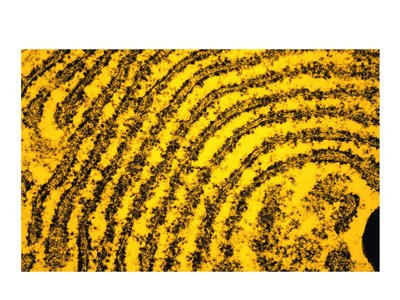
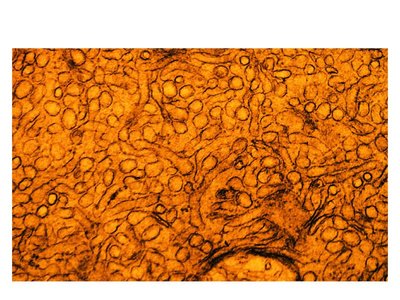
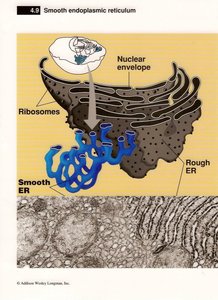
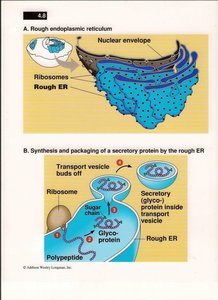
The ER is a network of membranes involved in protein and lipid synthesis. The rough ER (RER) is studded with ribosomes, while the smooth ER (SER) lacks ribosomes.
Rough ER: Synthesizes and processes proteins for secretion or membrane insertion.
Smooth ER: Involved in lipid synthesis, detoxification, and carbohydrate metabolism.
Smooth ER Functions
The smooth ER is abundant in liver cells and performs several key functions:
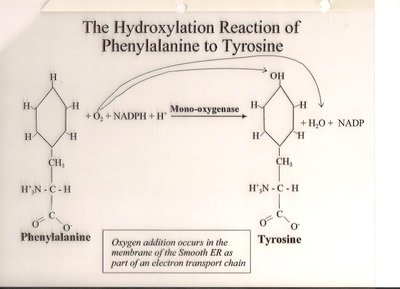
Hydroxylation Reactions: Addition of hydroxyl groups to molecules, such as amino acids.
Drug Detoxification: Metabolism of drugs and toxins.
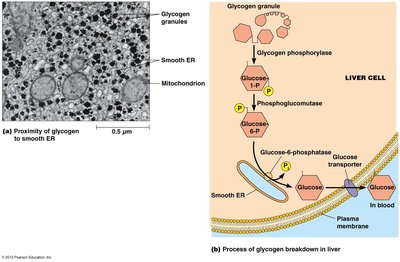
Glycogen Catabolism: Enzymes in the SER convert glycogen to glucose.
Membrane Production: Synthesis of membrane lipids.
Steroid Biosynthesis in Smooth ER
The smooth ER is the site of cholesterol and steroid hormone synthesis. Cells that produce these compounds have extensive smooth ER.
Cholesterol: Precursor for steroid hormones.
HMG-CoA Reductase: Key enzyme in cholesterol biosynthesis, targeted by statins.
Membrane Biosynthesis
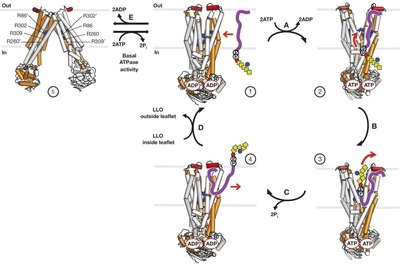
The ER is the primary source of membrane lipids in eukaryotic cells. Fatty acids are synthesized in the cytoplasm and incorporated into the ER membrane. Phospholipid translocators (flippases) transfer lipids across the bilayer, establishing membrane asymmetry.
Phospholipid Exchange Proteins: Transfer specific phospholipids to mitochondria, chloroplasts, or peroxisomes.
Rough ER Functions
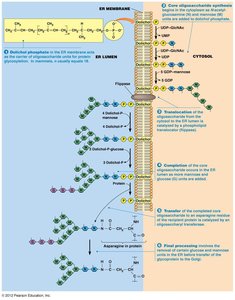
The rough ER is responsible for protein folding, glycosylation, and quality control.
Chaperone Proteins: Ensure correct protein folding.
Glycosylation: Addition of carbohydrate groups to proteins for post-translational modification.
Quality Control: Misfolded proteins are exported for degradation in cytosolic proteasomes (ERAD).
Golgi Apparatus
Structure and Function
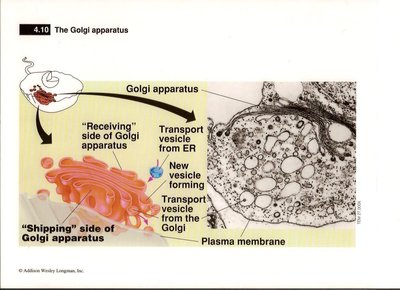
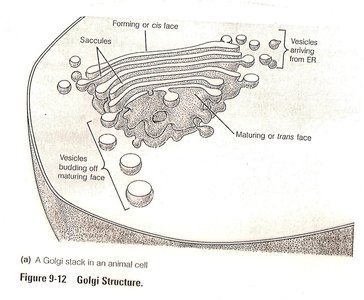
The Golgi apparatus is a series of flattened sacs (cisternae) responsible for packaging, sorting, and modifying proteins and lipids.
Packaging: Proteins are packaged for transport or export.
Sorting: Proteins are sorted for correct destination.
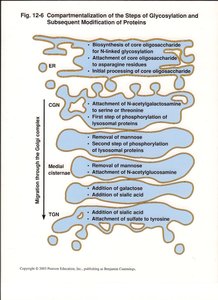
Terminal Glycosylation: Final carbohydrate modifications.
Additional Modifications: Phosphorylation, sulfonation, methylation.
Protein Glycosylation and Sorting
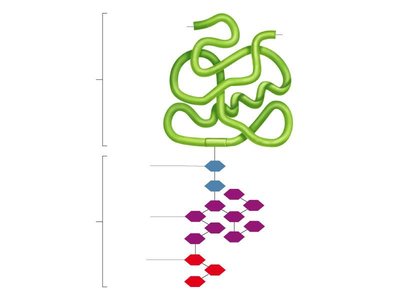
Proteins undergo glycosylation in the ER and Golgi, which acts as a signal for sorting and transport. The attached sugars serve as 'zip codes' for cellular trafficking.
Core Glycosylation: Occurs in the ER.
Terminal Glycosylation: Occurs in the Golgi, with three possible outcomes: high mannose, trimmed core, or addition of new sugars.
Endomembrane System and Protein Sorting
Connections Among Organelles
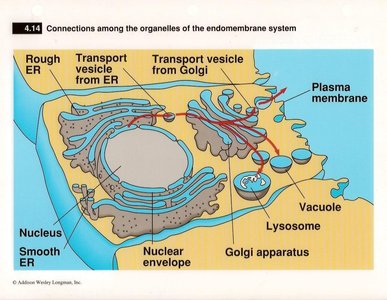
The endomembrane system is a network of organelles involved in synthesis, modification, and transport of proteins and lipids. It includes the ER, Golgi apparatus, lysosomes, vacuoles, and transport vesicles.
Anterograde Transport: Movement of material toward the plasma membrane.
Retrograde Transport: Flow of vesicles from Golgi back to the ER.
Protein Retention and Retrieval Tags
Protein composition in the ER and Golgi is maintained by retention and retrieval tags. These tags ensure proteins remain in or return to their correct organelle.
Retention Tag (RXR): Keeps proteins in the ER.
Retrieval Tag (KDEL, KKXX, HDEL): Returns proteins from Golgi to ER.
Sorting of Golgi Proteins
Golgi proteins may be sorted based on the length of their membrane-spanning domains. Membrane thickness increases from the cis to trans face, affecting protein migration.
Hydrophobic Domain Length: Correlates with protein location in Golgi.
Targeting of Lysosomal Proteins
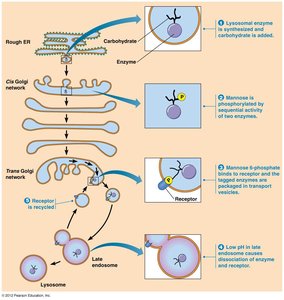
Soluble lysosomal enzymes are tagged with mannose-6-phosphate in the Golgi, ensuring their delivery to lysosomes.
N-glycosylation: Initial glycosylation in ER and early Golgi.
Mannose-6-Phosphate Tag: Added in Golgi for lysosomal targeting.
Summary Table: Organelle Functions
Organelle | Main Function |
|---|---|
Nucleus | Genetic information storage, transcription |
Rough ER | Protein synthesis, folding, glycosylation |
Smooth ER | Lipid synthesis, detoxification, carbohydrate metabolism |
Golgi Apparatus | Protein sorting, packaging, terminal glycosylation |
Lysosome | Digestion of cellular waste and foreign material |
Vacuole (plants) | Storage, turgor maintenance, pH regulation |
Peroxisome | Detoxification, fatty acid oxidation, nitrogen metabolism |
Additional info:
Some details about protein sorting and membrane biosynthesis were inferred for completeness.
Images were included only when directly relevant to the adjacent explanation.
