 Back
BackFoundations of Anatomy, Physiology, and Basic Chemistry for Biology
Study Guide - Smart Notes
 Tailored notes based on your materials, expanded with key definitions, examples, and context.
Anatomy and Physiology: Foundations
Differences and Subdivisions
Anatomy and physiology are two closely related fields in biology, but they focus on different aspects of living organisms. Anatomy is the study of structure, while physiology is the study of function.
Anatomy Subdivisions:
Gross Anatomy: Study of structures visible to the naked eye (e.g., organs).
Microscopic Anatomy: Study of structures requiring a microscope (e.g., cells, tissues).
Regional Anatomy: Study of specific body regions (e.g., head, chest).
Systemic Anatomy: Study of body systems (e.g., digestive system).
Physiology Subdivisions:
Cell Physiology: How cells function.
Systemic Physiology: How organ systems work (e.g., cardiovascular physiology).
Pathophysiology: How disease affects function.
Example: Studying the shape of the heart is anatomy; studying how the heart pumps blood is physiology.
Structural-Functional Relationships
The structure of a biological component determines its function. For example, the hard matrix of bone (containing calcium and collagen) allows it to support the body, protect organs, and assist with movement.
Levels of Organization
Biological systems are organized hierarchically:
Atoms → Molecules → Organelles → Cells → Tissues → Organs → Organ Systems → Organism
Homeostasis
Homeostasis is the maintenance of a stable internal environment. Key components include:
Receptor/Sensor: Detects changes.
Control Center: Processes information and determines response.
Effector: Carries out the response.
Communication occurs as the receptor sends information to the control center, which signals the effector.
Feedback Mechanisms
Negative Feedback: Reverses a change to maintain balance (e.g., body temperature regulation).
Positive Feedback: Amplifies a change (e.g., blood clotting).
Emergent Properties
An emergent property is a characteristic that appears at a higher level of organization but is not present at lower levels (e.g., consciousness in the brain).
Basic Chemistry for Biology
The Metric System and Unit Conversions
The metric system is used for scientific measurements. Key base units include:
Meter (m): Length
Gram (g): Mass
Liter (L): Volume
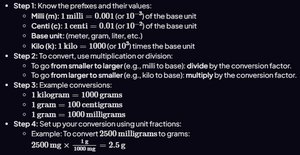
Common prefixes:
Milli (m): 0.001 (10-3) of the base unit
Centi (c): 0.01 (10-2) of the base unit
Kilo (k): 1000 (103) times the base unit
To convert between units, use multiplication or division by the conversion factor. For example, to convert from a smaller to a larger unit (mg to g), divide by the conversion factor; to convert from a larger to a smaller unit (kg to g), multiply by the conversion factor.
Atoms and Subatomic Particles
Atoms: Basic building blocks of matter, defined by the number of protons.
Protons: Located in the nucleus, charge +1, mass ≈ 1 amu.
Neutrons: Located in the nucleus, charge 0, mass ≈ 1 amu.
Electrons: Located in shells around the nucleus, charge -1, very small mass.
Atomic Number: Number of protons (defines the element). Atomic Mass Number: Number of protons + neutrons. Isotope: Atoms of the same element with different numbers of neutrons.
Electron Shells and Energy
Electrons occupy energy shells around the nucleus.
Lower energy shells fill first.
First shell: 2 electrons; Second shell: 8 electrons; Third shell: 8 electrons.
Ions and Electrical Neutrality
Electrically Neutral Atom: Equal numbers of protons and electrons.
Ion: Atom that has gained or lost electrons (charged).
Cation: Positive ion (loss of electrons).
Anion: Negative ion (gain of electrons).
Ionization Energy
Ionization energy is the energy required to remove an electron from an atom in its gaseous state.
Chemical Bonds
Covalent Bonds: Atoms share electrons (strong bonds, e.g., H2O).
Hydrogen Bonds: Weak attraction between a hydrogen atom and an electronegative atom (important in water and DNA).
Ionic Bonds: One atom transfers electrons to another, forming charged ions (e.g., NaCl).
Water Molecule Interactions
Water molecules are polar and form hydrogen bonds with each other, leading to unique properties like high surface tension and solvent abilities.
Predicting Atomic Behavior
Atoms with 1-3 valence electrons tend to lose electrons (form cations).
Atoms with 5-7 valence electrons tend to gain electrons (form anions).
Atoms with 4 valence electrons tend to share electrons (form covalent bonds).
Electronegativity and Bond Types
Similar electronegativity: Non-polar covalent bonds (equal sharing).
Different electronegativity: Polar covalent bonds (unequal sharing) or ionic bonds (electron transfer).
Chemical Notation and Formulas
Chemical notation uses symbols and numbers to represent atoms, molecules, and reactions. For example, C6H12O6 (glucose) contains 3 elements and 24 atoms in total.
Types of Chemical Reactions
Decomposition (Catabolic): Breaks down complex molecules, releases energy (exergonic).
Synthesis (Anabolic): Builds complex molecules, requires energy (endergonic).
Exchange: Rearranges components without changing complexity.
Reversible: Can proceed in both directions.
Balancing Chemical Equations
Ensure the number of each type of atom is the same on both sides of the equation.
Energy Types in Biology
Thermal Energy: Heat from cellular respiration.
Electromagnetic Energy: Sunlight used in photosynthesis.
Electrical Energy: Movement of ions across membranes.
Chemical Energy: Stored in ATP and chemical bonds.
Kinetic vs. Potential Energy
Kinetic Energy: Energy of motion (e.g., diffusion, muscle contraction).
Potential Energy: Stored energy (e.g., chemical bonds, concentration gradients).
Exergonic vs. Endergonic Reactions
Exergonic: Release energy, spontaneous (e.g., cellular respiration).
Endergonic: Require energy input, non-spontaneous (e.g., photosynthesis).
Anabolic/Synthesis: Usually endergonic.
Catabolic/Decomposition: Usually exergonic.
