 Back
BackMembrane Structure and Function: Organization, Transport, and Communication
Study Guide - Smart Notes
 Tailored notes based on your materials, expanded with key definitions, examples, and context.
Membrane Structure and Function
Overview of Membrane Functions
The cellular membrane is a dynamic structure that plays multiple essential roles in maintaining cellular integrity and function. It acts as a selective barrier, organizes cellular processes, facilitates transport, detects signals, and mediates cell-to-cell interactions.
Boundary and Permeability Barrier: The membrane separates the internal environment of the cell from the extracellular space, controlling the entry and exit of substances.
Organization and Localization of Function: Membranes compartmentalize cellular processes, allowing specialized functions to occur in distinct regions (e.g., organelles).
Transport Processes: Membranes regulate the movement of ions (such as Na+ and K+) and nutrients, maintaining homeostasis and supporting metabolic activities.
Signal Detection: Membrane proteins detect extracellular signals and initiate intracellular responses, a process known as signal transduction.
Cell-to-Cell Interactions: Membranes facilitate communication and adhesion between neighboring cells, which is crucial for tissue formation and immune responses.
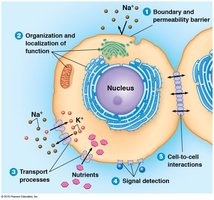
Example: The sodium-potassium pump (Na+/K+-ATPase) is a membrane protein that actively transports Na+ out of and K+ into the cell, maintaining the electrochemical gradient essential for nerve impulse transmission.
Additional info: The membrane's selective permeability is due to its lipid bilayer structure and embedded proteins, which together determine which molecules can cross and how signals are transmitted.
