 Back
BackOrganelles and Cellular Trafficking: The Endomembrane System
Study Guide - Smart Notes
 Tailored notes based on your materials, expanded with key definitions, examples, and context.
Organelles and Cellular Trafficking
Components of the Endomembrane System
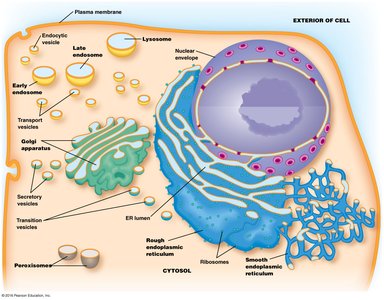
The endomembrane system is a network of organelles and vesicles in eukaryotic cells that work together to synthesize, process, sort, and transport proteins and lipids. It includes the endoplasmic reticulum (ER), Golgi complex, endosomes, lysosomes, and the vesicles that connect them.
Endoplasmic Reticulum (ER): Site for protein synthesis, processing, and sorting.
Golgi Complex: Further processes and sorts proteins and lipids received from the ER.
Endosomes: Carry and sort material brought into the cell.
Lysosomes: Digest ingested material and unneeded cellular components.
The Endoplasmic Reticulum
Structure and Function of the ER
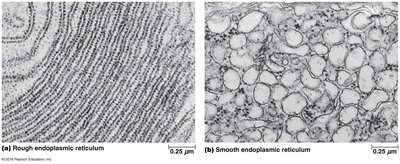
The endoplasmic reticulum (ER) is a continuous network of flattened sacs, tubules, and vesicles throughout the cytoplasm. The membrane-bound sacs are called ER cisternae, and the space inside them is the ER lumen.
Rough ER: Studded with ribosomes, consists of large, flattened sheets.
Smooth ER: Lacks ribosomes, consists of smooth, tubular structures.
All eukaryotic cells have both rough and smooth ER; their proportions vary based on cellular function.
Rough ER: Biosynthesis and Processing of Proteins
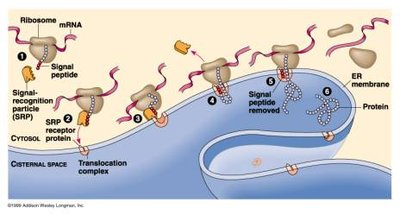
The rough ER is involved in the biosynthesis and processing of proteins. Ribosomes on the cytosolic side synthesize both membrane-bound and soluble proteins for the endomembrane system. Newly synthesized proteins are inserted into the ER cotranslationally through a pore complex.
Initial steps of glycoprotein formation: Addition of carbohydrates to proteins.
Folding of polypeptides and removal of misfolded proteins.
Assembly of multimeric proteins.
Membrane Biosynthesis in the ER
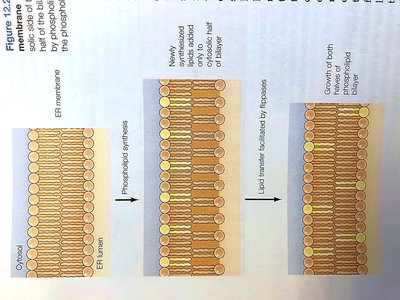
Fatty acids for membrane phospholipids are synthesized in the cytoplasm and incorporated into the ER membrane on the cytosolic side. Phospholipids are transferred to the lumenal side of the bilayer by enzymes called phospholipid translocators (flippases).
Phospholipid synthesis: Occurs on the cytosolic side of the ER membrane.
Flippases: Enzymes that transfer phospholipids to the lumenal side, ensuring growth of both sides of the bilayer.
The Golgi Complex
Structure and Function of the Golgi Complex
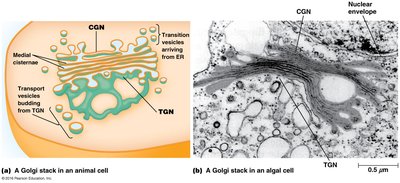
The Golgi complex is functionally and physically linked to the ER. Glycoproteins and membrane lipids from the ER undergo further processing and are sorted and packaged for transport. The Golgi plays a central role in membrane and protein trafficking in eukaryotic cells.
Cis face: Oriented toward the ER; receives materials.
Trans face: Oriented away from the ER; sorts and dispatches materials.
Transport Through the Golgi Complex
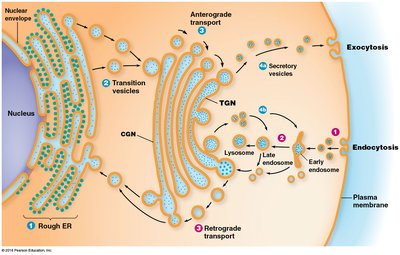
Material moves through the Golgi via anterograde transport (toward the plasma membrane) and retrograde transport (back to the ER). This balances the flow of lipids and ensures a supply of materials for forming new vesicles.
Anterograde transport: Movement toward the plasma membrane; includes exocytosis.
Retrograde transport: Movement from Golgi cisternae back to the ER.
Stationary model: Each cisterna is stable; materials are transported by shuttle vesicles.
Protein Glycosylation and Sorting
Glycosylation: ER and Golgi Coordination
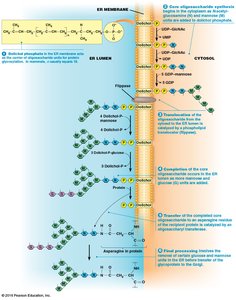
Protein processing in the ER and Golgi involves glycosylation, the addition of carbohydrate side chains to proteins. Enzyme-catalyzed reactions modify the oligosaccharide side chain, including trimming and phosphorylation.
Initial glycosylation: Occurs on the cytosolic side of the ER membrane.
Flippase: Switches glycosylated dolichol phosphate to the interior side of the ER membrane.
Oligosaccharide transfer: To transmembrane proteins; trimming and completion in the Golgi.
Protein Tags and Targeting
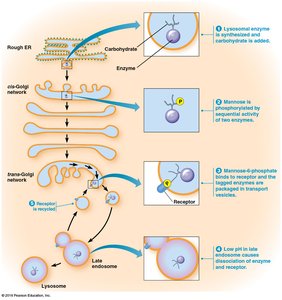
Proteins synthesized in the rough ER must be directed to specific locations. Each protein contains a specific "tag" that targets it to a transport vesicle for the correct location.
Tags: May be amino acid sequences, hydrophobic domains, oligosaccharide side chains, or other features.
ER retention tag (RXR): Retains proteins in the ER until assembly is complete.
ER retrieval tags (KDEL, KKXX, HDEL): Direct proteins back to the ER from the Golgi.
Lysosomal targeting: Mannose-6-phosphate tag ensures delivery of lysosomal proteins to lysosomes.
Exocytosis and Endocytosis
Exocytosis: Transporting Material Out of the Cell
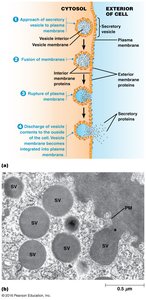
Exocytosis is the process by which vesicles containing products for secretion move to the cell surface, fuse with the plasma membrane, and discharge their contents. The vesicle membrane becomes part of the cell membrane.
Constitutive secretion: Continuous, unregulated process (e.g., mucus secretion).
Regulated secretion: Occurs in response to specific signals (e.g., neurotransmitter release).
Polarized secretion: Exocytosis limited to a specific cell surface (e.g., digestive enzyme secretion).
SNARE Proteins and Vesicle Fusion
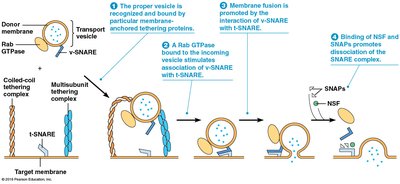
Fusion between vesicles and target membranes is mediated by SNARE proteins. v-SNAREs are found on vesicles, and t-SNAREs are found on target membranes. Their interaction allows recognition and fusion.
Rab GTPase: Stimulates association of v-SNARE with t-SNARE.
NSF and SNAP: Promote dissociation of the SNARE complex after fusion.
Endocytosis: Importing Material Into the Cell
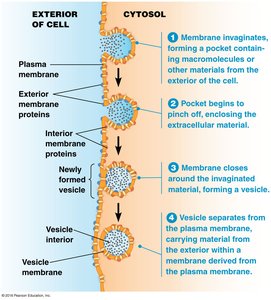
Endocytosis is the process by which extracellular molecules are imported by forming vesicles from the plasma membrane. Endocytic vesicles develop into early endosomes, which fuse with vesicles from the TGN and acquire digestive enzymes to form new lysosomes.
Phagocytosis: Ingestion of solid particles.
Pinocytosis: Uptake of liquids.
Endocytic vesicle formation: Membrane invaginates, pinches off, and separates from the plasma membrane.
Summary Table: Key Functions of Endomembrane System Components
Organelle | Main Function | Key Process |
|---|---|---|
Endoplasmic Reticulum (ER) | Protein synthesis, folding, and membrane biosynthesis | Glycosylation, lipid synthesis |
Golgi Complex | Protein and lipid processing, sorting, and packaging | Glycosylation, phosphorylation, vesicle trafficking |
Endosomes | Sorting of endocytosed material | pH-dependent maturation, fusion with lysosomes |
Lysosomes | Digestion of cellular waste and ingested material | Hydrolytic enzyme activity |
Additional info: The notes above expand on the original content by providing definitions, examples, and context for each organelle and process, ensuring completeness and academic quality for cell-biology students.
