Back
BackPathway of Hydrolase Protein Targeting to the Lysosome: Cell Biology Study Notes
Study Guide - Smart Notes
 Tailored notes based on your materials, expanded with key definitions, examples, and context.
Hydrolase Protein Targeting: From Gene Transcription to Lysosome Localization
Overview of the Endomembrane System Protein Pathway
The pathway by which a hydrolase protein is synthesized and targeted to the lysosome is a classic example of protein sorting in eukaryotic cells. Hydrolases are enzymes responsible for breaking down biomolecules within the lysosome, and their correct localization is essential for cellular function. The process involves multiple steps, beginning with gene transcription and ending with the maturation of the lysosomal enzyme.
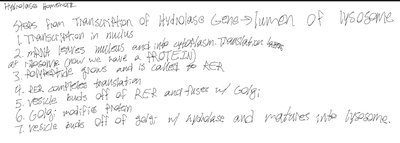
Step 1: Transcription in the Nucleus The hydrolase gene is transcribed into messenger RNA (mRNA) within the nucleus.
Step 2: mRNA Export and Translation Initiation The mRNA exits the nucleus through nuclear pores and enters the cytoplasm, where translation begins. Translation starts on free ribosomes, but for hydrolase (a secretory pathway protein), the ribosome becomes associated with the rough endoplasmic reticulum (RER).
Step 3: Polypeptide Targeting to the RER The nascent polypeptide contains a signal peptide that directs the ribosome to the RER. Translation continues, and the polypeptide is translocated into the lumen of the RER.
Step 4: Completion of Translation in the RER The hydrolase polypeptide is fully synthesized and folded within the RER lumen.
Step 5: Vesicle Budding and Transport to Golgi The hydrolase is packaged into a transport vesicle that buds off from the RER and fuses with the Golgi apparatus.
Step 6: Golgi Processing and Sorting Within the Golgi, the hydrolase undergoes further modifications (such as glycosylation) and is sorted for delivery to the lysosome.
Step 7: Vesicle Budding from Golgi and Lysosome Maturation The hydrolase is packaged into a vesicle that buds off from the Golgi, containing the enzyme and other lysosomal components. This vesicle matures into a lysosome or fuses with an existing lysosome, delivering the hydrolase to its functional location.
Key Terms:
Lumen: The internal space of an organelle, such as the ER or lysosome.
Signal Peptide: A short peptide sequence that directs the nascent polypeptide to the RER.
Glycosylation: The addition of carbohydrate groups to proteins, often occurring in the Golgi apparatus.
Hydrolase: An enzyme that catalyzes the hydrolysis of chemical bonds.
Example: Lysosomal hydrolases, such as acid phosphatase, are synthesized via this pathway and are essential for cellular digestion and recycling.
Additional info: This pathway is a fundamental aspect of the endomembrane system and protein sorting, covered in cell biology courses under topics such as "The Endomembrane System and Protein Sorting" and "Cellular Organelles." Proper targeting is crucial; mislocalization can lead to diseases such as lysosomal storage disorders.