 Back
Photosynthesis: Mechanisms and Cellular Context
Study Guide - Smart Notes
 Tailored notes based on your materials, expanded with key definitions, examples, and context.
Photosynthesis: Conversion of Light Energy to Chemical Energy
Overview of Photosynthesis
Photosynthesis is the process by which plants, algae, and certain bacteria convert light energy into chemical energy, producing organic compounds such as carbohydrates. This process is fundamental to life on Earth, as it provides the primary energy source for most organisms. - Definition: Photosynthesis is the conversion of light energy into chemical energy and its subsequent use in the synthesis of organic compounds. - Key Steps: Light-dependent reactions and light-independent reactions (Calvin cycle). - Importance: Provides energy and organic molecules for cellular metabolism. 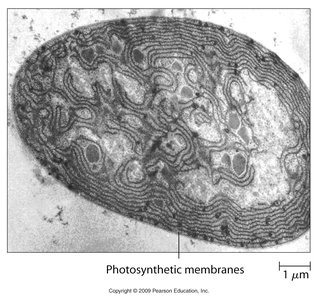
Cellular Structures Involved in Photosynthesis
Photosynthesis occurs within specialized organelles called chloroplasts in plant cells and in analogous structures in cyanobacteria. - Chloroplast Structure: Contains thylakoid membranes, stroma, and grana. - Thylakoid Membranes: Site of light-dependent reactions. - Stroma: Site of the Calvin cycle (light-independent reactions).

Light-Dependent Reactions
Light-Dependent Reactions
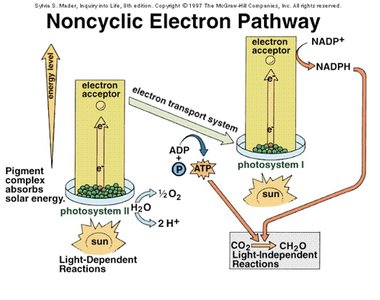
Location: Occurs within the thylakoid membranes.
Inputs: Light energy (photons) and Water (\(\text{H}_2\text{O}\)).
Photolysis of water: Water molecules are split, releasing Oxygen (\(\text{O}_{2}\)) as a byproduct and donating electrons (\(e^{-}\)).
Energy Output: Generates ATP and NADPH to power the next stage.
2. Light-Independent Reactions (Calvin Cycle)
Location: Occurs within the fluid-filled stroma.
Inputs: Carbon dioxide (\(\text{CO}_{2}\)) from the atmosphere, along with the ATP and NADPHproduced by the light reactions.
Synthesis of carbohydrates: Carbon fixed from \(\text{CO}_{2}\) is converted into sugar/carbohydrates (\(\text{CH}_2\text{O}\)).
Recycling: ADP and \(\text{NADP}^{+}\) are sent back to the thylakoids to be recharged.
Mechanism and Steps
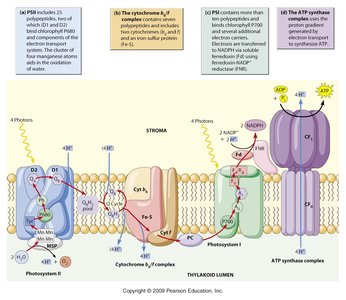
Light-dependent reactions occur in the thylakoid membranes and require light to generate ATP and NADPH. -
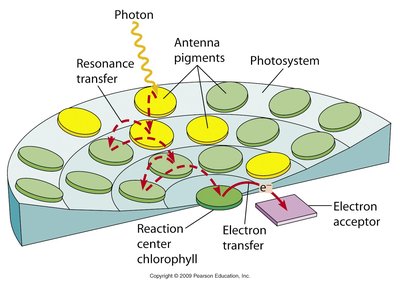
how photosystem. proton are coming from chlorophyll + photosystem 1 and 2 which depends on the need of the cell ?? Step 1: Light Harvesting - Pigments absorb photons ( energy is to going to migrate )and transfer energy to the reaction center.
- Step 2: Electron Transport and Proton Pumping - Excited electrons move through an electron transport chain, pumping protons across the membrane. - Step 3: ATP Synthesis - Proton gradient drives ATP synthesis via ATP synthase. - Products: ATP, NADPH, and O2 (from water photolysis). 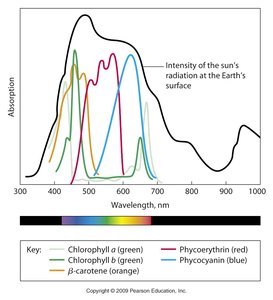
Photoexcitation and Pigments
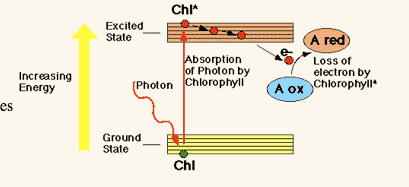
Photoexcitation is the process by which pigments absorb photons, causing electrons to move to higher energy states. - Chlorophyll: Main pigment, contains a porphyrin ring with Mg2+ at its center. - Other Pigments: Carotenoids, phycobilins, etc., broaden the absorption spectrum. - Energy Transfer: Resonance energy transfer funnels energy to the reaction center. 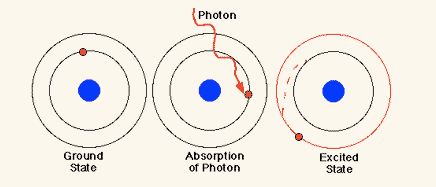
Light-Independent Reactions (Calvin Cycle)
Carbon Assimilation and the Calvin Cycle
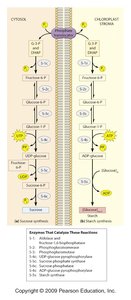
The Calvin cycle uses ATP and NADPH (2 main carbs) produced in the light-dependent reactions to fix carbon dioxide and synthesize carbohydrates. - Step 1: Carboxylation - CO2 is fixed by the enzyme Rubisco, forming 3-phosphoglycerate. - Step 2: Reduction - 3-phosphoglycerate is reduced to glyceraldehyde-3-phosphate (G3P). - Step 3: Regeneration - Ribulose bisphosphate is regenerated to continue the cycle. - Products: G3P, which is used to synthesize sucrose, glucose, and starch.
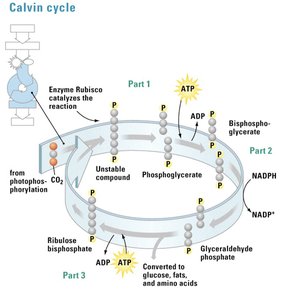
question in class: The Calvin cycle must run 6 times to produce one molecule of glucose. [1, 2]
Why 6 turns?
The Carbon Math: A single molecule of glucose (C₆H₁₂O₆) contains 6 carbon atoms.
One at a Time: Each single turn of the Calvin cycle fixes only 1 molecule of carbon dioxide (CO₂), meaning it adds just 1 carbon atom to the process. Therefore, the cycle must run 6 times to gather the 6 carbon atoms needed to build glucose. [1, 2]
you would need to draw keep cycle to track numbers of carb.
what happens next:
Carbohydrate Synthesis and Transport
Carbohydrates produced in the Calvin cycle are used for energy storage and transport within the plant. - Sucrose: Transported out to non-photosynthetic tissues (roots, fruits, flowers). - Starch: Stored in chloroplasts for later use. - Energy Flow: ATP is used to make sucrose, and sucrose is used to make ATP in other tissues.
Summary Table: Photosynthesis Reactions and Products
Reaction Type | Main Location | Key Inputs | Key Products |
|---|---|---|---|
Light-dependent | Thylakoid membrane | Light, H2O, NADP+, ADP | ATP, NADPH, O2 |
Light-independent (Calvin cycle) | Stroma | CO2, ATP, NADPH | G3P, ADP, NADP+ |
Carbohydrate synthesis | Chloroplast/cytosol | G3P | Sucrose, Glucose, Starch |
Key Questions and Answers
What are the products of the light-dependent reactions? ATP, NADPH, and O2.
What are the products of the light-independent reactions? Glyceraldehyde-3-phosphate (G3P), which is used to make carbohydrates.
What chemical is converted to sugar? Carbon dioxide (CO2).
Which chemical is converted to oxygen? Water (H2O).
Key Equations
Overall Photosynthesis Equation
ATP Synthesis (Photophosphorylation)
Calvin Cycle (Simplified)
Additional info:
Academic context was added to clarify the steps of photosynthesis, the role of chloroplasts, and the fate of carbohydrates. The summary table and equations were inferred for completeness and exam preparation.
