 Back
BackPhotosynthesis: Structure, Mechanisms, and Types
Study Guide - Smart Notes
 Tailored notes based on your materials, expanded with key definitions, examples, and context.
Photosynthesis
Overview of Photosynthesis
Photosynthesis is a fundamental biological process performed by plants, algae, and some bacteria, enabling them to convert light energy into chemical energy stored in glucose. This process is essential for sustaining life on Earth, as it provides energy and oxygen for other organisms.
Definition: Photosynthesis is the process by which light energy is converted into chemical energy.
Location: Occurs in the chloroplasts of plant cells.
General Equation:
Importance: Produces glucose and oxygen, supporting cellular respiration and life.
Chloroplast Structure
Chloroplast Anatomy
Chloroplasts are specialized organelles in plant cells where photosynthesis occurs. Their structure is adapted to maximize the efficiency of light absorption and energy conversion.
Outer and Inner Membranes: Enclose the chloroplast and regulate transport.
Stroma: Fluid-filled space containing enzymes for the Calvin cycle.
Thylakoid Membranes: Flattened sacs where light-dependent reactions occur.
Grana: Stacks of thylakoids that increase surface area for light absorption.
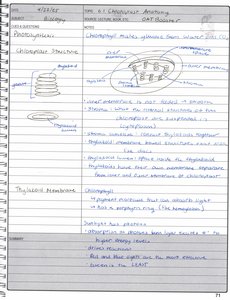
Thylakoid Membrane
The thylakoid membrane contains chlorophyll and other pigments that capture light energy. It is the site of the light-dependent reactions of photosynthesis.
Chlorophyll: Main pigment absorbing light, especially in the blue and red wavelengths.
Photosystems: Complexes of proteins and pigments that initiate the light reactions.
Light-Dependent Reactions
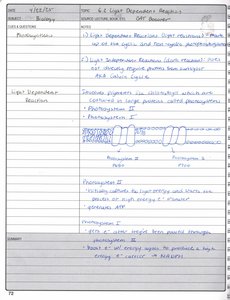
Mechanism of Light-Dependent Reactions
Light-dependent reactions occur in the thylakoid membranes and require light to produce ATP and NADPH, which are used in the Calvin cycle.
Photosystem II: Absorbs light, splits water, releases oxygen, and transfers electrons.
Electron Transport Chain: Transfers electrons, generating ATP via chemiosmosis.
Photosystem I: Absorbs light, produces NADPH.
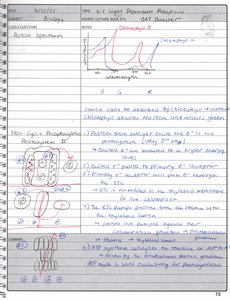
Action Spectrum
The action spectrum shows the effectiveness of different wavelengths of light in driving photosynthesis. Chlorophyll absorbs mainly blue and red light.
Key Pigments: Chlorophyll a, chlorophyll b, carotenoids.
Absorption Peaks: Blue (~430 nm) and red (~660 nm) regions.
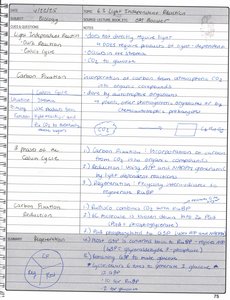
Light-Independent Reactions (Calvin Cycle)
Calvin Cycle
The Calvin cycle is the set of light-independent reactions that occur in the stroma of the chloroplast. It uses ATP and NADPH to fix carbon dioxide and produce glucose.
Carbon Fixation: CO2 is incorporated into organic molecules by the enzyme Rubisco.
Reduction: ATP and NADPH reduce 3-phosphoglycerate to glyceraldehyde-3-phosphate (G3P).
Regeneration: RuBP is regenerated to continue the cycle.
Types of Photosynthesis
C3 Photosynthesis
C3 photosynthesis is the most common pathway, occurring in most plants. It involves direct fixation of CO2 by Rubisco in the Calvin cycle.
Characteristics: Efficient under moderate light and moisture conditions.
Limitation: Prone to photorespiration under high temperatures.
C4 Photosynthesis
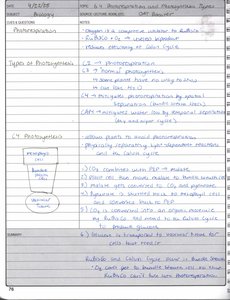
C4 photosynthesis is an adaptation found in plants from hot, dry environments. It separates carbon fixation and the Calvin cycle into different cell types to minimize photorespiration.
Key Steps: CO2 is initially fixed into a 4-carbon compound in mesophyll cells, then released in bundle sheath cells for the Calvin cycle.
Advantage: Reduces photorespiration and increases efficiency in high light and temperature.
CAM Photosynthesis
CAM (Crassulacean Acid Metabolism) photosynthesis is an adaptation for arid environments. Plants open their stomata at night to fix CO2, storing it as malate, and use it during the day for photosynthesis.
Key Steps: Night-time CO2 fixation, day-time Calvin cycle.
Advantage: Minimizes water loss.
Summary Table: Types of Photosynthesis
Type | Main Features | Adaptation |
|---|---|---|
C3 | Direct CO2 fixation by Rubisco | Moderate climates |
C4 | CO2 fixed in mesophyll, Calvin cycle in bundle sheath | Hot, sunny climates |
CAM | CO2 fixed at night, used during day | Arid climates |
Key Terms and Concepts
Chlorophyll: Main pigment for light absorption.
Photosystem: Protein-pigment complex for light reactions.
Rubisco: Enzyme for carbon fixation.
Photorespiration: Wasteful process competing with photosynthesis.
ATP & NADPH: Energy carriers produced in light reactions.
Additional info:
Photosynthesis is covered in detail in cell biology courses under the chapter "Photosynthesis" and is directly relevant to cellular energy and metabolism.
Diagrams and tables are inferred and expanded for clarity and completeness.
