 Back
BackStem Cells and Cloning: Principles, Methods, and Applications
Study Guide - Smart Notes
 Tailored notes based on your materials, expanded with key definitions, examples, and context.
Stem Cells and Cloning
Introduction to Stem Cells
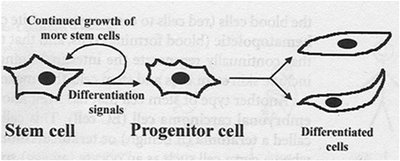
Stem cells are unique cells with the ability to both self-renew and differentiate into specialized cell types. They play a critical role in development, tissue maintenance, and regenerative medicine. Understanding their properties and manipulation is central to cell biology and biotechnology.
Self-renewal: Stem cells can divide and produce more stem cells, maintaining their population over time.
Differentiation: In response to specific signals, stem cells can become specialized cells with distinct functions.
Potency: The range of cell types a stem cell can produce. Categories include totipotent, pluripotent, multipotent, and unipotent.
Types of Stem Cells and Their Potency
Stem cells are classified based on their origin and differentiation potential:
Totipotent: Can give rise to all cell types, including embryonic and extraembryonic tissues (e.g., zygote).
Pluripotent: Can differentiate into any cell type of the body but not extraembryonic tissues (e.g., embryonic stem cells).
Multipotent: Can produce multiple, but limited, cell types (e.g., hematopoietic stem cells).
Unipotent: Can produce only one cell type but retain self-renewal (e.g., muscle stem cells).
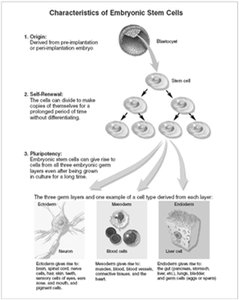
Early Mammalian Development and Stem Cells
Meiosis and Fertilization
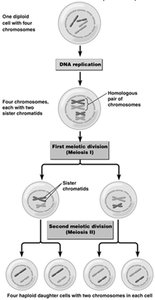
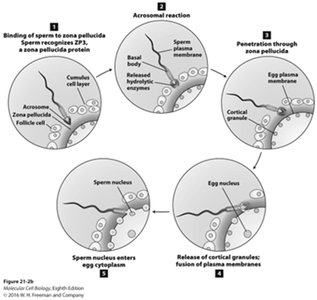
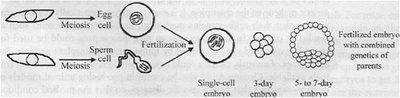
Meiosis is the process by which gametes (egg and sperm) are produced, reducing chromosome number by half. Fertilization restores the diploid chromosome number and initiates embryonic development.
Meiosis: Involves one round of DNA replication followed by two cell divisions (Meiosis I and II), resulting in four haploid cells.
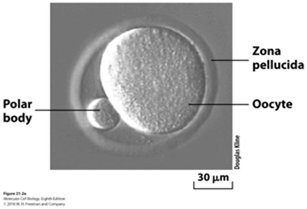
Fertilization: Fusion of haploid gametes forms a diploid zygote, combining genetic material from both parents.
Early Embryonic Development
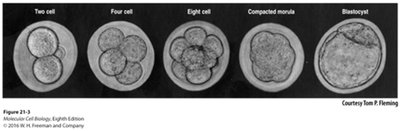
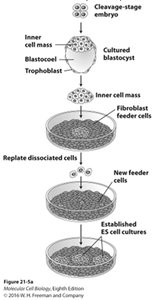
After fertilization, the zygote undergoes a series of cleavage divisions, forming a multicellular embryo. The blastocyst stage contains an inner cell mass (ICM) and an outer trophoblast layer.
Cleavage: Rapid mitotic divisions increase cell number without growth in size.
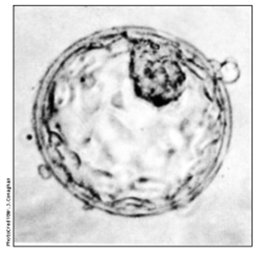
Blastocyst: The ICM is pluripotent and gives rise to the embryo proper, while the trophoblast forms extraembryonic tissues.
Cell Fate Determination
Cell position within the early embryo influences its developmental fate. The ICM is the source of embryonic stem cells, while the outer cells contribute to the placenta.
Pluripotency of ICM: ICM cells can generate all cell types of the body but not the placenta.
Trophoblast: Forms supporting structures necessary for embryonic development.
Embryonic Stem Cells (ESCs) and Induced Pluripotent Stem Cells (iPSCs)
Derivation and Properties of ESCs
ESCs are derived from the ICM of blastocyst-stage embryos and can be cultured indefinitely while maintaining pluripotency. Their use raises ethical questions regarding the destruction of embryos.
Self-renewal: ESCs can proliferate indefinitely in culture.
Pluripotency: ESCs can differentiate into any cell type of the body.
Ethical considerations: The use of human embryos for ESC derivation is controversial.
Induced Pluripotent Stem Cells (iPSCs)
iPSCs are generated by reprogramming adult somatic cells to a pluripotent state using defined transcription factors. This technology bypasses ethical issues associated with ESCs and enables patient-specific therapies.
Key factors: OCT4, SOX2, KLF4, and c-MYC (Yamanaka factors) are commonly used for reprogramming.
Applications: Disease modeling, drug screening, and regenerative medicine.

Cloning and Somatic Cell Nuclear Transfer (SCNT)
Principles of Cloning
Cloning involves generating a genetically identical organism or cell line. SCNT is a key technique where the nucleus of a somatic cell is transferred into an enucleated egg cell, which then develops into an embryo.
Reproductive cloning: Produces a live organism genetically identical to the donor.
Therapeutic cloning: Generates patient-specific ESCs for potential cell therapy.


Applications and Limitations of Cloning
Cloning has been used to produce animals and for research into development and disease. However, it faces technical and ethical challenges, including low efficiency, abnormal development, and mitochondrial DNA differences.
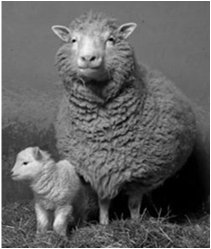
Low efficiency: Many attempts are required to produce a single viable clone (e.g., Dolly the sheep).
Mitochondrial DNA: Clones inherit mitochondrial DNA from the egg donor, not the nuclear donor.
Ethical concerns: Human cloning is widely debated and restricted in many countries.
Adult Stem Cells and Organoids
Adult Stem Cells
Adult stem cells are found in various tissues and are responsible for maintenance and repair. They are typically multipotent or unipotent.
Hematopoietic stem cells (HSCs): Give rise to all blood cell types.
Intestinal stem cells: LGR5+ cells in the crypts regenerate the intestinal epithelium.
Organoids
Organoids are three-dimensional structures grown from stem cells that mimic the architecture and function of real organs. They are valuable for studying development, disease, and drug responses.
Applications: Modeling human diseases, studying pathogen interactions, and personalized medicine.
Limitations: Less amenable to molecular analysis; single-cell techniques are often required.
Trans-differentiation
Direct Cell Fate Conversion
Trans-differentiation refers to the process of converting one differentiated cell type directly into another without reverting to a pluripotent state. This is achieved by introducing specific transcription factors or chemical treatments.
OKSM factors: Oct4, Klf4, Sox2, and c-Myc can induce trans-differentiation under certain conditions.
Applications: Potential for regenerative medicine and cell therapy without the risk of tumorigenesis associated with pluripotent cells.
Summary Table: Major Stem Cell Types
Type | Source | Potency | Applications |
|---|---|---|---|
Embryonic Stem Cells (ESCs) | Inner cell mass of blastocyst | Pluripotent | Developmental studies, regenerative medicine |
Induced Pluripotent Stem Cells (iPSCs) | Reprogrammed somatic cells | Pluripotent | Disease modeling, personalized therapy |
Adult Stem Cells | Tissues (e.g., bone marrow, intestine) | Multipotent/Unipotent | Tissue repair, transplantation |
