 Back
BackThe Regulation of Gene Expression in Eukaryotes
Study Guide - Smart Notes
 Tailored notes based on your materials, expanded with key definitions, examples, and context.
The Regulation of Gene Expression
Introduction to Gene Regulation
Regulation of gene expression is a fundamental process that enables cells to control the synthesis of proteins and RNA, ensuring cellular efficiency and specialization. Selective gene expression allows each cell type to produce only the proteins necessary for its function, which is essential for development, differentiation, and adaptation to environmental changes.
Gene expression refers to the process by which information from a gene is used to synthesize functional gene products (proteins or RNAs).
Regulation ensures that genes are expressed at the right time, place, and amount.
Example: During embryonic development, different genes are activated in different regions, leading to the formation of specialized tissues.
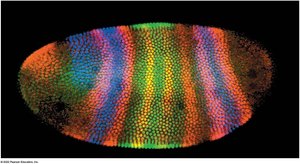
Main Levels of Eukaryotic Gene Regulation
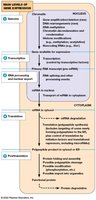
Overview of Regulatory Levels
Eukaryotic gene expression is regulated at five main levels, each providing opportunities for precise control. These levels are: genomic, transcriptional, RNA processing and nuclear export, translational, and posttranslational control.
Genomic control: Changes in DNA content or structure (e.g., amplification, deletion, rearrangement).
Transcriptional control: Regulation of the initiation and rate of transcription.
RNA processing and nuclear export: Modifications of pre-mRNA and control of mRNA export to the cytoplasm.
Translational control: Regulation of mRNA translation into protein.
Posttranslational control: Modifications of protein structure, function, and degradation.
Genomic Control
Gene Amplification, Deletion, and Rearrangement
Genomic control involves changes to the DNA itself, affecting gene copy number or arrangement. These changes can have profound effects on gene expression.
Gene amplification: Production of multiple copies of a gene to increase its expression (e.g., in oocytes or cancer cells).
Gene deletion: Loss of gene segments, as seen in the maturation of mammalian red blood cells.
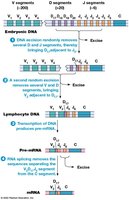
Gene rearrangement: Reorganization of DNA segments, such as V(D)J recombination in lymphocyte receptor genes, which generates antibody diversity.
Transposons: Mobile genetic elements that can move within the genome, altering gene expression.
Chromatin Structure and Remodeling
Chromatin structure plays a critical role in regulating gene accessibility. Genes are typically embedded in condensed chromatin, which must be decondensed for transcription to occur.
Acetylation of histones: Addition of acetyl groups to histone proteins reduces chromatin compaction, making DNA more accessible to transcription factors.
Methylation: Methylation of histones or DNA can repress gene expression.
Chromatin remodeling complexes: Protein complexes such as the SWI/SNF family reposition nucleosomes to expose promoter regions.
Transcriptional Control
Role of Transcription Factors
Transcriptional control determines which genes are transcribed and at what rate. This is primarily achieved through the action of transcription factors (TFs).
General transcription factors: Required for the transcription of all genes by a specific RNA polymerase; bind to the core promoter region.
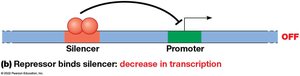
Regulatory transcription factors: Bind to proximal control elements, enhancers, or silencers to activate or repress transcription of specific genes.
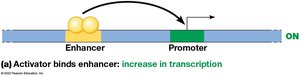
Enhancers: DNA sequences that increase transcription when bound by activators.
Silencers: DNA sequences that decrease transcription when bound by repressors.
Posttranscriptional Control
RNA Processing and Nuclear Export
After transcription, pre-mRNA undergoes several processing steps before becoming mature mRNA. These steps provide additional regulatory opportunities.
Alternative splicing: Allows a single gene to produce multiple mRNA variants by including or excluding specific exons.
RNA editing: Chemical modifications of RNA molecules can alter their coding potential.
Nuclear export: Only properly processed mRNAs are exported to the cytoplasm for translation.
Using the Same Gene to Produce Variant Proteins
Alternative splicing and RNA editing enable the production of different protein isoforms from a single gene, increasing proteomic diversity without increasing genome size.
Translational Control
Regulation of Translation Initiation and mRNA Stability
Translational control mechanisms determine how efficiently an mRNA is translated into protein.
Initiation factors: Proteins such as eIF2 and eIF4F regulate the initiation of translation; their activity can be modulated by phosphorylation.
Translational repressors: Proteins that bind to mRNA and inhibit translation.
mRNA stability: The length of the poly(A) tail influences mRNA half-life; longer tails generally increase stability and translation.
Posttranslational Control
Protein Modification and Degradation
Posttranslational control involves chemical modifications and targeted degradation of proteins, affecting their function, localization, and lifespan.
Reversible modifications: Phosphorylation, acetylation, and methylation can rapidly alter protein activity.
Proteolytic cleavage: Permanent removal of peptide segments to activate or deactivate proteins.
Chaperones: Assist in proper protein folding.
Targeting: Direct proteins to specific cellular compartments or for secretion.
Ubiquitin-Proteasome System
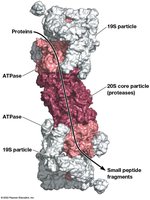
The ubiquitin-proteasome system is a major pathway for regulated protein degradation in eukaryotic cells.
Ubiquitin: A small protein that tags other proteins for degradation.
Enzymatic cascade: Involves E1 (activating), E2 (conjugating), and E3 (ligase) enzymes to attach ubiquitin to target proteins.
Proteasome: A large protease complex that recognizes polyubiquitinated proteins and degrades them into small peptides.
Summary Table: Levels of Eukaryotic Gene Regulation
Level | Main Mechanisms | Examples |
|---|---|---|
Genomic | Gene amplification, deletion, rearrangement, chromatin remodeling | V(D)J recombination, histone acetylation |
Transcriptional | Transcription factors, enhancers, silencers | Hormone-responsive genes |
RNA Processing & Export | Alternative splicing, RNA editing, nuclear export | Calcitonin/CGRP gene, mRNA capping |
Translational | Initiation factors, mRNA stability, translational repressors | Ferritin mRNA regulation |
Posttranslational | Protein modification, folding, degradation | Ubiquitin-proteasome pathway |
