 Back
BackTransport Across Membranes: Overcoming the Permeability Barrier
Study Guide - Smart Notes
 Tailored notes based on your materials, expanded with key definitions, examples, and context.
Transport Across Membranes
Overview of Membrane Transport
Cell membranes regulate the movement of substances into and out of cells, overcoming the permeability barrier imposed by the lipid bilayer. Transport mechanisms are classified as passive or active, depending on whether they require energy input and the direction of movement relative to concentration gradients.
Passive Transport: Movement along a gradient without net energy input. Includes simple diffusion and facilitated diffusion.
Active Transport: Movement against a concentration gradient, requiring energy input.
Key factors: Solute properties (polarity, charge), relative concentrations, transmembrane protein availability, and energy source.
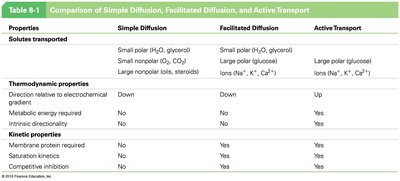
Comparison of Simple Diffusion, Facilitated Diffusion, and Active Transport
Different transport mechanisms are distinguished by the types of solutes transported, thermodynamic properties, and kinetic properties.
Properties | Simple Diffusion | Facilitated Diffusion | Active Transport |
|---|---|---|---|
Solutes transported | Small polar (H2O, glycerol), small nonpolar (O2, CO2), large nonpolar (fats, steroids) | Small polar (H2O, glycerol), large polar (glucose), ions (Na+, K+, Ca2+) | Large polar (glucose), ions (Na+, K+, Ca2+) |
Direction relative to electrochemical gradient | Down | Down | Up |
Metabolic energy required | No | No | Yes |
Membrane protein required | No | Yes | Yes |
Saturates kinetics | No | Yes | Yes |
Competitive inhibition | No | Yes | Yes |
Passive Transport: Simple Diffusion
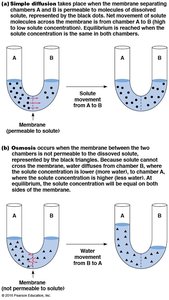
Simple diffusion is the unassisted movement of molecules down their concentration gradient. It is an exergonic process, requiring no energy input, and is proportional to the concentration difference across the membrane.
Examples: Oxygen (O2) and carbon dioxide (CO2) traverse the lipid bilayer by simple diffusion.
Rate equation: where is the rate of diffusion, is the permeability coefficient, and is the concentration difference.
Osmosis: Diffusion of Water
Osmosis is the diffusion of water across a selectively permeable membrane. Water moves toward the region of higher solute concentration, unaffected by membrane potential.
Osmolarity: Relative concentration of solutes between cytoplasm and extracellular solution.
Cell response: Cells shrink in hypertonic solutions and swell in hypotonic solutions. Plant cells maintain turgor pressure; animal cells may lyse or shrivel.
Cells with cell walls: Prevent bursting by building turgor pressure; plasmolysis occurs in hypertonic solutions.
Cells without cell walls: Regulate osmolarity by pumping out ions.
Facilitated Diffusion: Protein-Mediated Movement
Facilitated diffusion allows large or polar substances to cross membranes with the help of transport proteins. It is passive, but requires specific membrane proteins.
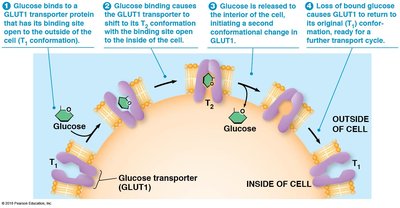
Carrier Proteins: Alternate between two conformational states, binding and releasing solute.
Channel Proteins: Form hydrophilic channels for solute passage.
Specificity: Carrier proteins are analogous to enzymes, showing substrate specificity and saturable kinetics.
Types of Transport Proteins
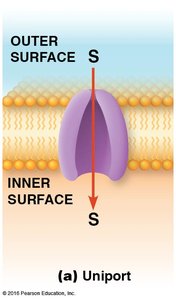
Uniport: Transports a single solute in one direction.
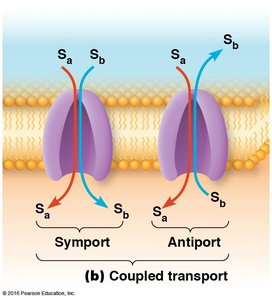
Symport: Transports two solutes in the same direction.
Antiport: Transports two solutes in opposite directions.
Example: GLUT1 Transporter
The GLUT1 transporter facilitates glucose uptake by alternating between two conformations, binding glucose on one side and releasing it on the other.
Channel Proteins
Channel proteins facilitate diffusion by forming hydrophilic transmembrane channels. Types include aquaporins, ion channels, and porins.
Aquaporins
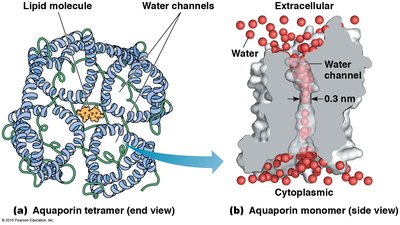
Aquaporins allow rapid passage of water through membranes, especially in erythrocytes, kidney cells, and plant root cells.
Ion Channels
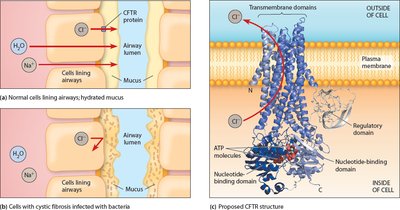
Ion channels are selective for specific ions, based on binding sites and size filters. They play roles in cellular communication, muscle contraction, and salt balance. The CFTR protein is a chloride ion channel; defects cause cystic fibrosis.
Porins
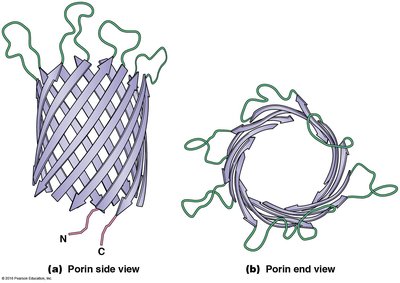
Porins are larger, less specific channels found in the outer membranes of bacteria, mitochondria, and chloroplasts. They are formed by β barrel structures.
Kinetics of Facilitated Diffusion
The rate of facilitated diffusion versus substrate concentration is not linear, unlike simple diffusion. This is because transport proteins become saturated at high substrate concentrations, similar to enzyme kinetics.
Facilitated diffusion: Limited by the number of active proteins; shows saturation kinetics.
Simple diffusion: Linear relationship with substrate concentration.
Summary Table: Transport Mechanisms
Mechanism | Energy Requirement | Direction | Protein Required | Solute Types |
|---|---|---|---|---|
Simple Diffusion | No | Down gradient | No | Small nonpolar, small polar |
Facilitated Diffusion | No | Down gradient | Yes | Large polar, ions |
Active Transport | Yes | Up gradient | Yes | Large polar, ions |
Additional info: Facilitated diffusion and active transport are both saturable and subject to competitive inhibition, unlike simple diffusion.
