 Back
BackViral Classification, Structure, and Replication: Study Notes for Cell Biology
Study Guide - Smart Notes
 Tailored notes based on your materials, expanded with key definitions, examples, and context.
Viruses: General Overview
Definition and Basic Properties
Viruses are obligate intracellular parasites that require the biochemical machinery of a host cell for replication. Unlike cellular organisms, viruses do not reproduce by binary fission but by assembly of individual components. Their structure and genetics have evolved through mutation and selection to optimize infection of hosts, including humans.
Cannot replicate independently; must infect a host cell.
Composed of nucleic acid (DNA or RNA), protein coat (capsid), and sometimes a membrane envelope.
Replication introduces many mutations, most of which are not beneficial.
Viral Classification
Basis of Classification
Viruses are classified by several criteria, including their physical and genetic characteristics, the diseases they cause, their target tissues, and their means of transmission.
By characteristics: e.g., Picornavirus (small RNA virus), Poxvirus (causes pox diseases)
By disease: e.g., Hepatitis viruses
By target tissue: e.g., Enteric viruses (infect the gut)
By transmission: e.g., Arboviruses (arthropod-borne)
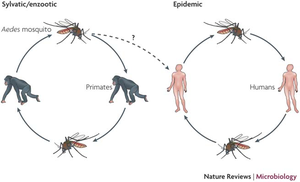
The most consistent classification is based on physiological and biochemical properties such as size, morphology, envelope presence, genome type, and replication strategy.
DNA viruses: 7 families associated with human disease
RNA viruses: At least 13 families
Comparison of Virus Families
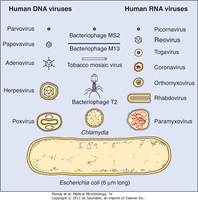
Viruses are grouped into families based on their genome type and structure.
Human DNA Viruses | Human RNA Viruses |
|---|---|
Parvovirus | Picornavirus |
Papovavirus | Reovirus |
Adenovirus | Togavirus |
Herpesvirus | Coronavirus |
Poxvirus | Orthomyxovirus |
Rhabdovirus | |
Paramyxovirus |
Virion Structure
Basic Components
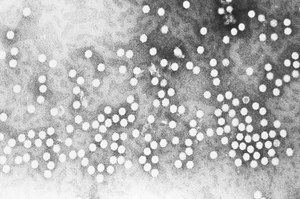
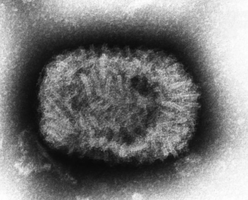
The virion is the complete virus particle. Its size is measured in nanometers (nm), ranging from 18 nm (parvoviruses) to 300 nm (poxviruses). Larger virions can encode more proteins and are generally more complex.
Nucleic acid genome: DNA or RNA, which may be single- or double-stranded, linear or circular, segmented or non-segmented.
Capsid: Protein coat that protects the genome.
Envelope: Lipid membrane derived from host cell, present in some viruses.
Enzymes: Some virions carry essential or accessory enzymes for replication.

Genome Types
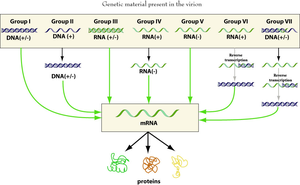
DNA viruses: Single- or double-stranded, linear or circular.
RNA viruses: Positive sense (+, like mRNA), negative sense (–, complementary to mRNA), double-stranded, or segmented.
Baltimore Classification
The Baltimore system classifies viruses based on their genome type and the pathway to mRNA synthesis.
Capsid and Envelope Properties
Capsid: Rigid, withstands harsh conditions (drying, acid, detergents). Many are transmitted by the fecal-oral route.
Envelope: Lipid bilayer, sensitive to drying, acid, and detergents. Must remain wet; transmitted in fluids, droplets, blood, or tissue.
Capsid Assembly
Capsid proteins assemble into subunits (protomers), then into capsomeres, and finally into the capsid.
Capsid forms around the genome or as an empty shell (procapsid) to be filled later.
Virion Symmetry
Helical: Rod-shaped (e.g., Tobacco Mosaic Virus)
Icosahedral: Spherical, 20-sided (e.g., Herpesvirus)
Complex: Non-symmetric, often seen in bacteriophages
Enveloped Viruses
Envelope composed of lipids, proteins, and glycoproteins, derived from host cell membranes but with virally encoded proteins.
Most enveloped viruses are round or pleomorphic; exceptions include poxviruses and rhabdoviruses.
Viral Replication
General Steps of Replication
All viruses follow a similar replication cycle, using the host cell as a factory for viral protein synthesis and genome replication.
Early phase: Recognition, attachment, penetration, and uncoating of the genome.
Late phase: Genome replication, viral macromolecular synthesis, assembly, and release.
Key Terms in Replication
Eclipse period: Time after uncoating when no infectious virus is detected.
Latent period: Time until new viruses are released; includes the eclipse period.
Burst size: Number of infectious virions produced per cell (often only 1–10% are infectious).
DNA Virus Replication
Requires DNA-dependent DNA polymerase, dNTPs, and often host cell enzymes.
Transcription occurs in the nucleus using host or viral polymerases.
Viral genes may have introns, requiring host splicing machinery.
Replication is semiconservative and initiated at a unique origin (ori).
Smaller DNA viruses rely more on host machinery; larger ones encode their own enzymes.
Example: Herpes simplex virus assembles capsids in the nucleus and encodes its own DNA polymerase.
RNA Virus Replication
Replication and transcription are similar; most RNA viruses must encode an RNA-dependent RNA polymerase.
Positive-strand RNA genomes can initiate infection directly; negative-strand RNA genomes require a polymerase to be carried into the cell.
Double-stranded RNA intermediates are strong inducers of innate immunity.
Retrovirus Replication
Retroviruses have a + strand RNA genome but replicate via a DNA intermediate using reverse transcriptase.
cDNA is synthesized in the cytoplasm, then integrated into the host genome.
Viral Protein Synthesis
All viruses depend on host ribosomes, tRNA, and posttranslational modification machinery.
Viral mRNA binds ribosomes via a 5’ cap or internal ribosome entry sequence (IRES).
