n Exercises 92–93, rewrite the equation in terms of base e. Express the answer in terms of a natural logarithm and then round to three decimal places. y = 73(2.6)^x
Ch. 4 - Exponential and Logarithmic Functions

Chapter 5, Problem 93
n Exercises 92–93, rewrite the equation in terms of base e. Express the answer in terms of a natural logarithm and then round to three decimal places. y = 6.5(0.43)^x
Verified step by step guidance1
Rewrite the given equation y = 6.5(0.43)^x in terms of base e. To do this, recall that any exponential expression a^x can be rewritten as e^(x * ln(a)), where ln(a) is the natural logarithm of a.
Apply the property to rewrite (0.43)^x as e^(x * ln(0.43)). This transforms the equation into y = 6.5 * e^(x * ln(0.43)).
Now, the equation is expressed in terms of base e: y = 6.5 * e^(x * ln(0.43)).
If you need to solve for x, isolate the exponential term by dividing both sides of the equation by 6.5: y / 6.5 = e^(x * ln(0.43)).
Take the natural logarithm (ln) of both sides to eliminate the exponential: ln(y / 6.5) = x * ln(0.43). Then, solve for x by dividing both sides by ln(0.43): x = ln(y / 6.5) / ln(0.43).

Verified video answer for a similar problem:
This video solution was recommended by our tutors as helpful for the problem above.
Video duration:
2mWas this helpful?
Key Concepts
Here are the essential concepts you must grasp in order to answer the question correctly.
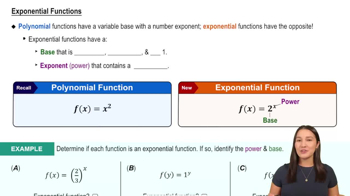
Exponential Functions
Exponential functions are mathematical expressions in the form y = a(b^x), where 'a' is a constant, 'b' is the base, and 'x' is the exponent. In this context, the function y = 6.5(0.43)^x represents an exponential decay since the base (0.43) is less than 1. Understanding the behavior of exponential functions is crucial for rewriting the equation in terms of natural logarithms.
Recommended video:
Exponential Functions
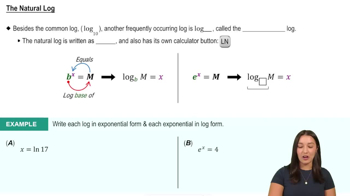
Natural Logarithm
The natural logarithm, denoted as ln(x), is the logarithm to the base e, where e is approximately 2.71828. It is used to solve equations involving exponential functions, particularly when rewriting them in a linear form. In this problem, converting the exponential equation to a natural logarithm will allow us to isolate the variable x and express the equation in a more manageable form.
Recommended video:
The Natural Log
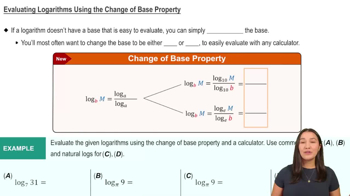
Logarithmic Properties
Logarithmic properties are rules that govern the manipulation of logarithms, such as the product, quotient, and power rules. These properties are essential for simplifying expressions and solving equations involving logarithms. In this case, applying the power rule will help in rewriting the equation y = 6.5(0.43)^x in terms of natural logarithms, facilitating the solution process.
Recommended video:
Change of Base Property
Related Practice
Textbook Question
664
views
Textbook Question
In Exercises 89–102, determine whether each equation is true or false. Where possible, show work to support your conclusion. If the statement is false, make the necessary change(s) to produce a true statement. ln(x + 1) = ln x + ln 1
736
views
Textbook Question
In Exercises 89–102, determine whether each equation is true or false. Where possible, show work to support your conclusion. If the statement is false, make the necessary change(s) to produce a true statement.
x log 10x = x2
766
views
Textbook Question
Solve each equation. 3x+2 ⋅ 3x=81
694
views
Textbook Question
Evaluate or simplify each expression without using a calculator. eln 125
942
views
Textbook Question
Solve each equation. 52x ⋅ 54x=125
660
views