Graphing Logarithmic Functions definitions Flashcards
Graphing Logarithmic Functions definitions
You can tap to flip the card.
Control buttons has been changed to "navigation" mode.
1/15
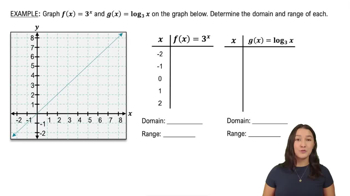
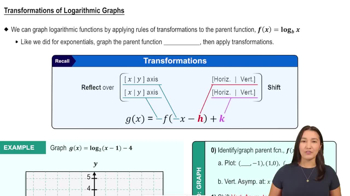
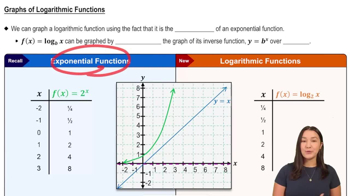
Logarithmic FunctionInverse of an exponential function, with a graph reflected over the line y = x and a vertical asymptote.Exponential FunctionFunction where the variable is in the exponent, serving as the inverse of a logarithmic function.Inverse FunctionA function that reverses another, swapping x and y values and reflecting graphs over y = x.Vertical AsymptoteA dashed line the graph approaches but never touches, typically at x = 0 or x = h for logarithmic functions.Horizontal AsymptoteA line the graph approaches as x goes to infinity, such as y = 0 for exponential functions.ReflectionA transformation flipping the graph over the x-axis, y-axis, or the line y = x, altering its orientation.TransformationAny change to a graph, including shifts, stretches, compressions, or reflections, applied to the parent function.Parent FunctionThe simplest form of a function, serving as the base for transformations, such as log base 2 of x.DomainAll possible x-values for which the function is defined, often starting at the vertical asymptote for logarithmic graphs.RangeAll possible y-values a function can take; for logarithmic functions, this is always all real numbers.Ordered PairA set of x and y values representing a point on the graph, often swapped between inverse functions.BaseThe constant in a logarithmic or exponential function that determines the graph's direction and shape.Horizontal ShiftA transformation moving the graph left or right, determined by the value of h in the function.Vertical ShiftA transformation moving the graph up or down, determined by the value of k in the function.Test PointA specific point used to help plot and transform the graph, often derived from the parent function.