How does the graph of y = log(-x) differ from the graph of y = log(x)?
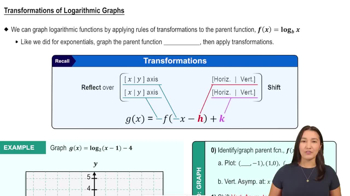
The graph of y = log(-x) is a reflection of the graph of y = log(x) over the y-axis. This is because the negative inside the logarithm reflects the graph horizontally.
What is the inverse relationship between exponential and logarithmic functions when graphing?
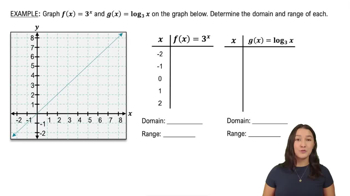
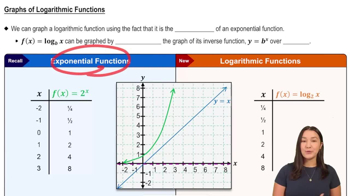
Exponential and logarithmic functions are inverses, so their graphs are reflections of each other across the line y = x. This means each point (x, y) on one graph corresponds to (y, x) on the other.
How do you determine the ordered pairs for a logarithmic function using its inverse exponential function?
You can flip the x and y values of the ordered pairs from the exponential function to get the ordered pairs for the logarithmic function. This works because the functions are inverses.
What is the vertical asymptote for the parent logarithmic function y = log_b(x)?
The vertical asymptote for y = log_b(x) is at x = 0. The graph approaches but never touches this line.
How does the base b of a logarithmic function affect whether its graph increases or decreases?
If b > 1, the graph of the logarithmic function increases as x increases. If 0 < b < 1, the graph decreases as x increases.
What is the effect of a horizontal shift h in the function y = log_b(x - h)?
A horizontal shift h moves the vertical asymptote to x = h. The entire graph shifts h units to the right.
How do you apply vertical and horizontal shifts to the test points when graphing a transformed logarithmic function?
Shift each test point h units right and k units down if the function is y = log_b(x - h) + k. This moves the graph according to the transformations.
What is the range of any logarithmic function, regardless of base or transformations?
The range of any logarithmic function is all real numbers. This does not change with shifts or reflections.
How does the domain of a transformed logarithmic function depend on the direction the graph approaches its asymptote?
If the graph approaches the asymptote from the right, the domain is (h, β); if from the left, the domain is (ββ, h). The value h is the location of the vertical asymptote.
What mnemonic can help you remember the shapes of exponential and logarithmic function graphs?
The graph of an exponential function resembles an extended lowercase 'e', while a logarithmic function resembles an extended lowercase 'r'. This visual can help recall their shapes.