Introduction to Exponential Functions definitions Flashcards
Introduction to Exponential Functions definitions
You can tap to flip the card.
Control buttons has been changed to "navigation" mode.
1/15
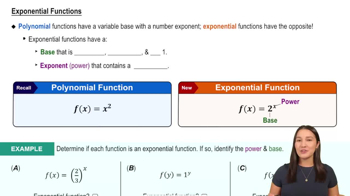
Exponential FunctionA mathematical relationship where a constant base is raised to a variable exponent, producing rapid growth or decay.Polynomial FunctionAn expression involving variables raised to whole number powers, with the variable in the base rather than the exponent.BaseA constant positive number, not equal to 1, that is repeatedly multiplied in an exponential expression.ExponentA value, often a variable, indicating how many times the base is used as a factor in repeated multiplication.VariableA symbol, such as x or y, representing a quantity that can change within a mathematical expression.ConstantA fixed value that does not change, often serving as the base in exponential functions.Fractional BaseA base expressed as a fraction, allowed in exponential functions if it is constant and positive.Negative ExponentAn exponent less than zero, resulting in the reciprocal of the base raised to the corresponding positive power.Caret KeyA calculator symbol (^) used to indicate exponentiation, allowing entry of powers for computation.EvaluationThe process of substituting specific values for variables in a function to determine its output.GrowthA pattern in exponential functions where values increase rapidly as the exponent increases.DecayA pattern in exponential functions where values decrease rapidly, often when the base is between 0 and 1.PowerThe complete expression in the exponent, which may include variables and constants, indicating the degree of exponentiation.ReciprocalA value obtained by inverting a number, commonly resulting from negative exponents in exponential expressions.ParenthesesSymbols used in calculations to group terms, ensuring correct order of operations when entering exponents.