Skip to main content
College Algebra
My Course
Learn
Exam Prep
AI Tutor
Study Guides
Textbook Solutions
Flashcards
Explore
Try the app
My Course
Learn
Exam Prep
AI Tutor
Study Guides
Textbook Solutions
Flashcards
Explore
Try the app
Back
Introduction to Rational Functions definitions
You can tap to flip the card.
Rational Function
You can tap to flip the card.
👆
Rational Function
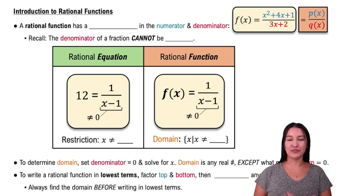
A mathematical expression formed by dividing one polynomial by another, where the denominator is not zero.
Track progress
Control buttons has been changed to "navigation" mode.
1/15
Related flashcards
Related practice
Recommended videos
Introduction to Rational Functions quiz
Introduction to Rational Functions
15 Terms
Introduction to Rational Functions
5. Rational Functions
4 problems
Topic
Callie
Asymptotes
5. Rational Functions
5 problems
Topic
Callie
5. Rational Functions
3 topics
7 problems
Chapter
Callie
Guided course
6:04
Intro to Rational Functions
3815
views
92
rank
Terms in this set (15)
Hide definitions
Rational Function
A mathematical expression formed by dividing one polynomial by another, where the denominator is not zero.
Polynomial
An algebraic expression consisting of variables and coefficients, combined using addition, subtraction, and multiplication.
Numerator
The top part of a fraction, representing the dividend in a rational function.
Denominator
The bottom part of a fraction, representing the divisor and determining domain restrictions.
Domain
The set of all real numbers for which a function is defined, excluding values that make the denominator zero.
Domain Restriction
A value or values of the variable that are excluded from the domain because they make the denominator zero.
Set Notation
A mathematical format used to describe the domain, specifying which values are included or excluded.
Lowest Terms
The simplest form of a rational function, achieved by factoring and canceling common factors in numerator and denominator.
Factoring
The process of expressing a polynomial as a product of its simpler components, often used to simplify rational functions.
Difference of Squares
A special factoring pattern where a squared term is subtracted from another squared term, resulting in two binomial factors.
Common Factor
A factor that appears in both the numerator and denominator, which can be canceled to simplify a rational function.
Real Number
Any value on the continuous number line, including both rational and irrational numbers, used in defining domains.
Simplification
The process of reducing a rational function to its most basic form by canceling common factors.
Restriction
A specific value that is not allowed in the domain due to causing division by zero in the denominator.
Greatest Common Factor
The largest factor shared by terms in a polynomial, useful for factoring and simplifying rational functions.
 BackBack
 6:04
6:04