How do you determine the scale factor of a dilation between two similar figures in the context of function transformations?
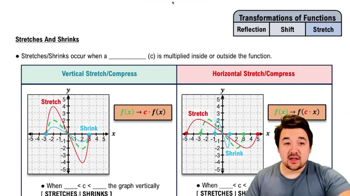
The scale factor of a dilation is found by comparing corresponding lengths or values in the original and transformed figures. In function transformations, if a function is multiplied by a constant c outside the function (e.g., c·f(x)), the scale factor is c for a vertical dilation. If c > 1, the graph is stretched; if 0 < c < 1, the graph is compressed.
What does a vertical dilation by a factor of 2 do to the graph of a function?
A vertical dilation by a factor of 2 multiplies all y-values of the function by 2, resulting in a vertical stretch. The graph becomes twice as tall, and every point (x, y) on the original graph moves to (x, 2y).
If a function is dilated so that a length of 4 in the original becomes 8 in the image, what is the scale factor of the dilation?
The scale factor is found by dividing the image length by the original length. In this case, the scale factor is 8 ÷ 4 = 2.
What steps should you follow to find the scale factor of a dilation using a graph of a function?
To find the scale factor on a graph, identify a pair of corresponding points (one from the original and one from the dilated graph). Divide the y-value (for vertical dilation) or x-value (for horizontal dilation) of the transformed point by the original point's value. The result is the scale factor.
How do you find the scale factor of a dilation in function transformations?
In function transformations, the scale factor of a dilation is the constant c that multiplies the function. For vertical dilation, the transformation is c·f(x), where c is the scale factor. For horizontal dilation, the transformation is f(cx), and the scale factor is 1/c.
What happens to the equation of a function when it is reflected over the y-axis?
The x-values in the function change sign, so f(x) becomes f(-x). This means the graph is folded over the y-axis.
How does a horizontal shift to the left by 2 units affect the function notation?
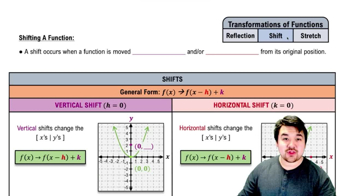
The function becomes f(x + 2), indicating a shift left by 2 units. The plus sign inside the function means the graph moves to the left.
If a function is transformed by multiplying the input by 1/2, what type of transformation occurs?
Multiplying the input by 1/2 causes a horizontal stretch of the graph. All x-values are doubled, making the graph wider horizontally.
When combining a reflection over the x-axis and a shift 3 units up, what is the resulting function notation?
The function becomes -f(x) + 3, where the negative sign reflects over the x-axis and the +3 shifts the graph up. Both transformations are applied to the original function.
How can you determine the new range of a function after a vertical shift?
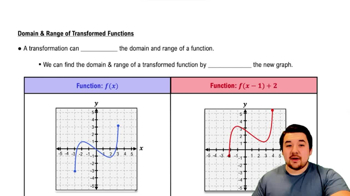
Observe the graph after the shift and note the lowest and highest y-values. The new range will be the original range shifted up or down by the value of the vertical shift.