The domain of a polynomial function is all real numbers, which can be written as (−∞, ∞).
How do you determine the end behavior of a polynomial function?
To determine the end behavior of a polynomial function, examine the leading term (the term with the highest degree) in standard form. The sign of the leading coefficient and whether the degree is even or odd will dictate the end behavior: if the degree is even, both ends of the graph go in the same direction (up if the leading coefficient is positive, down if negative); if the degree is odd, the ends go in opposite directions (rising right if positive, falling right if negative).
What steps should you follow to find the end behavior of a polynomial function?
To find the end behavior of a polynomial function: (1) Write the function in standard form; (2) Identify the leading term (the term with the highest degree); (3) Check the sign of the leading coefficient and whether the degree is even or odd; (4) Use these to determine if both ends rise, both fall, or if one rises while the other falls.
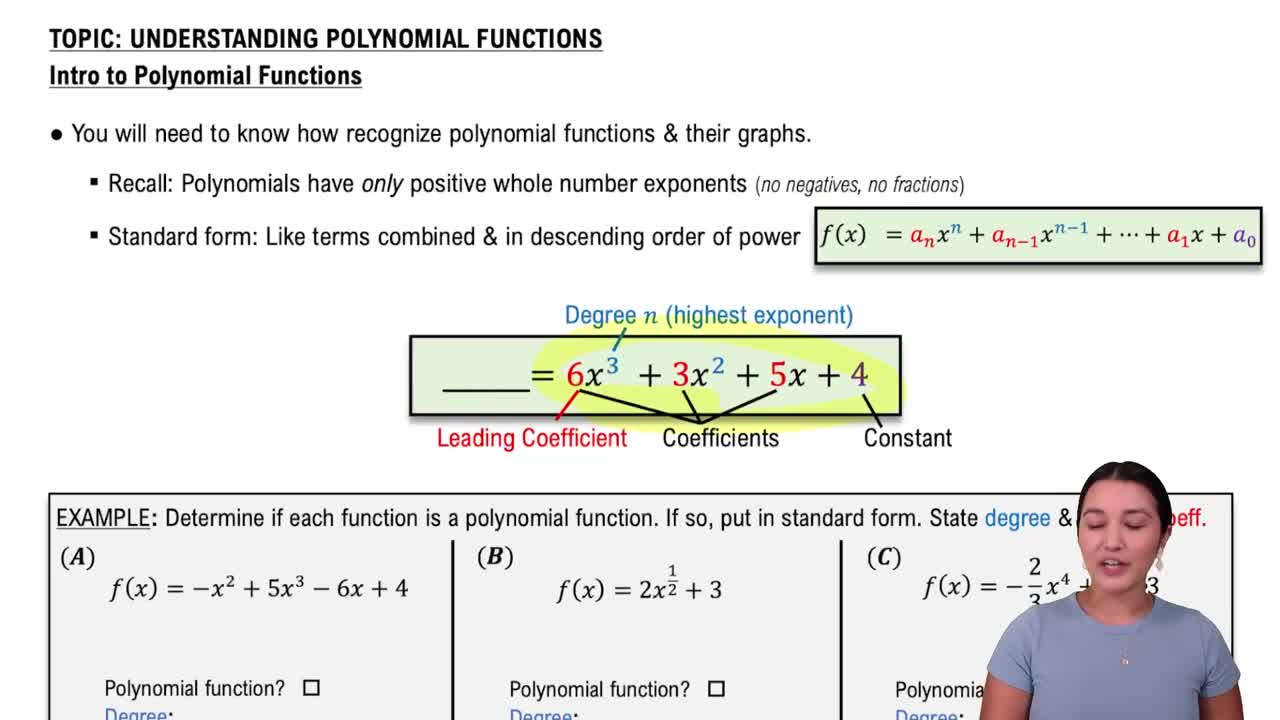
What must be true about the exponents in a polynomial function?
All exponents in a polynomial function must be positive whole numbers. Negative or fractional exponents are not allowed.
How can you identify the leading coefficient and degree in a polynomial written in standard form?
The leading coefficient is the coefficient of the term with the highest power, and the degree is the exponent of that term. Both are found in the first term when the polynomial is written in descending order of powers.
What graphical features distinguish polynomial functions from non-polynomial functions?
Polynomial function graphs are always smooth and continuous, with no corners or breaks. Non-polynomial functions may have sharp corners or discontinuities.
Can a polynomial function have fractional coefficients, and why?
Yes, a polynomial function can have fractional coefficients because coefficients are not restricted to whole numbers. Only the exponents must be positive whole numbers.
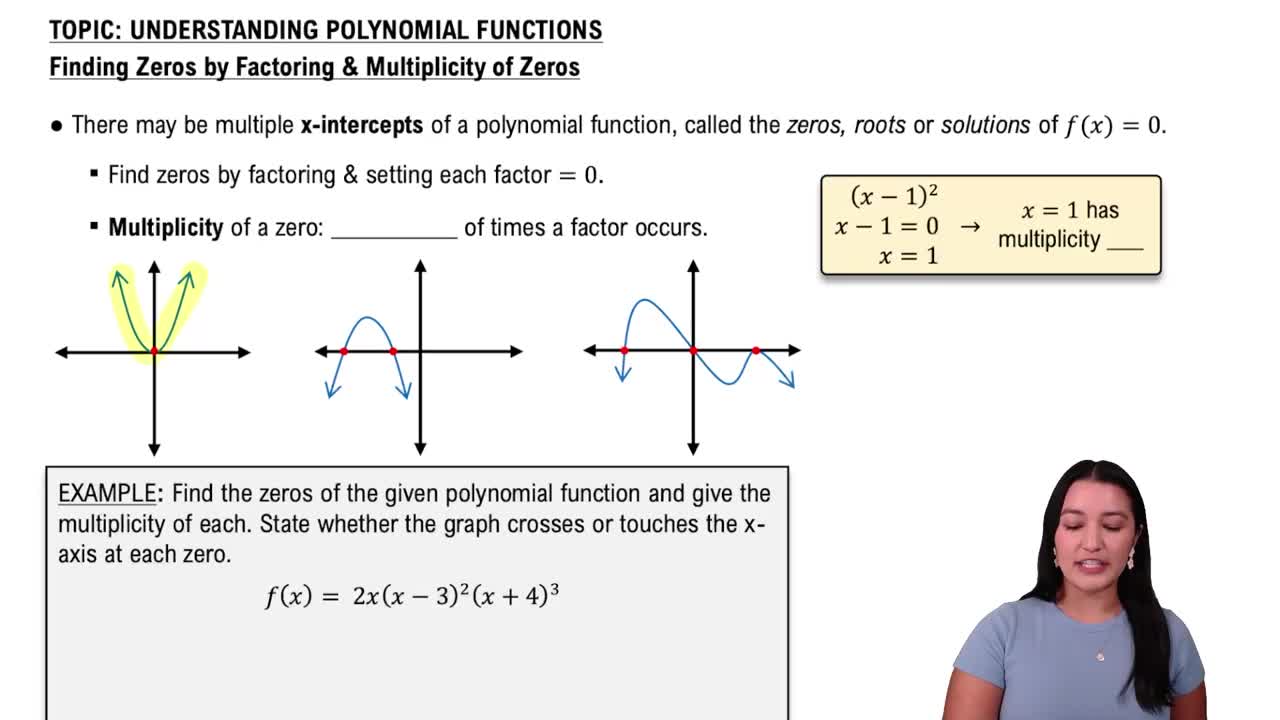
How do you determine the zeros of a polynomial function given in factored form?
Set each factor equal to zero and solve for x to find the zeros. Each solution corresponds to an x-intercept of the polynomial function.
What does the multiplicity of a zero tell you about the graph at that point?
If the multiplicity is even, the graph touches and bounces off the x-axis at that zero. If the multiplicity is odd, the graph crosses the x-axis at that zero.
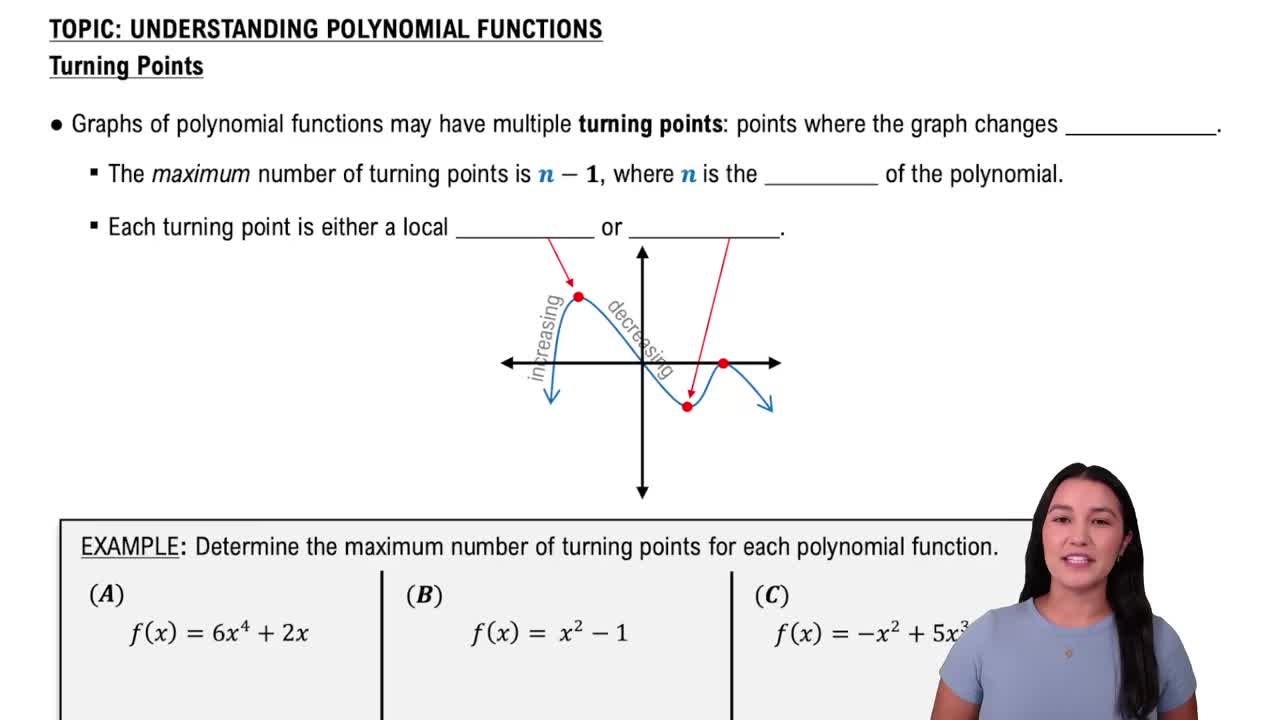
How do you calculate the maximum number of turning points for a polynomial function?
Subtract one from the degree of the polynomial to find the maximum number of turning points. This number represents the most times the graph can change direction.
 Back
Back

 06:04
06:04