 Back
Absolute Value Equations and Inequalities: Concepts, Methods, and Applications
Study Guide - Smart Notes
 Tailored notes based on your materials, expanded with key definitions, examples, and context.
Absolute Value Equations and Inequalities
Definition of Absolute Value
The absolute value of a real number is its distance from zero on the number line, regardless of direction. It is denoted by |x|.
Key Property: For any real number x, |x| ≥ 0.
Examples: |5| = 5; |−5| = 5
Solving Absolute Value Equations
To solve equations involving absolute value, follow these steps:
Step 1: Isolate the absolute value expression if necessary.
Step 2: Apply the definition of absolute value: For |X| = a (where a ≥ 0), the solutions are X = a or X = −a.
General Form: For a > 0 and an algebraic expression X:
Example: Solve |x| = 5.
Solutions: x = 5 or x = -5

Worked Example
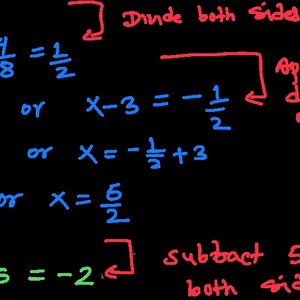
Solve 8|x − 3| = 4
Divide both sides by 8:
Apply the definition: or
So, or
Special Cases
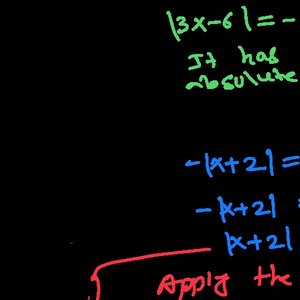
If the equation is of the form |X| = b, where b < 0, there is no solution because absolute value cannot be negative.
Solving Absolute Value Inequalities
Absolute value inequalities can be classified into two main types:
Type 1: is equivalent to
Type 2: is equivalent to or
For a > 0 and an algebraic expression X:
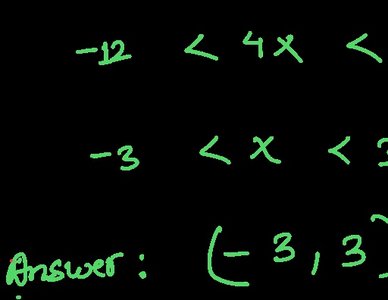
Example 1:
By definition:
Divide by 4:
Interval Notation: (−3, 3)
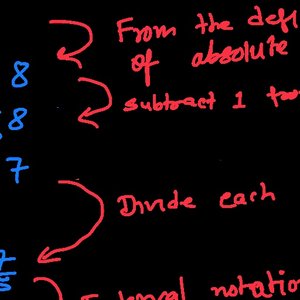
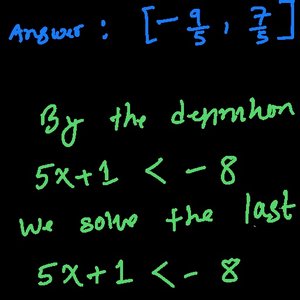
Example 2:
By definition:
Subtract 1:
Divide by 5:
Interval Notation:
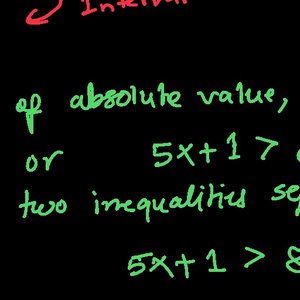
Example 3:
By definition: or
Solve each inequality separately:
Interval Notation:
Applications of Absolute Value Inequalities
Example 1: Temperature Range
Suppose you want your room temperature to stay within 4 degrees of 70°F. Let T be the temperature. The requirement can be written as:
So,
Example 2: Manufacturing Tolerances
A machine is designed to produce metal rods that are 10 cm long, with a maximum allowable error of 0.03 cm. Let L be the length of a rod. The acceptable lengths satisfy:
So,
