 Back
BackChapter 2: More on Functions – College Algebra Study Notes
Study Guide - Smart Notes
 Tailored notes based on your materials, expanded with key definitions, examples, and context.
Section 2.1 Types of Functions
Families of Functions
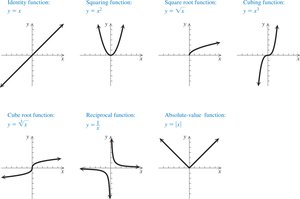
In college algebra, understanding the basic families of functions is essential, as these serve as building blocks for more complex functions. Each family has a characteristic graph and algebraic form.
Identity Function:
Squaring Function:
Square Root Function:
Cubing Function:
Cube Root Function:
Reciprocal Function:
Absolute Value Function:
These basic functions are often used to model real-world phenomena and to construct new functions through transformations.
Identifying Basic Functions from Graphs
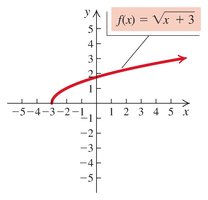
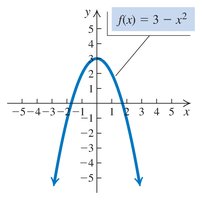
When given a graph, it is important to recognize which basic function it resembles, even if it has been transformed (shifted, reflected, etc.).
Example: The graph of is a square root function shifted left by 3 units.
Example: The graph of is a squaring function reflected across the x-axis and shifted up by 3 units.
Applications of Functions
Modeling Real-World Situations
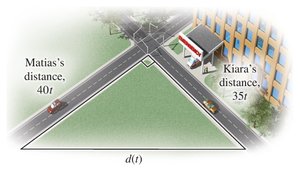
Many real-world situations can be modeled using functions. For example, the distance between two moving objects can be expressed as a function of time.
Example: Two nurses, Kiara and Matias, drive away from a hospital at right angles. Kiara’s speed is 35 mph, Matias’s is 40 mph. The distance between them after t hours is found using the Pythagorean theorem.
Distance Function:
Domain: (nonnegative real numbers)
Piecewise-Defined Functions
Definition and Evaluation
A piecewise-defined function uses different formulas for different parts of its domain. To evaluate such a function, first determine which part of the domain the input belongs to, then use the corresponding formula.
Key Steps:
Identify the domain intervals for each formula.
Choose the correct formula based on the input value.
Evaluate the function using that formula.
Example: For defined as: To find , , , and , select the formula based on the value of .
Graphing Piecewise-Defined Functions
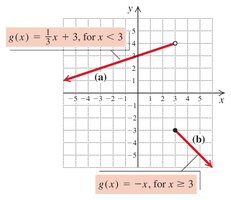
When graphing a piecewise-defined function, plot each segment only over its specified domain interval. Pay attention to open and closed circles, which indicate whether endpoints are included or excluded.
Example: The function defined as above is graphed with a line for and another for .
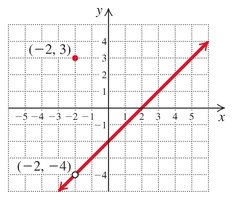
Graph with a Hole
Sometimes, a piecewise-defined function has a 'hole' at a certain point, meaning the function is not defined there. This is shown with an open circle on the graph, and the actual value at that point may be plotted separately.
Example: The graph below shows a line with a hole at , and the value at that point is plotted above the open circle.
Greatest Integer Function
Definition and Properties
The greatest integer function, denoted , pairs each input with the greatest integer less than or equal to that input. This function is also known as the floor function.
Notation:
Example: ,
Graph: The graph consists of horizontal segments, each starting at an integer value.

Step Function Illustration
The greatest integer function is a classic example of a step function, where the output jumps at integer values.

Summary Table: Basic Function Properties
The following table summarizes the main properties of the basic functions discussed:
Function | Equation | Graph Shape | Domain | Range |
|---|---|---|---|---|
Identity | Line | All real numbers | All real numbers | |
Squaring | Parabola | All real numbers | ||
Square Root | Curve (starts at x=0) | |||
Cubing | S-shaped curve | All real numbers | All real numbers | |
Cube Root | S-shaped curve | All real numbers | All real numbers | |
Reciprocal | Hyperbola | |||
Absolute Value | V-shaped | All real numbers | ||
Greatest Integer | Step function | All real numbers | All integers |
Key Takeaways
Basic functions are foundational for modeling and understanding more complex functions.
Piecewise-defined functions require careful attention to domain intervals.
Graphing functions involves recognizing transformations and special features like holes or steps.
The greatest integer function is a classic example of a step function.
