 Back
College Algebra Chapter 1: Equations and Inequalities - Structured Study Notes
Study Guide - Smart Notes
 Tailored notes based on your materials, expanded with key definitions, examples, and context.
Equations and Inequalities
Graphs and the Cartesian Coordinate System
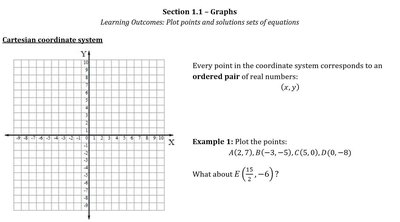
The Cartesian coordinate system is a fundamental tool in algebra for visualizing equations and their solutions. Each point in the system is represented by an ordered pair of real numbers, written as .
Ordered Pair: A pair of numbers indicating the position of a point on the plane.
Plotting Points: To plot points, locate the x-coordinate on the horizontal axis and the y-coordinate on the vertical axis.
Example: Plot the points A(2, 7), B(-3, -5), C(5, 0), D(0, -8), and E.
Graphs of Equations
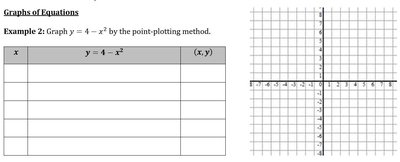
Graphing equations allows us to visualize the relationship between variables. The point-plotting method involves calculating values for y given x and plotting the resulting points.
Example: Graph by plotting points for various values of x.
Example: Graph by plotting points for various values of x.
x | y = 4 - x^2 | (x, y) |
|---|---|---|
-2 | 0 | (-2, 0) |
-1 | 3 | (-1, 3) |
0 | 4 | (0, 4) |
1 | 3 | (1, 3) |
2 | 0 | (2, 0) |
Additional info: Table entries inferred for demonstration. |
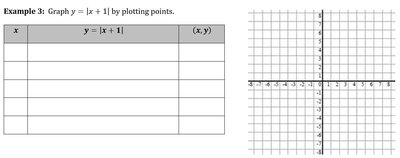
x | y = |x + 1| | (x, y) |
|---|---|---|
-3 | 2 | (-3, 2) |
-1 | 0 | (-1, 0) |
0 | 1 | (0, 1) |
1 | 2 | (1, 2) |
Additional info: Table entries inferred for demonstration. |
Intercepts
Intercepts are key features of graphs that indicate where the graph crosses the axes.
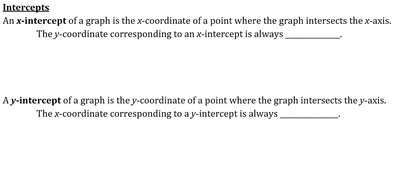
x-intercept: The x-coordinate of a point where the graph intersects the x-axis. The y-coordinate is always 0.
y-intercept: The y-coordinate of a point where the graph intersects the y-axis. The x-coordinate is always 0.
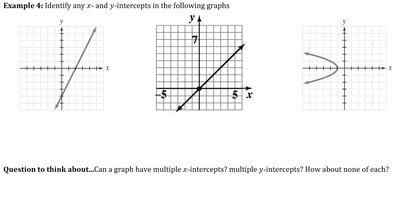
Example: Identify x- and y-intercepts in given graphs. A graph can have multiple x-intercepts, multiple y-intercepts, or none at all.
Interpreting Information from Graphs
Graphs can be used to interpret real-world data, such as the probability of divorce based on age at marriage. Mathematical models can approximate data shown in graphs.
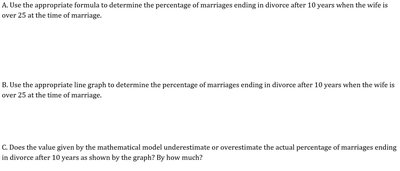
Model Example: approximates the percentage of marriages ending in divorce when the wife is under 18.
Model Example: approximates the percentage when the wife is over 25.
Application: Use the model to estimate values and compare with actual graph data.
Rational Equations
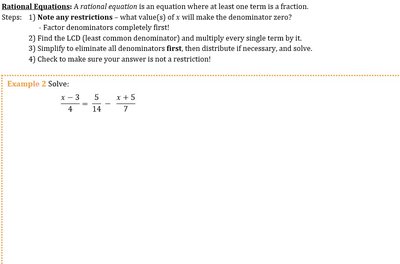
A rational equation is an equation where at least one term is a fraction. Solving rational equations requires careful attention to restrictions and denominators.
Note any restrictions: Values of x that make the denominator zero are not allowed.
Find the least common denominator (LCD) and multiply every term by it.
Simplify and solve, checking that the solution does not violate any restrictions.
Example: Solve .
Classifying Equations
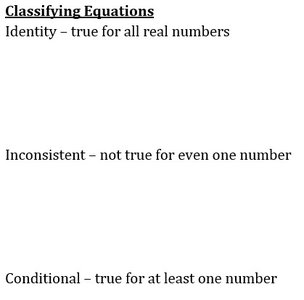
Equations can be classified based on their truth for different values:
Identity: True for all real numbers.
Inconsistent: Not true for any number.
Conditional: True for at least one number.
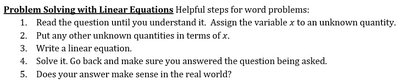
Problem Solving with Linear Equations
Solving word problems with linear equations involves several steps:
Read and understand the question. Assign a variable to the unknown quantity.
Express other unknowns in terms of the variable.
Write a linear equation.
Solve the equation and check your answer.
Ensure the answer makes sense in the real world.
Example: Investment problem involving interest rates and total income.
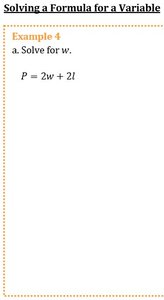
Solving a Formula for a Variable
Sometimes, you need to solve a formula for a specific variable. This involves isolating the variable using algebraic operations.
Example: Solve for .

Complex Numbers
Definition and Imaginary Unit
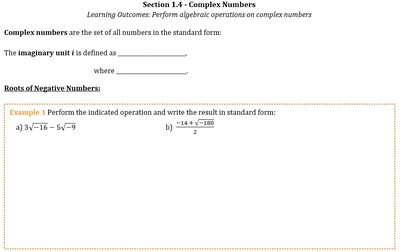
Complex numbers are numbers in the form , where and are real numbers and is the imaginary unit defined as .
Roots of Negative Numbers: The square root of a negative number can be written in terms of .
Example:
Adding and Subtracting Complex Numbers
To add or subtract complex numbers, combine the real parts and the imaginary parts separately.
Example:
Complex Conjugates
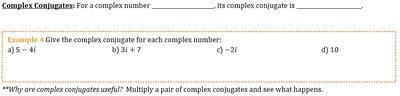
The complex conjugate of is . Conjugates are useful in simplifying expressions and rationalizing denominators.
Example: The conjugate of is .
Quadratic Equations
Factoring and Solving Quadratic Equations
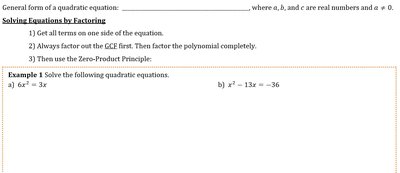
The general form of a quadratic equation is , where . Quadratic equations can be solved by factoring, completing the square, or using the quadratic formula.
Get all terms on one side of the equation.
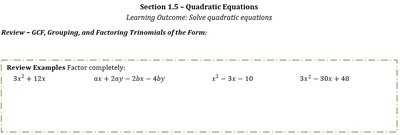
Factor out the greatest common factor (GCF) first, then factor completely.
Use the Zero-Product Principle: If , then or .
Example: Solve and .
Completing the Square
Completing the square is a method for solving quadratic equations by transforming them into a perfect square trinomial.
If , divide every term by .
Move the constant to the right side.
Add to both sides.
Factor the left side.
Use the Square Root Property to finish solving.
The Discriminant
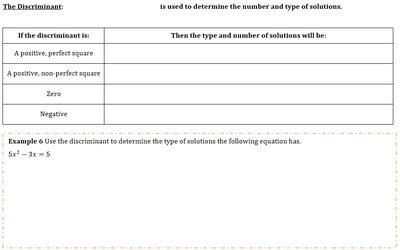
The discriminant of a quadratic equation is . It determines the number and type of solutions.
If the discriminant is: | Then the type and number of solutions will be: |
|---|---|
Positive, perfect square | Two real, rational solutions |
Positive, non-perfect square | Two real, irrational solutions |
Zero | One real solution |
Negative | Two complex solutions |

Solving Other Types of Equations
Solving Polynomial Equations by Factoring
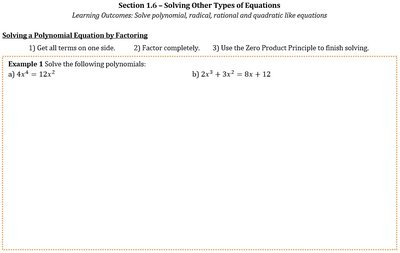
Polynomial equations can be solved by factoring and applying the Zero-Product Principle.
Get all terms on one side.
Factor completely.
Set each factor equal to zero and solve.
Example: Solve and .
Linear Inequalities and Absolute Value Inequalities
Solving Equations Involving Absolute Value
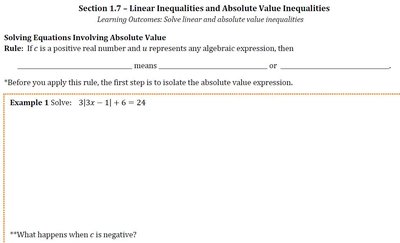
Absolute value equations are solved by considering both the positive and negative cases.
If , then or .
First, isolate the absolute value expression before applying the rule.
Example: Solve .
Interval Notation and Set-Builder Notation
Interval notation and set-builder notation are used to describe solution sets for inequalities.
Brackets [ ]: Used when the endpoint is included in the interval.
Parentheses ( ): Used when the endpoint is not included.
Parentheses are always used for and .
Interval Notation | Set-Builder Notation | Graph |
|---|---|---|
[a, b] | {x | a ≤ x ≤ b} | Solid line between a and b, closed circles |
(a, b) | {x | a < x < b} | Solid line between a and b, open circles |
[a, b) | {x | a ≤ x < b} | Solid line, closed at a, open at b |
(a, b] | {x | a < x ≤ b} | Solid line, open at a, closed at b |
(a, ∞) | {x | x > a} | Ray starting at a, open circle |
[a, ∞) | {x | x ≥ a} | Ray starting at a, closed circle |
(-∞, b) | {x | x < b} | Ray ending at b, open circle |
(-∞, b] | {x | x ≤ b} | Ray ending at b, closed circle |
Additional info: Table entries inferred for clarity. |
Solving Linear Inequalities
Linear inequalities are solved similarly to equations, but special care must be taken when multiplying or dividing by negative numbers.
If you multiply or divide both sides by a negative number, you must flip the inequality sign.
"Switch sides...switch signs" is the same as flipping the inequality.

