 Back
BackCollege Algebra Comprehensive Study Notes: Equations, Functions, Graphs, and Applications
Study Guide - Smart Notes
 Tailored notes based on your materials, expanded with key definitions, examples, and context.
Algebraic Equations
Solving Polynomial Equations
Polynomial equations are solved by factoring, completing the square, or using the quadratic formula. The solutions (roots) are the values of x that satisfy the equation.
Factoring: Express the equation as a product of factors and set each factor to zero.
Completing the Square: Rearrange the equation to form a perfect square trinomial.
Quadratic Formula: For equations of the form , use .
Example: Solve by factoring to get , so .
Solving Radical and Rational Equations
Radical equations involve roots, and rational equations involve fractions. Isolate the radical or rational expression, then square or multiply both sides as needed, checking for extraneous solutions.
Example: leads to after isolating and squaring both sides.
Solving Absolute Value Equations and Inequalities
Absolute value equations are solved by considering both the positive and negative cases. For inequalities, express the solution in interval notation and graph on the real number line.
Example: gives or .
Example (Inequality): leads to .
Functions and Graphs
Definition and Identification of Functions
A function is a relation where each input (x) has exactly one output (y). Algebraically, solve for y and check if each x yields only one y.
Example: is a function; is not a function.
Graphical Representation and Symmetry
Functions can be represented graphically. Symmetry can be tested algebraically or visually:
y-axis symmetry: Replace x with -x; if unchanged, symmetric about y-axis.
x-axis symmetry: Replace y with -y; if unchanged, symmetric about x-axis.
Origin symmetry: Replace x with -x and y with -y; if unchanged, symmetric about the origin.
Type | Test | Example |
|---|---|---|
y-axis | f(-x) = f(x) | y = x^2 |
x-axis | f(x) = -f(x) | Not a function |
Origin | f(-x) = -f(x) | y = x^3 |
Common Functions and Their Graphs
Recognizing the shapes and properties of common functions is essential in algebra.
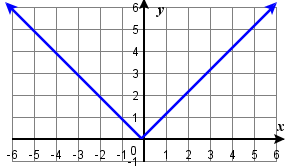
Absolute Value: is V-shaped, vertex at (0,0).
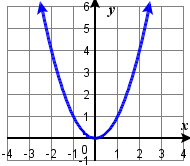
Quadratic: is U-shaped, vertex at (0,0).
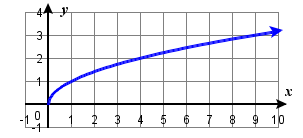
Square Root: starts at (0,0), curves right.
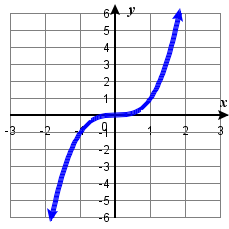
Cubic: is S-shaped, passes through (0,0).
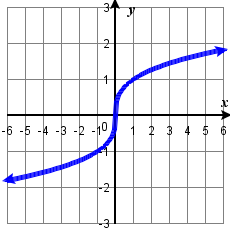
Cube Root: is a gentle S-curve through (0,0).
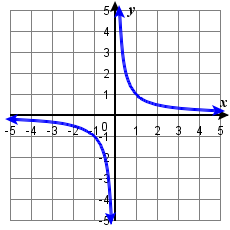
Rational: has two branches, asymptotes at x=0 and y=0.
Piecewise Functions
Piecewise functions are defined by different expressions over different intervals of the domain. Analyze each piece separately for domain, range, and intercepts.
Example:
Transformations of Functions
Functions can be shifted, reflected, stretched, or compressed. The order of transformations is important:
Horizontal shift: shifts right by h units.
Vertical shift: shifts up by k units.
Reflection: reflects over x-axis; reflects over y-axis.
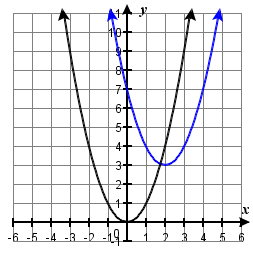
Example: is shifted right 2 and up 3.
Polynomial and Rational Functions
Quadratic Functions: Vertex, Axis of Symmetry, Intercepts
The standard form of a quadratic is , where (h, k) is the vertex. The axis of symmetry is .
Vertex:
x-intercepts: Set and solve for .
y-intercept: Set and solve for .
Finding Zeros and Factoring Polynomials
Zeros of a polynomial are the values of x where . Use factoring, synthetic division, or the Rational Root Theorem to find zeros.
Example: with known zero at can be factored using synthetic division.
Polynomial Division
Polynomials can be divided using long division or synthetic division. The Remainder Theorem states that the remainder of divided by is .
Example: using synthetic division.
End Behavior and Leading Coefficient Test
The end behavior of a polynomial function is determined by its degree and leading coefficient.
Even degree, positive leading coefficient: Rises left and right.
Odd degree, positive leading coefficient: Falls left, rises right.
Even degree, negative leading coefficient: Falls left and right.
Odd degree, negative leading coefficient: Rises left, falls right.
Exponential and Logarithmic Functions
Exponential Functions
Exponential functions have the form , where and . The domain is and the range is for .
Horizontal asymptote: (unless shifted).
Inverse: The inverse of is or .
Logarithmic Functions
Logarithmic functions are the inverses of exponential functions. The general form is .
Domain:
Range:
Vertical asymptote: (unless shifted).
Properties of Logarithms
Solving Exponential and Logarithmic Equations
To solve exponential equations, take the logarithm of both sides. To solve logarithmic equations, rewrite in exponential form or use properties to combine logs.
Example: leads to .
Example: leads to .
Applications
Variation Problems
Direct, inverse, and joint variation describe how one variable changes with respect to others.
Direct variation:
Inverse variation:
Joint variation:
Exponential Growth and Decay
Exponential growth and decay are modeled by , where for growth and for decay.
Half-life: The time required for a quantity to reduce to half its initial value.
Doubling time: The time required for a quantity to double in size.
Compound Interest
Compound interest is calculated using , where is the principal, is the annual rate, is the number of compounding periods per year, and is the time in years.
Graphical Analysis and Interpretation
Interpreting Graphs of Functions
Understanding the key features of function graphs—such as intercepts, asymptotes, intervals of increase/decrease, and symmetry—is essential for analysis and applications.
Intercepts: Points where the graph crosses the axes.
Asymptotes: Lines the graph approaches but never touches.
Intervals: Where the function is increasing, decreasing, positive, or negative.
Examples of Graphs and Their Properties
Rational Function: has vertical and horizontal asymptotes at and respectively.
Quadratic Function: is symmetric about the y-axis and has a vertex at (0,0).
Absolute Value Function: is V-shaped and symmetric about the y-axis.
Ellipse: is symmetric about both axes.
Sinusoidal Function: or is periodic and symmetric about the origin or y-axis depending on the function.
Summary Table: Common Functions and Their Properties
Function | Shape | Symmetry | Domain | Range |
|---|---|---|---|---|
U-shaped | y-axis | |||
V-shaped | y-axis | |||
Curve right | None | |||
S-shaped | Origin | |||
Two branches | Origin |
