 Back
BackCollege Algebra Exam II Review – Step-by-Step Guidance
Study Guide - Smart Notes
 Tailored notes based on your materials, expanded with key definitions, examples, and context.
Q1. Consider shown below.
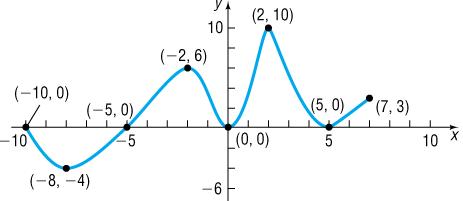
Background
Topic: Graph Analysis of Functions
This question tests your ability to interpret a graph, identify key features such as relative minima, domain, range, and zeros of a function.
Key Terms:
Relative minimum: A point where the function value is lower than all nearby points.
Domain: All possible input values () for which the function is defined.
Range: All possible output values () the function can take.
Zero of a function: An -value where (the graph crosses the -axis).
Step-by-Step Guidance
To find all relative minima, look for points on the graph where the curve changes from decreasing to increasing. These are the lowest points in their immediate area.
To determine the domain, observe the leftmost and rightmost -values for which the graph exists. Write your answer in interval notation.
To determine the range, find the lowest and highest -values the graph reaches. Again, use interval notation.
To find the value(s) of where , identify all -intercepts (where the graph crosses the -axis).
Try solving on your own before revealing the answer!
Q2. Consider .
Background
Topic: Quadratic Functions
This question tests your ability to find the vertex of a quadratic function algebraically and to solve for -intercepts.
Key Terms and Formulas:
Vertex of a parabola: For , the vertex is at .
-intercepts: Solve for .
Step-by-Step Guidance
Identify , , and in the quadratic: , , .
Find the -coordinate of the vertex using .
Plug this value back into to find the -coordinate of the vertex.
To find -intercepts, set and solve using the quadratic formula: .
Try solving on your own before revealing the answer!
Q3. Consider the piecewise function .
Background
Topic: Piecewise Functions and Graphing
This question tests your ability to graph a piecewise function and identify endpoints and other points on the graph.
Key Terms:
Piecewise function: A function defined by different expressions over different intervals.
Closed endpoint: The endpoint is included in the interval (solid dot).
Open endpoint: The endpoint is not included (open circle).
Step-by-Step Guidance
For , use . Calculate and to find endpoints.
For , use . Calculate and another value, such as , to plot points.
Identify which endpoints are closed (included) and which are open (not included) based on the interval notation.
Plot at least two other points from each piece to help sketch the graph accurately.
Try solving on your own before revealing the answer!

Q4. Given .
Background
Topic: Transformations of Functions
This question tests your understanding of how to write equations for transformed functions, including reflections, stretches, and shifts.
Key Terms and Formulas:
Reflection across the -axis:
Horizontal stretch by :
Vertical stretch by :
Horizontal shift right by :
Vertical shift up by :
Step-by-Step Guidance
For part (a): Reflect across the -axis and stretch horizontally by a factor of 2. Write the new equation using the transformation rules.
For part (b): Shift right by 2, stretch vertically by 5, and shift up by 3. Apply each transformation step-by-step to write the new equation.
Try solving on your own before revealing the answer!
Q5. Find a degree 3 polynomial that crosses the -axis at and touches the -axis at .
Background
Topic: Polynomial Functions and Zeros
This question tests your ability to construct a polynomial given information about its zeros and their behavior (cross/touch).
Key Terms:
Degree: The highest power of in the polynomial.
Zero (root): Value of where .
Crosses the -axis: Zero with odd multiplicity (usually 1).
Touches the -axis: Zero with even multiplicity (usually 2).
Step-by-Step Guidance
Write the general form of a degree 3 polynomial with zeros at (crosses) and (touches).
Assign the correct multiplicity to each zero: 1 for crossing, 2 for touching.
Write as a product of factors based on the zeros and their multiplicities.
Include a leading coefficient if needed, but you can leave it as 1 unless otherwise specified.
Try solving on your own before revealing the answer!
