 Back
BackCollege Algebra Exam Question Topics – Step-by-Step Study Guidance
Study Guide - Smart Notes
 Tailored notes based on your materials, expanded with key definitions, examples, and context.
Q1. Find the domain and range of a relation and determine whether the relation is a function.
Background
Topic: Functions and Relations
This question tests your understanding of how to identify the domain (possible input values) and range (possible output values) of a relation, and how to determine if the relation is a function (each input has only one output).
Key Terms:
Domain: The set of all possible input values (usually x-values).
Range: The set of all possible output values (usually y-values).
Function: A relation where each input corresponds to exactly one output.
Step-by-Step Guidance
List all the input values (x-values) in the relation to identify the domain.
List all the output values (y-values) in the relation to identify the range.
Check if any input value is paired with more than one output value. If so, the relation is not a function.
Write the domain and range in set notation or interval notation, as appropriate.
Try solving on your own before revealing the answer!
Q2. Determine whether an equation represents a function.
Background
Topic: Functions
This question tests your ability to analyze an equation and decide if it defines a function (each input has only one output).
Key Terms:
Function: Each input value (x) produces only one output value (y).
Vertical Line Test: A graphical method to check if a relation is a function.
Step-by-Step Guidance
Examine the equation to see if, for every x-value, there is only one y-value.
If the equation is solved for y, check if y is uniquely determined for each x.
Consider using the vertical line test if you have a graph.
Try solving on your own before revealing the answer!
Q3. Identify intervals on which a function increases, decreases, or is constant.
Background
Topic: Behavior of Functions
This question tests your ability to analyze a function's graph or formula to determine where it is increasing, decreasing, or constant.
Key Terms:
Increasing: The function's output gets larger as the input increases.
Decreasing: The function's output gets smaller as the input increases.
Constant: The function's output stays the same as the input increases.
Step-by-Step Guidance
Look at the graph or formula of the function.
Identify intervals where the function's output increases as the input increases.
Identify intervals where the function's output decreases as the input increases.
Identify intervals where the function's output remains constant.
Try solving on your own before revealing the answer!
Q4. Identify even or odd functions and recognize symmetries.
Background
Topic: Function Symmetry
This question tests your ability to classify functions as even, odd, or neither, and to recognize their symmetries.
Key Terms and Formulas:
Even Function: for all x in the domain.
Odd Function: for all x in the domain.
Symmetry: Even functions are symmetric about the y-axis; odd functions are symmetric about the origin.
Step-by-Step Guidance
Substitute into the function and compare to and .
If , the function is even.
If , the function is odd.
If neither, the function is neither even nor odd.
Try solving on your own before revealing the answer!
Q5. Calculate the slope of a line.
Background
Topic: Linear Equations
This question tests your ability to find the slope of a line given two points or a graph.
Key Formula:
Where:
= slope
and = two points on the line
Step-by-Step Guidance
Identify the coordinates of the two points: and .
Subtract from to find the change in y.
Subtract from to find the change in x.
Divide the change in y by the change in x to find the slope.
Try solving on your own before revealing the answer!
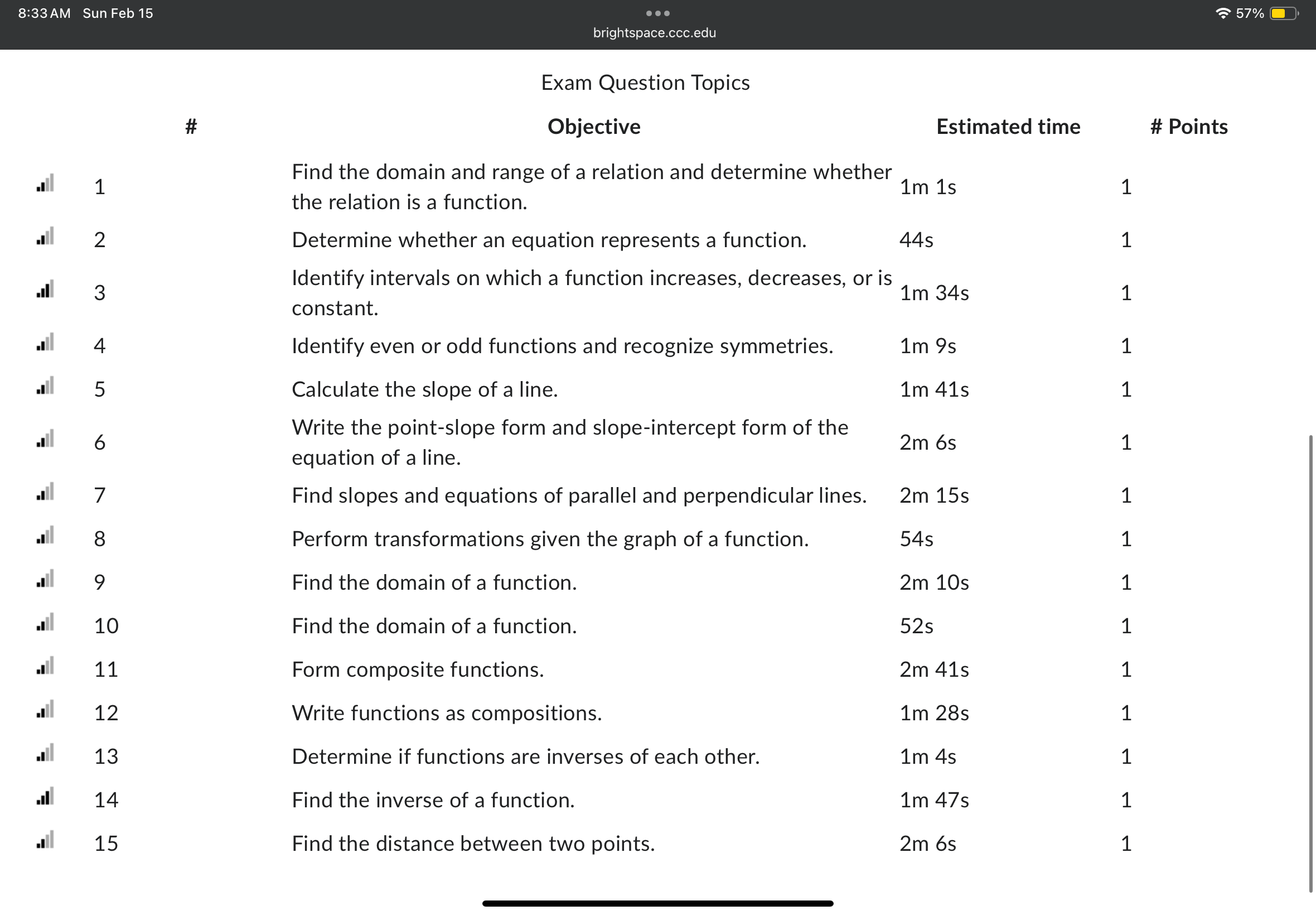
Q6. Write the point-slope form and slope-intercept form of the equation of a line.
Background
Topic: Linear Equations
This question tests your ability to write equations of lines in different forms.
Key Formulas:
Point-Slope Form:
Slope-Intercept Form:
Step-by-Step Guidance
Identify the slope and a point on the line.
Write the equation in point-slope form using the formula above.
Expand and rearrange the equation to get it into slope-intercept form.
Try solving on your own before revealing the answer!
Q7. Find slopes and equations of parallel and perpendicular lines.
Background
Topic: Linear Relationships
This question tests your understanding of how to find slopes and write equations for lines that are parallel or perpendicular to a given line.
Key Terms and Formulas:
Parallel Lines: Have the same slope.
Perpendicular Lines: Slopes are negative reciprocals:
Step-by-Step Guidance
Find the slope of the given line.
For parallel lines, use the same slope.
For perpendicular lines, use the negative reciprocal of the slope.
Write the equation using the appropriate slope and a given point.
Try solving on your own before revealing the answer!
Q8. Perform transformations given the graph of a function.
Background
Topic: Function Transformations
This question tests your ability to apply transformations (shifts, stretches, reflections) to the graph of a function.
Key Terms:
Transformation: Changes to a function's graph, such as shifting, stretching, or reflecting.
Vertical/Horizontal Shifts: Moving the graph up/down or left/right.
Reflections: Flipping the graph over an axis.
Stretches/Compressions: Changing the graph's shape.
Step-by-Step Guidance
Identify the type of transformation applied to the function.
Describe how the transformation affects the graph (direction, magnitude).
Write the new function equation if required.
Try solving on your own before revealing the answer!
Q9. Find the domain of a function.
Background
Topic: Domain of Functions
This question tests your ability to determine the set of input values for which a function is defined.
Key Terms:
Domain: The set of all possible input values (x-values) for which the function is defined.
Step-by-Step Guidance
Examine the function for restrictions (such as division by zero or square roots of negative numbers).
Identify values of x that make the function undefined.
Write the domain in interval or set notation, excluding any restricted values.
Try solving on your own before revealing the answer!
Q10. Find the domain of a function.
Background
Topic: Domain of Functions
This question is similar to Q9 and tests your ability to find the domain of a function.
Key Terms:
Domain: The set of all possible input values (x-values) for which the function is defined.
Step-by-Step Guidance
Check for any restrictions in the function (such as division by zero or square roots of negative numbers).
List the values of x that are excluded from the domain.
Express the domain in interval or set notation.
Try solving on your own before revealing the answer!
Q11. Form composite functions.
Background
Topic: Composite Functions
This question tests your ability to combine two functions into a single composite function.
Key Formula:
Step-by-Step Guidance
Identify the two functions, f(x) and g(x).
Substitute g(x) into f(x) to form the composite function.
Simplify the resulting expression as needed.
Try solving on your own before revealing the answer!
Q12. Write functions as compositions.
Background
Topic: Function Composition
This question tests your ability to express a function as a composition of two or more functions.
Key Terms:
Composition: Writing a function as or .
Step-by-Step Guidance
Analyze the given function to see if it can be written as a composition of simpler functions.
Identify the inner and outer functions.
Write the function in composition form.
Try solving on your own before revealing the answer!
Q13. Determine if functions are inverses of each other.
Background
Topic: Inverse Functions
This question tests your ability to check if two functions are inverses by composing them and seeing if the result is the identity function.
Key Formula:
If and are inverses, then and for all x in the domain.
Step-by-Step Guidance
Compose the two functions: and .
Simplify each composition to see if the result is .
If both compositions yield , the functions are inverses.
Try solving on your own before revealing the answer!
Q14. Find the inverse of a function.
Background
Topic: Inverse Functions
This question tests your ability to find the inverse of a function algebraically.
Key Steps:
Replace with .
Swap and in the equation.
Solve for to get the inverse function.
Step-by-Step Guidance
Write the function as .
Swap and in the equation.
Solve for to find the inverse function.
Try solving on your own before revealing the answer!
Q15. Find the distance between two points.
Background
Topic: Distance Formula
This question tests your ability to use the distance formula to find the length between two points in the coordinate plane.
Key Formula:
Where:
and = coordinates of the two points
Step-by-Step Guidance
Identify the coordinates of the two points.
Subtract from and from .
Square the differences.
Add the squared differences and take the square root.
Try solving on your own before revealing the answer!
