 Back
BackCollege Algebra Final Exam Study Guide: Step-by-Step Guidance
Study Guide - Smart Notes
 Tailored notes based on your materials, expanded with key definitions, examples, and context.
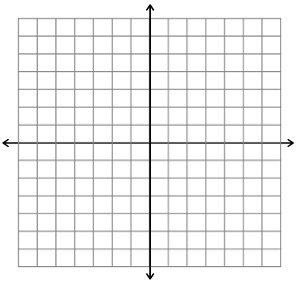
Q1. Find the equation of a line that passes through the points (-1,3) and (2,1). Put your final answer in slope-intercept form. State the slope and y-intercept and sketch the line.
Background
Topic: Linear Equations and Slope-Intercept Form
This question tests your ability to find the equation of a line given two points, and to express it in slope-intercept form (). You also need to identify the slope and y-intercept, and sketch the line.
Key Terms and Formulas:
Slope ():
Slope-intercept form:
y-intercept (): The value of when
Step-by-Step Guidance
Label the points: Let be and be .
Calculate the slope using the formula: .
Plug the slope and one point into the point-slope form: .
Rearrange the equation to slope-intercept form ().
Try solving on your own before revealing the answer!
Final Answer:
Slope:
y-intercept:
The line passes through the given points and is sketched on the provided graph.
Q2. Solve the equation:
Background
Topic: Solving Linear Equations
This question tests your ability to solve a linear equation for by applying algebraic operations.
Key Terms and Formulas:
Linear equation: An equation of the form
Distributive property:
Step-by-Step Guidance
Expand using the distributive property: .
Rewrite the equation: .
Combine like terms: .
Isolate by moving constants to the other side.
Try solving on your own before revealing the answer!
Final Answer:
After combining like terms and isolating , you find .
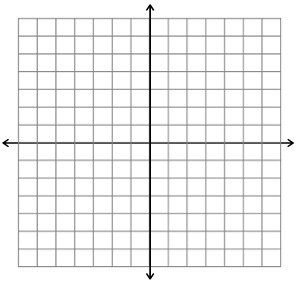
Q3. Sketch the graph of . Include at least one point on either side of the vertex. Identify the transformations that took place from . State the domain and range.
Background
Topic: Quadratic Functions and Transformations
This question tests your understanding of how to graph a quadratic function, identify its vertex, and describe transformations from the parent function .
Key Terms and Formulas:
Vertex form:
Transformation: Horizontal shift (), vertical shift ()
Domain: All possible values
Range: All possible values
Step-by-Step Guidance
Identify the vertex: The function is in vertex form, so the vertex is .
Describe the transformations: The graph is shifted left by 2 units and down by 1 unit from .
Choose points on either side of the vertex (e.g., and ) and calculate for those values.
State the domain and range: For a quadratic, domain is all real numbers; range starts at the vertex's value.
Try solving on your own before revealing the answer!
Final Answer:
Vertex:
Domain:
Range:
Points: and
The graph is a parabola opening upwards, shifted left 2 units and down 1 unit.
