 Back
College Algebra Midterm Review: Key Concepts and Study Guide
Study Guide - Smart Notes
 Tailored notes based on your materials, expanded with key definitions, examples, and context.
Review of Algebra
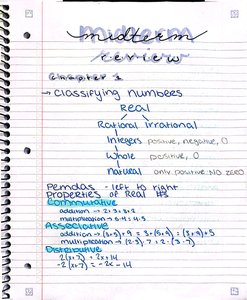
Classifying Numbers
Understanding the classification of numbers is fundamental in algebra. The real number system is divided into several subsets, each with distinct properties.
Real Numbers: All numbers on the number line, including rational and irrational numbers.
Rational Numbers: Numbers that can be expressed as a fraction of two integers.
Irrational Numbers: Numbers that cannot be written as a simple fraction (e.g., \( \sqrt{2} \), \( \pi \)).
Integers: Positive, negative, and zero (e.g., -3, 0, 7).
Whole Numbers: Non-negative integers (e.g., 0, 1, 2, 3).
Natural Numbers: Positive integers (e.g., 1, 2, 3).
Order of Operations (PEMDAS)
PEMDAS stands for Parentheses, Exponents, Multiplication/Division, Addition/Subtraction. Operations are performed from left to right.
Parentheses
Exponents
Multiplication/Division
Addition/Subtraction
Properties of Real Numbers
Several properties govern the operations of real numbers:
Commutative Property:
Addition: \( a + b = b + a \)
Multiplication: \( a \times b = b \times a \)
Associative Property:
Addition: \( (a + b) + c = a + (b + c) \)
Multiplication: \( (a \times b) \times c = a \times (b \times c) \)
Distributive Property:
\( a \times (b + c) = a \times b + a \times c \)
Inverse, Identity, and Zero Properties
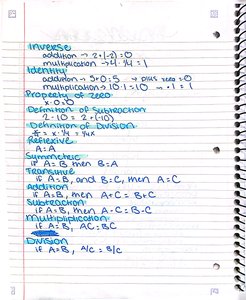
Inverse Property:
Addition: \( a + (-a) = 0 \)
Multiplication: \( a \times \frac{1}{a} = 1 \) (for \( a \neq 0 \))
Identity Property:
Addition: \( a + 0 = a \)
Multiplication: \( a \times 1 = a \)
Property of Zero:
Multiplication: \( a \times 0 = 0 \)
Definitions and Properties of Operations
Definition of Subtraction: \( a - b = a + (-b) \)
Definition of Division: \( a \div b = a \times \frac{1}{b} \)
Reflexive, Symmetric, and Transitive Properties
Reflexive: \( a = a \)
Symmetric: If \( a = b \), then \( b = a \)
Transitive: If \( a = b \) and \( b = c \), then \( a = c \)
Properties of Equality
Addition: If \( a = b \), then \( a + c = b + c \)
Subtraction: If \( a = b \), then \( a - c = b - c \)
Multiplication: If \( a = b \), then \( a \times c = b \times c \)
Division: If \( a = b \), then \( \frac{a}{c} = \frac{b}{c} \) (for \( c \neq 0 \))
Equations & Inequalities
Linear Equations and Properties of Equality
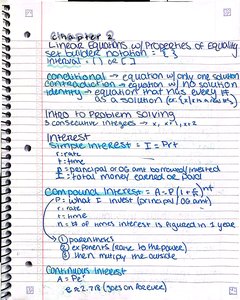
Linear equations are equations of the first degree, meaning the highest power of the variable is one. Properties of equality are used to solve these equations.
Set Builder Notation: Used to describe the solution set, e.g., \( \{ x \mid x > 2 \} \).
Interval Notation: Used to represent intervals, e.g., \( (1, 2) \).
Types of Equations
Conditional Equation: Has only one solution.
Contradiction: Has no solution.
Identity: True for all values of the variable.
Problem Solving and Interest
Consecutive Integers: \( x, x+1, x+2, \ldots \)
Simple Interest: \( I = Prt \) Where \( I \) is interest, \( P \) is principal, \( r \) is rate, \( t \) is time.
Compound Interest: \( A = P(1 + r)^t \) Where \( A \) is amount, \( P \) is principal, \( r \) is rate, \( t \) is time.
Continuous Interest: \( A = Pe^{rt} \)
Linear Equations & Inequalities
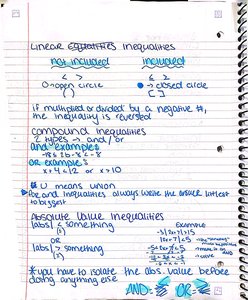
Solving linear inequalities involves similar steps to solving equations, but special care must be taken when multiplying or dividing by negative numbers.
Not Included: Open circle on number line.
Included: Closed circle on number line.
Reversing Inequality: If multiplied or divided by a negative number, the inequality sign is reversed.
Compound Inequalities:
"And" (intersection): Both conditions must be satisfied.
"Or" (union): At least one condition must be satisfied.
Absolute Value Inequalities:
\( |x| < a \): \( -a < x < a \)
\( |x| > a \): \( x < -a \) or \( x > a \)
Functions
Graphing & Functions
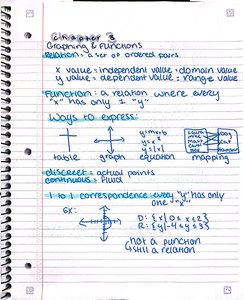
A function is a relation in which each input (x-value) corresponds to exactly one output (y-value). Functions can be represented in various ways.
Relation: A set of ordered pairs.
Ways to Express: Table, graph, equation, mapping.
Discrete: Actual points.
Continuous: Fluid, unbroken curve.
One-to-One Correspondence: Each y has only one x.
Functions & Equations
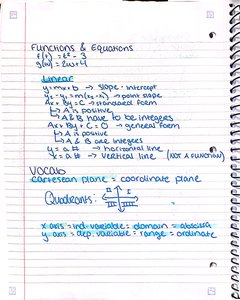
Function Notation: \( f(x) \), \( g(x) \)
Linear Functions:
Slope-intercept form: \( y = mx + b \)
Point-slope form: \( y - y_1 = m(x - x_1) \)
General form: \( Ax + By = C \)
Vertical Line: Not a function.
Vocabulary and Quadrants
Coordinate Plane: Also called Cartesian plane.
Quadrants: Four regions divided by x- and y-axes.
x-axis: Independent variable, domain, abscissa.
y-axis: Dependent variable, range, ordinate.
Slope
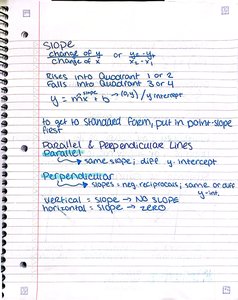
The slope of a line measures its steepness and direction.
Formula: \( m = \frac{y_2 - y_1}{x_2 - x_1} \)
Positive Slope: Rises into Quadrant I or II.
Negative Slope: Falls into Quadrant III or IV.
Slope-Intercept Form: \( y = mx + b \)
Vertical Line: No slope.
Horizontal Line: Slope is zero.
Parallel and Perpendicular Lines
Parallel Lines: Same slope, different y-intercept.
Perpendicular Lines: Slopes are negative reciprocals.
Systems of Equations
Piecewise Functions
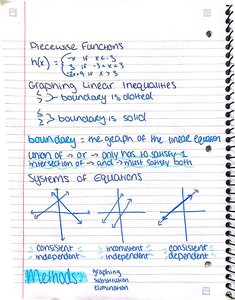
Piecewise functions are defined by different expressions depending on the input value.
Example: \( h(x) = \begin{cases} 2 & \text{if } x < 3 \\ 3 & \text{if } x = 3 \\ x + 2 & \text{if } x > 3 \end{cases} \)
Graphing Linear Inequalities
Boundary: The graph of the related equation.
\( > \): Boundary is dotted.
\( \geq \): Boundary is solid.
Union and Intersection
Union (or): Only one condition must be satisfied.
Intersection (and): Both conditions must be satisfied.
Systems of Equations
Systems of equations involve solving for variables that satisfy multiple equations simultaneously.
Consistent Independent: One solution.
Inconsistent Independent: No solution.
Consistent Dependent: Infinite solutions.
Methods: Graphing, substitution, elimination.
