 Back
BackCollege Algebra Review: Circles, Parabolas, Ellipses, and Matrices
Study Guide - Smart Notes
 Tailored notes based on your materials, expanded with key definitions, examples, and context.
Review of Conic Sections and Matrices
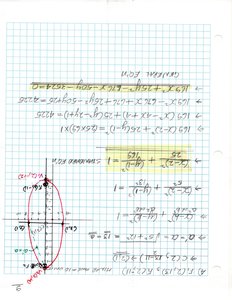
21-5, 21-7: The Ellipse – Review Questions
The ellipse is a conic section defined as the set of all points in a plane such that the sum of the distances from two fixed points (foci) is constant. Ellipses have important applications in physics, astronomy, and engineering.
Standard Equation: The standard form for an ellipse centered at the origin is: where a is the semi-major axis and b is the semi-minor axis.
Foci: The foci are located at where for .
Vertices: The vertices are at and .
Eccentricity: , where for ellipses.
Graphing: Identify the center, axes lengths, and foci to sketch the ellipse.
Example: For , , , .
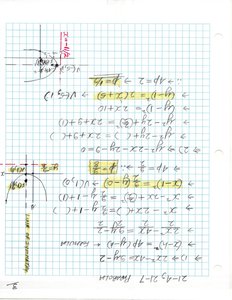
21-4, 21-7: The Parabola – Review Questions
A parabola is the set of all points equidistant from a fixed point (focus) and a fixed line (directrix). Parabolas are commonly seen in physics (projectile motion) and engineering (satellite dishes).
Standard Equation: For a parabola opening right/left: . For up/down: .
Focus and Directrix: The focus is at and the directrix is for .
Vertex: The vertex is at the origin (0,0) in standard form.
Axis of Symmetry: The line passing through the vertex and focus.
Example: For , . Focus at , directrix .
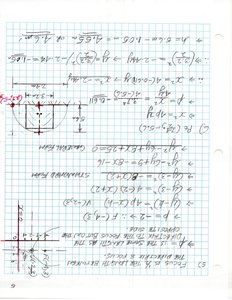
21-3: The Circle – Review Questions
A circle is a special case of an ellipse where the two axes are equal. It is the set of all points equidistant from a fixed center point.
Standard Equation: , where is the center and is the radius.
Graphing: Plot the center and use the radius to draw the circle.
Example: is a circle centered at (2, -1) with radius 3.
Review of Matrices
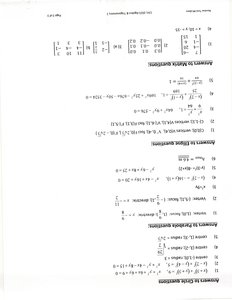
Answers to Matrix Questions
Matrices are rectangular arrays of numbers used to represent systems of equations, transformations, and more. Operations include addition, multiplication, and finding determinants and inverses.
Matrix Addition: Add corresponding elements.
Matrix Multiplication: Multiply rows by columns; the number of columns in the first matrix must equal the number of rows in the second.
Determinant: For a 2x2 matrix , determinant is .
Inverse: For a 2x2 matrix, the inverse exists if the determinant is nonzero.
Example: Multiply by :
Additional info:
Some handwritten notes include step-by-step solutions for conic section equations and their graphs, reinforcing the algebraic and geometric properties discussed above.
All examples and images are directly relevant to the algebraic manipulation and graphical representation of circles, ellipses, parabolas, and matrices.
