 Back
College Algebra Study Guide: Equations of Lines and Linear Functions
Study Guide - Smart Notes
 Tailored notes based on your materials, expanded with key definitions, examples, and context.
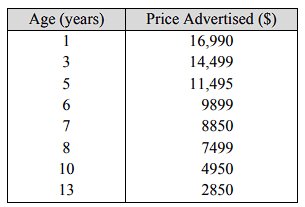
Q1. Is the data for Toyota Corolla prices approximately linear or exactly linear? Why?
Background
Topic: Linear Models and Data Analysis
This question tests your ability to recognize linear relationships in real-world data and distinguish between exact and approximate linearity.
Key Terms:
Linear relationship: A relationship where the change between variables is constant.
Approximately linear: Data points are close to a straight line but may not all lie exactly on it.
Exactly linear: All data points lie perfectly on a straight line.
Step-by-Step Guidance
Examine the table of ages and prices for Toyota Corollas. Look for a pattern in how price changes as age increases.
Consider whether the price drops by a consistent amount for each year increase in age. If the decrease is not perfectly consistent, the data is approximately linear.
Think about real-world factors: Used car prices are influenced by many variables, so exact linearity is rare.
Describe whether the data is approximately or exactly linear, and explain your reasoning based on the observed pattern.
Try solving on your own before revealing the answer!
Final Answer:
The data is approximately linear, not exactly linear. The price decreases as the car gets older, but the decrease is not perfectly consistent for each year. This is typical in real-world data, where other factors affect price.
Q2. Is the slope for the line segment joining the first and last points positive or negative? How can you tell?
Background
Topic: Slope of a Line
This question tests your understanding of how to determine the direction of a line segment based on the data points.
Key Terms:
Slope: The rate at which one variable changes with respect to another.
Positive slope: The line rises as you move from left to right.
Negative slope: The line falls as you move from left to right.
Step-by-Step Guidance
Identify the first and last points in the data table: (1, 16990) and (13, 2850).
Compare the values: As age increases from 1 to 13 years, the price decreases from $16,990 to $2,850.
Recall that a decrease in y as x increases indicates a negative slope.
Explain how the direction of change in the data points determines the sign of the slope.
Try solving on your own before revealing the answer!
Final Answer:
The slope is negative. As the age of the car increases, the price decreases, which means the line falls from left to right.
Q3. Determine the slope of the line segment joining the first and last points as both a rational number (fraction) and a decimal rounded to the nearest hundredth. Interpret the meaning in context of both forms.
Background
Topic: Slope Calculation and Interpretation
This question tests your ability to calculate the slope between two points and interpret its meaning in a real-world context.
Key Formula:
Where:
= first point (1, 16990)
= last point (13, 2850)
Step-by-Step Guidance
Write down the coordinates for the first and last points: and .
Plug these values into the slope formula: .
Simplify the numerator and denominator separately.
Express the slope as a fraction and then as a decimal rounded to the nearest hundredth.
Interpret what the slope means: How much does the price change per year of age?
Try solving on your own before revealing the answer!
Final Answer:
The slope is (rounded to the nearest hundredth).
This means that, on average, the price of a Toyota Corolla decreases by about $1178.33 per year as it ages.
Q4. Determine the point-slope form of the equation of the line passing through the first and last points.
Background
Topic: Point-Slope Form of a Line
This question tests your ability to write the equation of a line given two points using the point-slope form.
Key Formula:
Where:
= slope calculated in the previous question
= first point (1, 16990)
Step-by-Step Guidance
Recall the slope from the previous calculation.
Use the first point and the slope in the point-slope formula: .
Write the equation with the slope substituted in, but do not simplify to the final form yet.
Try solving on your own before revealing the answer!
Final Answer:
The point-slope form is .
This equation models the price of a Toyota Corolla based on its age.
Q5. Use your equation to predict the price of a Toyota Corolla that is 4 years old.
Background
Topic: Linear Prediction Using Point-Slope Form
This question tests your ability to use a linear equation to make predictions for values not explicitly given in the data.
Key Formula:
Where:
(age of the car)
= slope from previous question
= first point (1, 16990)
Step-by-Step Guidance
Substitute into the point-slope equation: .
Use the slope value from earlier and set up the calculation.
Calculate the value inside the parentheses and multiply by the slope.
Add the result to $16990$ to get the predicted price.
Try solving on your own before revealing the answer!
Final Answer:
The predicted price for a 4-year-old Toyota Corolla is .
This means a 4-year-old Corolla is expected to cost about $15,455.01 based on the linear model.
Q6. Convert your equation from part d to slope-intercept form. Interpret the meaning of the y-intercept.
Background
Topic: Slope-Intercept Form and Interpretation
This question tests your ability to rewrite a linear equation in slope-intercept form and interpret the y-intercept in context.
Key Formula:
Slope-intercept form:
Where:
= slope
= y-intercept
Step-by-Step Guidance
Start with the point-slope form: .
Expand the equation: .
Combine like terms to get .
Identify the y-intercept and interpret its meaning: What does represent in this context?
Try solving on your own before revealing the answer!
Final Answer:
The slope-intercept form is .
The y-intercept () represents the predicted price of a Toyota Corolla when it is brand new (age 0).
Q7. Find the equation of the line through the points (−2, 1) and (2, 3) using point-slope form and slope-intercept form.
Background
Topic: Writing Equations of Lines
This question tests your ability to find the equation of a line given two points, using both point-slope and slope-intercept forms.
Key Formulas:
Slope formula:
Point-slope form:
Slope-intercept form:
Step-by-Step Guidance
Calculate the slope using the two points: and .
Plug the slope and one of the points into the point-slope form.
Expand the point-slope form to get the slope-intercept form.
Identify the y-intercept in the slope-intercept form.
Try solving on your own before revealing the answer!
Final Answer:
Slope:
Point-slope form:
Slope-intercept form:
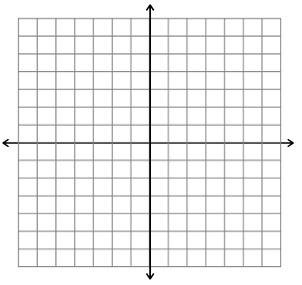
Q8. Sketch the graph of
Background
Topic: Graphing Linear Equations in Standard Form
This question tests your ability to graph a linear equation given in standard form by finding intercepts.
Key Formula:
Standard form:
Where:
, ,
Step-by-Step Guidance
Find the x-intercept by setting and solving for .
Find the y-intercept by setting and solving for .
Plot these intercepts on the graph.
Draw a straight line through the intercepts to represent the equation.
Try solving on your own before revealing the answer!
Final Answer:
x-intercept: when
y-intercept: when
Plot the points (5, 0) and (0, 3) and draw a line through them.
Q9. Find the equation of the line parallel to that passes through the point (4, 5).
Background
Topic: Parallel Lines and Linear Equations
This question tests your ability to write the equation of a line parallel to a given line, passing through a specific point.
Key Terms:
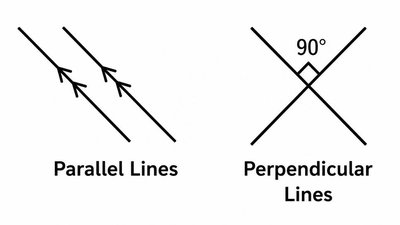
Parallel lines: Lines with the same slope.
Key Formula:
Point-slope form:
Where:
(same as the given line)
Step-by-Step Guidance
Identify the slope of the given line: .
Use the point-slope form with the slope and the given point.
Write the equation but do not expand to slope-intercept form yet.
Try solving on your own before revealing the answer!
Final Answer:
Point-slope form:
Slope-intercept form:
Q10. Find the equation of the line perpendicular to that passes through the point (−3, −3).
Background
Topic: Perpendicular Lines and Linear Equations
This question tests your ability to write the equation of a line perpendicular to a given line, passing through a specific point.
Key Terms:
Perpendicular lines: Lines whose slopes are negative reciprocals.
Key Formula:
Point-slope form:
Where:
Slope of the given line:
Slope of perpendicular line:
Step-by-Step Guidance
Find the negative reciprocal of the given slope: .
Use the point-slope form with the perpendicular slope and the given point.
Write the equation but do not expand to slope-intercept form yet.
Try solving on your own before revealing the answer!
Final Answer:
Point-slope form:
Slope-intercept form:
