Back
BackCollege Algebra Study Guide: Functions, Domains, Ranges, and Transformations
Study Guide - Smart Notes
 Tailored notes based on your materials, expanded with key definitions, examples, and context.
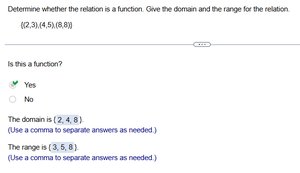
Q1. Determine whether the relation is a function. Give the domain and the range for the relation: {(2,3), (4,5), (8,8)}
Background
Topic: Functions and Relations
This question tests your understanding of what makes a relation a function, and how to identify the domain and range from a set of ordered pairs.
Key Terms:
Function: A relation in which each input (x-value) corresponds to exactly one output (y-value).
Domain: The set of all possible input values (x-values).
Range: The set of all possible output values (y-values).
Step-by-Step Guidance
List all the x-values and y-values from the given pairs.
Check if any x-value is repeated with a different y-value. If not, the relation is a function.
Identify the domain by collecting all unique x-values.
Identify the range by collecting all unique y-values.
Try solving on your own before revealing the answer!
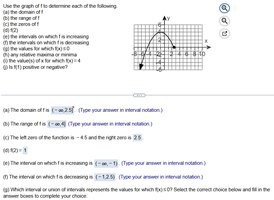
Q2. Use the graph of f to determine each of the following: domain, range, zeros, intervals of increase/decrease, relative maximum/minimum, and values for which f(x) is positive or negative.
Background
Topic: Graph Analysis of Functions
This question tests your ability to interpret a function's graph and extract information such as domain, range, zeros, and intervals of increase/decrease.
Key Terms:
Domain/Range: Interval notation is often used for continuous graphs.
Zeros: x-values where f(x) = 0.
Increasing/Decreasing: Intervals where the graph goes up or down.
Relative Maximum/Minimum: Highest/lowest points in a local region.
Step-by-Step Guidance
Examine the graph to determine the domain (x-values covered) and range (y-values covered).
Identify the zeros by finding where the graph crosses the x-axis.
Look for intervals where the graph is rising (increasing) or falling (decreasing).
Find any relative maximum or minimum points by checking peaks and valleys.
Determine where f(x) is positive (above x-axis) or negative (below x-axis).
Try solving on your own before revealing the answer!
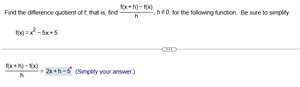
Q3. Find the difference quotient of f, that is, find \frac{f(x+h)-f(x)}{h}, h \neq 0, for the function f(x) = x^2 - 5x + 5.
Background
Topic: Difference Quotient
This question tests your ability to compute the difference quotient, which is foundational for understanding rates of change and calculus concepts.
Key Formula:
Step-by-Step Guidance
Calculate by substituting into the function.
Subtract from .
Divide the result by and simplify the expression.
Try solving on your own before revealing the answer!
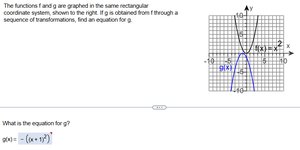
Q4. The functions f and g are graphed in the same rectangular coordinate system. If g is obtained from f through a sequence of transformations, find an equation for g.
Background
Topic: Function Transformations
This question tests your understanding of how to write the equation of a function after it has been transformed (shifted, reflected, stretched, etc.).
Key Terms:
Transformation: Operations such as translation, reflection, and scaling applied to functions.
Step-by-Step Guidance
Identify the original function f(x) from the graph.
Observe how the graph of g(x) differs from f(x) (e.g., shifts left/right, up/down).
Write the equation for g(x) based on the observed transformation(s).
Try solving on your own before revealing the answer!
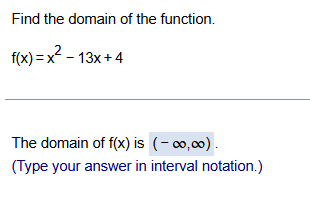
Q5. Find the domain of the function f(x) = x^2 - 13x + 4.
Background
Topic: Domain of Polynomial Functions
This question tests your ability to determine the domain of a polynomial function, which is typically all real numbers.
Key Terms:
Domain: The set of all possible input values (x-values) for which the function is defined.
Step-by-Step Guidance
Recognize that polynomials are defined for all real numbers.
Express the domain in interval notation.
Try solving on your own before revealing the answer!
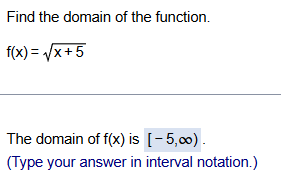
Q6. Find the domain of the function f(x) = \sqrt{x+5}.
Background
Topic: Domain of Radical Functions
This question tests your ability to find the domain of a function involving a square root, which requires the radicand to be non-negative.
Key Terms:
Radicand: The expression inside the square root.
Domain: Values of x for which the radicand is greater than or equal to zero.
Step-by-Step Guidance
Set the radicand and solve for x.
Express the solution in interval notation.
Try solving on your own before revealing the answer!
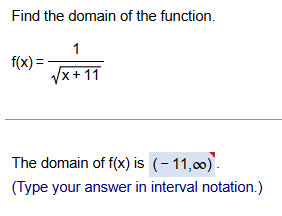
Q7. Find the domain of the function f(x) = \frac{1}{\sqrt{x+11}}.
Background
Topic: Domain of Rational and Radical Functions
This question tests your ability to find the domain of a function with both a square root and a denominator, requiring the radicand to be positive.
Key Terms:
Denominator: Cannot be zero.
Radicand: Must be positive for the square root in the denominator.
Step-by-Step Guidance
Set to ensure the denominator is defined and positive.
Solve for x and write the domain in interval notation.
Try solving on your own before revealing the answer!
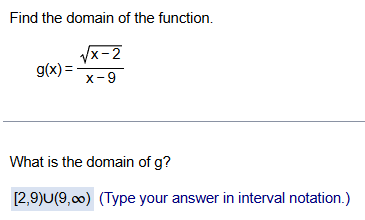
Q8. Find the domain of the function g(x) = \frac{\sqrt{x-2}}{x-9}.
Background
Topic: Domain of Rational Functions with Radicals
This question tests your ability to find the domain of a function with a square root in the numerator and a variable in the denominator.
Key Terms:
Numerator: The radicand must be non-negative.
Denominator: Cannot be zero.
Step-by-Step Guidance
Set to ensure the square root is defined.
Set to ensure the denominator is not zero.
Combine the restrictions to write the domain in interval notation.
Try solving on your own before revealing the answer!
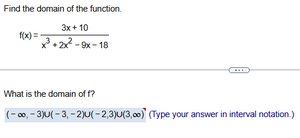
Q9. Find the domain of the function f(x) = \frac{3x+10}{x^3+2x^2-9x-18}.
Background
Topic: Domain of Rational Functions
This question tests your ability to find the domain of a rational function by identifying values that make the denominator zero.
Key Terms:
Rational Function: A function that is the ratio of two polynomials.
Domain: All real numbers except where the denominator is zero.
Step-by-Step Guidance
Set the denominator equal to zero and solve for x.
Exclude these values from the domain.
Express the domain in interval notation, omitting the excluded values.
Try solving on your own before revealing the answer!