 Back
BackCollege Algebra Study Guide: Functions, Equations, Graphs, and Transformations
Study Guide - Smart Notes
 Tailored notes based on your materials, expanded with key definitions, examples, and context.
Q1. Solve the equation:
Background
Topic: Linear Equations
This question tests your ability to solve a basic linear equation for the variable .
Key Terms and Formulas:
Linear equation: An equation of the form .
Solving for : Isolate $x$ on one side of the equation.
Step-by-Step Guidance
Start by adding $2$ to both sides to eliminate the constant term on the left.
Divide both sides by $5x$.
Try solving on your own before revealing the answer!
Final Answer:
We isolated and solved using basic algebraic steps.
Q2. Solve and graph the solution in interval notation:
Background
Topic: Linear Inequalities
This question tests your ability to solve a linear inequality and express the solution using interval notation.
Key Terms and Formulas:
Linear inequality: An inequality involving a linear expression.
Interval notation: A way to represent the set of solutions.
Step-by-Step Guidance
Combine like terms on the left side: .
Add or subtract terms to isolate .
Divide both sides by $3x$.
Express the solution in interval notation.
Try solving on your own before revealing the answer!
Final Answer:
Interval notation:
Q3. Solve and graph the solution in interval notation:
Background
Topic: Linear Inequalities
This question tests your ability to solve a linear inequality and express the solution using interval notation.
Key Terms and Formulas:
Linear inequality: An inequality involving a linear expression.
Interval notation: A way to represent the set of solutions.
Step-by-Step Guidance
Combine like terms: .
Isolate on one side.
Divide both sides by $2x$.
Express the solution in interval notation.
Try solving on your own before revealing the answer!
Final Answer:
Interval notation:
Q4. Determine the domain of
Background
Topic: Domain of Functions
This question tests your understanding of the domain of a linear function.
Key Terms and Formulas:
Domain: The set of all possible input values () for which the function is defined.
Step-by-Step Guidance
Recognize that is a linear function.
Linear functions are defined for all real numbers.
Try solving on your own before revealing the answer!
Final Answer: Domain is
Linear functions have no restrictions on their domain.
Q5. Determine the domain of
Background
Topic: Domain of Polynomial Functions
This question tests your understanding of the domain of a polynomial function.
Key Terms and Formulas:
Domain: The set of all possible input values () for which the function is defined.
Polynomial function: An expression involving powers of .
Step-by-Step Guidance
Identify the function as a polynomial.
Polynomial functions are defined for all real numbers.
Try solving on your own before revealing the answer!
Final Answer: Domain is
Polynomial functions have no restrictions on their domain.
Q6. Determine the domain of
Background
Topic: Domain of Linear Functions
This question tests your understanding of the domain of a linear function.
Key Terms and Formulas:
Domain: The set of all possible input values () for which the function is defined.
Step-by-Step Guidance
Recognize that is a linear function.
Linear functions are defined for all real numbers.
Try solving on your own before revealing the answer!
Final Answer: Domain is
Linear functions have no restrictions on their domain.
Q7. For the following graph of , find:
Domain
Range
Interval(s) where increasing
The value(s) of for which
Background
Topic: Graph Analysis
This question tests your ability to interpret a graph and identify key features such as domain, range, intervals of increase, and specific function values.
Key Terms and Formulas:
Domain: All -values for which the graph exists.
Range: All -values the graph attains.
Increasing interval: Where the graph moves upward as increases.
: The -value when .
: Find where the graph crosses .
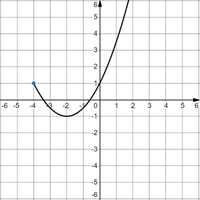
Step-by-Step Guidance
Examine the graph to determine the leftmost and rightmost -values for the domain.
Identify the lowest and highest -values for the range.
Look for intervals where the graph is rising as you move from left to right.
Find the -value at by locating the point where the graph crosses the $y$-axis.
Locate the -value(s) where the graph crosses .
Try solving on your own before revealing the answer!
Final Answer:
Domain:
Range:
Increasing:
when
These values are determined by analyzing the graph's endpoints, turning points, and intersections.
