 Back
College Algebra Study Guide: Inverse, Exponential, Logarithmic Functions, and Applications
Study Guide - Smart Notes
 Tailored notes based on your materials, expanded with key definitions, examples, and context.
Q1. Find an equation for the inverse of the following relation: y = x^2 + 1
Background
Topic: Inverse Functions
This question tests your understanding of how to find the inverse of a function by interchanging the variables and solving for the new dependent variable.
Key Terms and Formulas:
Inverse function: If is a function, its inverse is denoted .
To find the inverse, swap and and solve for $y$.
Step-by-Step Guidance
Start with the original equation: .
Interchange and to get: .
Subtract 1 from both sides to isolate the term: .
To solve for , take the square root of both sides. Remember to consider both the positive and negative roots.
Try solving on your own before revealing the answer!
Final Answer:
By taking the square root, you get both positive and negative values for . This is the inverse relation for the original function.
Q2. Find an equation for the inverse of the following relation: y = x^3 - 1
Background
Topic: Inverse Functions
This question tests your ability to find the inverse of a cubic function by interchanging variables and solving for the new dependent variable.
Key Terms and Formulas:
Inverse function:
Swap and and solve for $y$.
Step-by-Step Guidance
Start with the original equation: .
Interchange and to get: .
Add 1 to both sides to isolate : .
To solve for , take the cube root of both sides.
Try solving on your own before revealing the answer!
Final Answer:
Taking the cube root gives the inverse function for the original cubic relation.
Q3. Graph . Find the equation of the inverse. Graph the inverse. Graph the line .
Background
Topic: Inverse Functions and Graphs
This question tests your ability to graph a linear function, find its inverse, and graph both the function and its inverse along with the line .
Key Terms and Formulas:
Inverse function:
To find the inverse, swap and and solve for $y$.
The line is the axis of symmetry for a function and its inverse.
Step-by-Step Guidance
Start with the original equation: .
Interchange and to get: .
Subtract 1 from both sides: .
Divide both sides by 2 to solve for .
Graph , its inverse, and the line on the same axes.
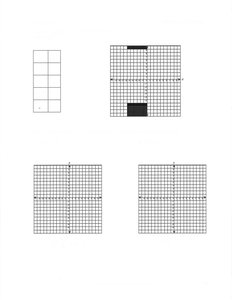
Try solving on your own before revealing the answer!
Final Answer:
The inverse function is . When graphed, the function and its inverse are reflections across the line .
Q4. Use the Horizontal Line Test to decide if the graph of the function is one-to-one.
Background
Topic: One-to-One Functions and Horizontal Line Test
This question tests your understanding of how to determine if a function is one-to-one by using the horizontal line test.
Key Terms and Formulas:
One-to-one function: A function is one-to-one if each output is produced by only one input.
Horizontal Line Test: If any horizontal line intersects the graph more than once, the function is not one-to-one.
Step-by-Step Guidance
Examine the graph of the function.
Imagine or draw horizontal lines across the graph.
Check if any horizontal line crosses the graph more than once.
If so, the function is not one-to-one. If not, it is one-to-one.

Try solving on your own before revealing the answer!
Final Answer: If a horizontal line crosses the graph more than once, the function is not one-to-one. Otherwise, it is one-to-one.
Use the horizontal line test to visually determine the one-to-one property for each graph.
Q5. Use a calculator to find each value. Round to four decimal places: 2^3, 0.4^7, 2.14^4
Background
Topic: Exponential Functions
This question tests your ability to evaluate exponential expressions using a calculator and round the results.
Key Terms and Formulas:
Exponential function:
Use a calculator to compute powers.
Step-by-Step Guidance
For each expression, enter the base and exponent into your calculator.
Calculate the value.
Round the result to four decimal places.
Try solving on your own before revealing the answer!
Final Answer:
Each value is rounded to four decimal places as requested.
Q6. Simplify:
Background
Topic: Properties of Exponents
This question tests your understanding of how to multiply exponential expressions with the same base.
Key Terms and Formulas:
Product Rule:
Step-by-Step Guidance
Identify the base and exponents: both have base 2.
Add the exponents: .
Write the result as a single exponent.
Try solving on your own before revealing the answer!
Final Answer:
By adding the exponents, you get , which equals 32.
Q7. Simplify:
Background
Topic: Logarithmic Functions
This question tests your ability to evaluate logarithms by expressing the argument as a power of the base.
Key Terms and Formulas:
Definition: means
Step-by-Step Guidance
Express 64 as a power of 2.
Set up the equation: .
Solve for .
Try solving on your own before revealing the answer!
Final Answer:
Since , the logarithm evaluates to 6.
Q8. If you invest $5,000 in an account that earns 9% interest, compounded quarterly, how much will you have in the account in 5 years?
Background
Topic: Compound Interest
This question tests your ability to use the compound interest formula to calculate the future value of an investment.
Key Terms and Formulas:
Compound Interest Formula:
= principal, = annual rate (decimal), = compounding periods per year, = time in years
Step-by-Step Guidance
Identify the values: , , , .
Plug these values into the formula: .
Calculate and .
Set up the expression for the final calculation.
Try solving on your own before revealing the answer!
Final Answer:
After 5 years, the account will have approximately $7,756.50.
Q9. The population growth function is . In 2013, the population of Ghana was about 25.2 million, and the exponential growth rate was 2.19% per year. Estimate the population in 2018.
Background
Topic: Exponential Growth Models
This question tests your ability to use the exponential growth formula to estimate future population.
Key Terms and Formulas:
Exponential growth formula:
= initial population, = growth rate (decimal), = time in years
Step-by-Step Guidance
Identify the values: , , .
Plug these values into the formula: .
Calculate .
Set up the expression for the final calculation.
Try solving on your own before revealing the answer!
Final Answer: million
The estimated population in 2018 is approximately 28.12 million.
