 Back
BackCollege Algebra Study Guide: Linear, Rational, Quadratic Equations, Complex Numbers, and Inequalities
Study Guide - Smart Notes
 Tailored notes based on your materials, expanded with key definitions, examples, and context.
Linear and Rational Equations
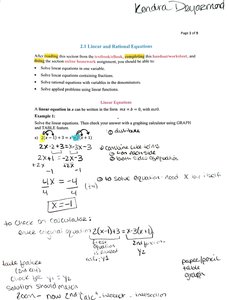
Solving Linear Equations
Linear equations are equations of the form ax + b = 0, where a and b are constants. Solving linear equations involves isolating the variable on one side of the equation.
Key Point 1: Combine like terms and use inverse operations to solve for the variable.
Key Point 2: Check your solution by substituting back into the original equation or using a graphing calculator.
Example: Solve
Solving Rational Equations
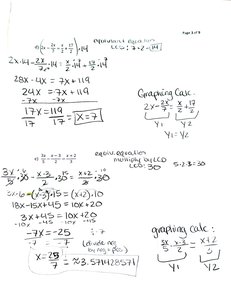
Rational equations contain fractions with variables in the denominator. To solve, clear denominators by multiplying both sides by the least common denominator (LCD).
Key Point 1: Identify the LCD and multiply both sides to eliminate fractions.
Key Point 2: Solve the resulting linear equation.
Example: Solve Multiply both sides by 119:
Models and Applications
Solving Word Problems
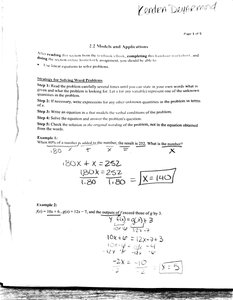
Word problems require translating real-world situations into algebraic equations. Follow a systematic approach to identify variables, set up equations, and solve.
Key Point 1: Define variables and write equations based on the problem statement.
Key Point 2: Solve the equation and interpret the solution in context.
Example: If , solve for :
Complex Numbers
Definition and Properties
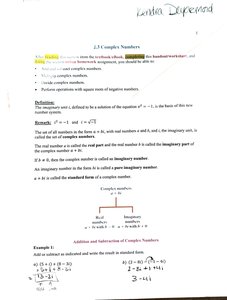
Complex numbers are numbers of the form a + bi, where a is the real part and b is the imaginary part. The imaginary unit i is defined as .
Key Point 1: The real part is a, and the imaginary part is b.
Key Point 2: Standard form:
Example: is a complex number.
Addition, Subtraction, Multiplication, and Division
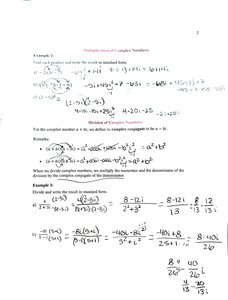
Operations with complex numbers follow algebraic rules, with .
Addition/Subtraction: Add/subtract real and imaginary parts separately.
Multiplication: Use distributive property and substitute .
Division: Multiply numerator and denominator by the conjugate of the denominator.
Example:
Quadratic Equations
Definition and Methods of Solution
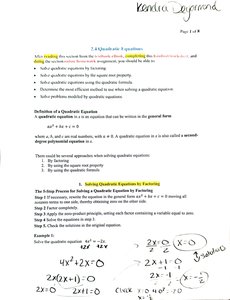
A quadratic equation is an equation of the form ax^2 + bx + c = 0. Solutions can be found by factoring, using the square root property, or the quadratic formula.
Key Point 1: Factoring: Write the equation as a product of binomials and set each factor to zero.
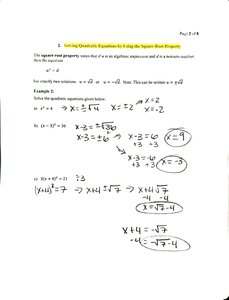
Key Point 2: Square Root Property: If , then .
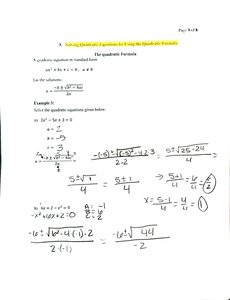
Key Point 3: Quadratic Formula:
Example: Solve
Solving Quadratic Equations by Factoring
Factoring is a method where the equation is rewritten as a product of two binomials.
Example: or
Solving Quadratic Equations Using the Square Root Property
Use the square root property when the equation can be written as .
Example:
Solving Quadratic Equations Using the Quadratic Formula
The quadratic formula is used when factoring is not possible.
Example: or
Linear Inequalities
Solving and Graphing Linear Inequalities
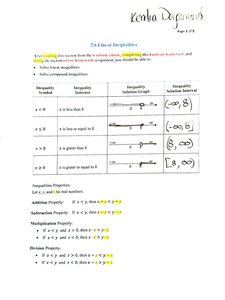
Linear inequalities are expressions involving <, >, ≤, ≥. Solutions are represented on a number line or using interval notation.
Key Point 1: Solve inequalities using similar steps as equations, but reverse the inequality sign when multiplying/dividing by a negative number.
Key Point 2: Graph solutions on a number line and use interval notation.
Example: is represented as
Inequality | Solution Graph | Interval Notation |
|---|---|---|
x < a | Arrow left from a | (-∞, a) |
x > a | Arrow right from a | (a, ∞) |
x ≤ a | Arrow left, closed at a | (-∞, a] |
x ≥ a | Arrow right, closed at a | [a, ∞) |
Inequality Properties
Properties of inequalities help in manipulating and solving them.
Addition Property: If , then
Subtraction Property: If , then
Multiplication Property: If and , then
Division Property: If and , then
Additional info:
Some examples and applications are inferred from context and standard college algebra curriculum, including the use of graphing calculators for checking solutions and interpreting word problems.
