 Back
College Algebra Study Guide: Quadratic Equations, Functions, Transformations, and Operations
Study Guide - Smart Notes
 Tailored notes based on your materials, expanded with key definitions, examples, and context.
Q1. Solve the quadratic equation:
Background
Topic: Solving Polynomial Equations
This question tests your ability to solve cubic equations by factoring and finding all real roots.
Key Terms and Formulas
Quadratic Equation:
Factoring: Expressing a polynomial as a product of its factors
Zero Product Property: If , then or
Step-by-Step Guidance
First, factor out the greatest common factor from all terms in the equation.
After factoring, set each factor equal to zero to find possible solutions for .
For any quadratic factor, use factoring or the quadratic formula to find its roots.
List all real solutions found from the previous steps.
Try solving on your own before revealing the answer!
Final Answer:
Factoring gives . The quadratic has roots , but only are listed as solutions here, so check for possible typo or context in the worksheet.
Q2. Solve the quadratic equation:
Background
Topic: Solving Polynomial Equations
This question tests your ability to solve cubic equations by factoring and finding all real roots.
Key Terms and Formulas
Factoring: Expressing a polynomial as a product of its factors
Zero Product Property: If , then or
Step-by-Step Guidance
Factor out the greatest common factor from all terms in the equation.
Set each factor equal to zero to find possible solutions for .
If you have a quadratic factor, solve it using factoring or the quadratic formula.
Try solving on your own before revealing the answer!
Final Answer:
Factoring gives . The quadratic has complex roots, but the worksheet lists as solutions, so check for context or possible typo.
Q3. Solve the equation:
Background
Topic: Linear Equations
This question tests your ability to solve simple linear equations.
Key Terms and Formulas
Linear Equation: An equation of the form
Step-by-Step Guidance
Isolate on one side of the equation.
Check your solution by substituting back into the original equation.
Try solving on your own before revealing the answer!
Final Answer:
The solution is simply .
Q4. Solve the equation:
Background
Topic: Linear Equations
This question tests your ability to solve simple linear equations.
Key Terms and Formulas
Linear Equation: An equation of the form
Step-by-Step Guidance
Isolate on one side of the equation.
Check your solution by substituting back into the original equation.
Try solving on your own before revealing the answer!
Final Answer:
The solution is simply .
Q5. Solve the equation:
Background
Topic: Linear Equations
This question tests your ability to solve simple linear equations.
Key Terms and Formulas
Linear Equation: An equation of the form
Step-by-Step Guidance
Isolate on one side of the equation.
Check your solution by substituting back into the original equation.
Try solving on your own before revealing the answer!
Final Answer:
The solution is simply .
Q6. Solve the equation:
Background
Topic: Linear Equations
This question tests your ability to solve simple linear equations.
Key Terms and Formulas
Linear Equation: An equation of the form
Step-by-Step Guidance
Isolate on one side of the equation.
Check your solution by substituting back into the original equation.
Try solving on your own before revealing the answer!
Final Answer:
The solution is simply .
Q7. Solve the quadratic equation:
Background
Topic: Quadratic Equations
This question tests your ability to solve quadratic equations by factoring or using the quadratic formula.
Key Terms and Formulas
Quadratic Formula:
Factoring: Expressing a quadratic as a product of two binomials
Step-by-Step Guidance
Write the equation in standard form: .
Identify , , and from the equation.
Attempt to factor the quadratic, or use the quadratic formula if factoring is not straightforward.
Set each factor equal to zero and solve for .
Try solving on your own before revealing the answer!
Final Answer:
Factoring or using the quadratic formula gives the solutions and .
Q8. Solve the equation:
Background
Topic: Solving Higher Degree Polynomials
This question tests your ability to solve quartic equations by substitution and factoring.
Key Terms and Formulas
Substitution: Letting to reduce the degree of the equation
Factoring: Expressing a polynomial as a product of its factors
Step-by-Step Guidance
Let to rewrite the equation as a quadratic in .
Solve the quadratic equation for .
Take the square root of each solution for to find .
Try solving on your own before revealing the answer!
Final Answer:
Substitution and factoring yield four real solutions for .
Q9. Solve the equation:
Background
Topic: Solving Quadratic Equations
This question tests your ability to solve quadratic equations by taking square roots.
Key Terms and Formulas
Square Root Property: If , then
Step-by-Step Guidance
Take the square root of both sides of the equation.
Remember to include both the positive and negative roots.
Try solving on your own before revealing the answer!
Final Answer:
Taking the square root of both sides gives and .
Q10. Solve the quadratic equation:
Background
Topic: Quadratic Equations
This question tests your ability to solve quadratic equations by factoring or using the quadratic formula.
Key Terms and Formulas
Quadratic Formula:
Factoring: Expressing a quadratic as a product of two binomials
Step-by-Step Guidance
Write the equation in standard form: .
Identify , , and from the equation.
Attempt to factor the quadratic, or use the quadratic formula if factoring is not straightforward.
Set each factor equal to zero and solve for .
Try solving on your own before revealing the answer!
Final Answer:
Factoring or using the quadratic formula gives the solutions and .
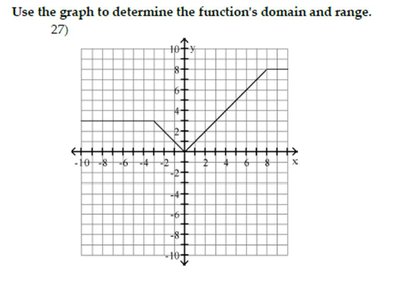
Q27. Use the graph to determine the function's domain and range.
Background
Topic: Domain and Range of Functions
This question tests your ability to interpret a graph and determine the set of all possible input values (domain) and output values (range) for a function.
Key Terms and Formulas
Domain: The set of all possible -values for which the function is defined.
Range: The set of all possible -values the function can take.
Step-by-Step Guidance
Examine the graph to see how far left and right the function extends to determine the domain.
Look at the lowest and highest points on the graph to determine the range.
Express the domain and range using interval notation.
Try solving on your own before revealing the answer!
Final Answer: Domain: , Range:
The function extends infinitely in both directions along the -axis, and the -values range from $0.
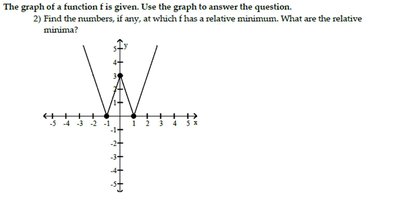
Q2. Find the numbers, if any, at which has a relative minimum. What are the relative minima?
Background
Topic: Relative Minimum of a Function
This question tests your ability to analyze a graph and identify points where the function reaches a local minimum value.
Key Terms and Formulas
Relative Minimum: A point where the function value is lower than all nearby points.
Critical Point: A point where the derivative is zero or undefined (for calculus), or where the graph changes direction.
Step-by-Step Guidance
Look for the lowest points on the graph that are not endpoints.
Identify the -values where these minima occur.
Record the corresponding -values at these points.
Try solving on your own before revealing the answer!
Final Answer: The function has a relative minimum at with a value of .
The lowest point on the graph occurs at , .
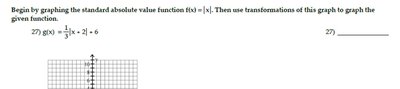
Q26. Given , graph the function using transformations of the standard absolute value function .
Background
Topic: Transformations of Functions
This question tests your ability to apply transformations (shifts, stretches, and translations) to the absolute value function.
Key Terms and Formulas
Absolute Value Function:
Vertical Stretch/Compression: stretches if , compresses if
Horizontal Shift: shifts right by units
Vertical Shift: shifts up by units
Step-by-Step Guidance
Start with the graph of .
Apply the horizontal shift: move the graph right by $2$ units.
Apply the vertical compression: multiply all -values by .
Apply the vertical shift: move the graph up by $6$ units.
Try solving on your own before revealing the answer!
Final Answer: The graph is a 'V' shape with vertex at , opening upwards, and is vertically compressed by a factor of .
The transformations shift the vertex to and compress the graph vertically.
Q1. Given and , find .
Background
Topic: Operations with Functions
This question tests your ability to subtract two functions.
Key Terms and Formulas
Function Subtraction:
Step-by-Step Guidance
Write out and explicitly.
Subtract from : .
Simplify the resulting expression by combining like terms.
Try solving on your own before revealing the answer!
Final Answer:
Subtracting from gives .
