 Back
College Algebra Study Guide: Quadratic Equations, Polynomial Functions, and Optimization
Study Guide - Smart Notes
 Tailored notes based on your materials, expanded with key definitions, examples, and context.
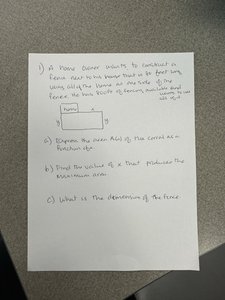
Q1. A horse owner wants to construct a fence next to a barn that is 40 feet long, using 60 ft of fence at the side and in front. What are the dimensions of the fence?
Background
Topic: Optimization and Quadratic Functions
This question tests your ability to set up and solve an optimization problem using algebraic expressions, specifically quadratic functions. You will use the concept of maximizing area given a fixed perimeter.
Key Terms and Formulas:
Area () of a rectangle:
Perimeter constraint: (where is the length parallel to the barn, is the width)
Step-by-Step Guidance
Let be the length of the fence parallel to the barn, and be the width (the two sides perpendicular to the barn).
Write the perimeter constraint: .
Solve the perimeter equation for in terms of : .
Express the area in terms of : .
To maximize the area, set up the quadratic function and find its maximum value by completing the square or using the vertex formula.
Try solving on your own before revealing the answer!
Final Answer:
The area function is . The maximum area occurs at feet, so feet.
The dimensions of the fence are 30 feet by 15 feet.
Q2. Write a polynomial based on these zeros: -1, 4, 6, 7
Background
Topic: Polynomial Functions and Roots
This question tests your ability to construct a polynomial given its roots (zeros).
Key Terms and Formulas:
Root/Zero: A value such that .
Factored form: If are roots, then .
Step-by-Step Guidance
List the zeros: .
Write the polynomial in factored form: .
Expand the factors if required, or leave in factored form for now.
Choose for a monic polynomial unless otherwise specified.
Try solving on your own before revealing the answer!
Final Answer:
The polynomial is .
Expanded form: .
Q3. Use synthetic division to divide by
Background
Topic: Synthetic Division
This question tests your ability to use synthetic division to divide a polynomial by a linear factor.
Key Terms and Formulas:
Synthetic division: A shortcut for dividing a polynomial by a binomial of the form .
Step-by-Step Guidance
Set up synthetic division using (since ).
Write the coefficients: .
Carry out the synthetic division steps: bring down the first coefficient, multiply by , add to the next coefficient, and repeat.
The result will be a quotient polynomial and a remainder.
Try solving on your own before revealing the answer!
Final Answer:
The quotient is and the remainder is $103$.
So .
Q4. Use synthetic division to find for
Background
Topic: Remainder Theorem and Synthetic Division
This question tests your ability to use synthetic division to evaluate a polynomial at a specific value.
Key Terms and Formulas:
Remainder Theorem: is the remainder when is divided by .
Step-by-Step Guidance
Set up synthetic division for .
Write the coefficients: .
Perform synthetic division steps as in the previous question.
The remainder will be .
Try solving on your own before revealing the answer!
Final Answer:
This is the remainder from the synthetic division, confirming the Remainder Theorem.
Q5. Solve
Background
Topic: Quadratic Equations
This question tests your ability to solve a quadratic equation by factoring or using the quadratic formula.
Key Terms and Formulas:
Quadratic formula:
Factoring: Find two numbers that multiply to and add to $5$.
Step-by-Step Guidance
Identify , , .
Set up the quadratic formula or try factoring.
Look for two numbers whose product is and sum is $5$.
Set up the factors or plug values into the quadratic formula.
Try solving on your own before revealing the answer!
Final Answer:
The solutions are and .
Both factoring and the quadratic formula yield these roots.
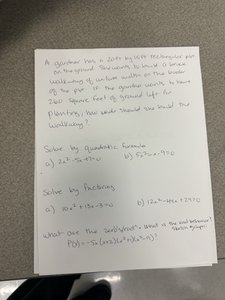
Q6. A gardener has a 20ft by 10ft rectangle plot and wants to break off a section for a walkway of width . If the garden needs to have 200 square feet of ground left for planting, how wide should she build the walkway?
Background
Topic: Quadratic Equations and Area
This question tests your ability to set up and solve a quadratic equation based on area constraints.
Key Terms and Formulas:
Area of rectangle:
Adjusted area:
Step-by-Step Guidance
Let be the width of the walkway.
The remaining planting area is .
Set up the equation: .
Expand and simplify the equation to form a quadratic equation in .
Solve the quadratic equation for using factoring or the quadratic formula.
Try solving on your own before revealing the answer!
Final Answer:
The width of the walkway should be feet.
This ensures the remaining area for planting is exactly 200 square feet.
Q7. What are the zeros/roots of ?
Background
Topic: Polynomial Roots
This question tests your ability to find the roots of a cubic polynomial, either by factoring or using the Rational Root Theorem and synthetic division.
Key Terms and Formulas:
Roots/Zeros: Values of where .
Factoring, Rational Root Theorem, Synthetic Division.
Step-by-Step Guidance
Set and look for rational roots using the Rational Root Theorem.
Test possible rational roots by substitution or synthetic division.
Once a root is found, factor it out and solve the resulting quadratic.
Find all roots by solving the quadratic equation.
Try solving on your own before revealing the answer!
Final Answer:
The roots are , , and .
These are the values where .
