Back
BackCollege Algebra Study Guide: Systems of Equations and Applications
Study Guide - Smart Notes
 Tailored notes based on your materials, expanded with key definitions, examples, and context.
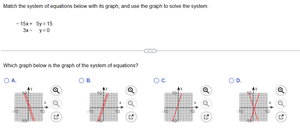
Q1. Match the system of equations below with its graph, and use the graph to solve the system.
-15x + 9y = 15 3x - y = 0
Background
Topic: Systems of Linear Equations and Graphs
This question tests your ability to match a system of linear equations to its graphical representation and use the graph to solve the system.
Key Terms and Formulas:
System of equations: Two or more equations with the same variables.
Graphical solution: The point where the lines intersect is the solution to the system.
Standard form:
Slope-intercept form:
Step-by-Step Guidance
Rewrite each equation in slope-intercept form () to identify the slope and y-intercept.
Compare the slopes and intercepts to the graphs provided (A, B, C, D) to find the matching graph.
Identify the intersection point on the correct graph, which represents the solution to the system.
Check that the intersection point satisfies both equations by substituting the values back into the original equations.
Try solving on your own before revealing the answer!
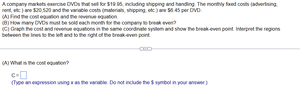
Q2. A company markets exercise DVDs that sell for $19.95 each, with fixed and variable costs. Find the cost equation.
Background
Topic: Linear Cost and Revenue Functions
This question tests your ability to write a cost equation based on fixed and variable costs, a common application in business algebra.
Key Terms and Formulas:
Fixed cost: Cost that does not change with the number of items produced.
Variable cost: Cost that changes with the number of items produced.
Cost equation: where is fixed cost, is variable cost per unit, is number of units.
Step-by-Step Guidance
Identify the fixed cost () and the variable cost per DVD () from the problem statement.
Let represent the number of DVDs produced and sold.
Write the cost equation in the form using the values from the problem.
Try solving on your own before revealing the answer!
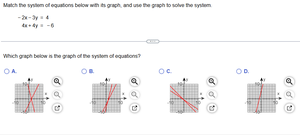
Q3. Match the system of equations below with its graph, and use the graph to solve the system.
-2x - 3y = 4 4x + 6y = -6
Background
Topic: Systems of Linear Equations and Graphs
This question tests your ability to recognize equivalent or related equations and match them to their graphical representation.
Key Terms and Formulas:
Parallel lines: No solution (if not the same line).
Same line: Infinitely many solutions.
Intersection: One solution.
Step-by-Step Guidance
Simplify both equations if possible to see if they are multiples of each other.
Convert to slope-intercept form to compare slopes and intercepts.
Match the equations to the correct graph (A, B, C, D) by analyzing the lines' relationships.
Identify the intersection or determine if the lines are parallel or the same.
Try solving on your own before revealing the answer!
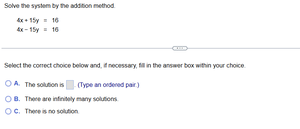
Q4. Solve the system by the addition method.
4x + 15y = 16 4x - 15y = 16
Background
Topic: Solving Systems by Elimination (Addition) Method
This question tests your ability to use the addition (elimination) method to solve a system of equations.
Key Terms and Formulas:
Addition (elimination) method: Add or subtract equations to eliminate one variable.
Step-by-Step Guidance
Align the equations and add them together to eliminate one variable.
Solve for the remaining variable.
Substitute the value found back into one of the original equations to solve for the other variable.
Write the solution as an ordered pair .
Try solving on your own before revealing the answer!
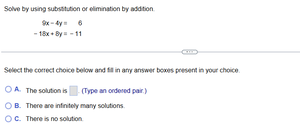
Q5. Solve by using substitution or elimination by addition.
9x - 4y = 6 -18x + 8y = -11
Background
Topic: Solving Systems by Substitution or Elimination
This question tests your ability to choose and apply either substitution or elimination to solve a system of equations.
Key Terms and Formulas:
Substitution method: Solve one equation for one variable and substitute into the other.
Elimination method: Add or subtract equations to eliminate a variable.
Step-by-Step Guidance
Multiply one or both equations if necessary to align coefficients for elimination.
Add or subtract the equations to eliminate one variable.
Solve for the remaining variable.
Substitute back to find the other variable and write the solution as an ordered pair.
Try solving on your own before revealing the answer!
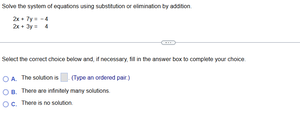
Q6. Solve the system of equations using substitution or elimination by addition.
2x + 7y = -4 2x + 3y = 4
Background
Topic: Solving Systems by Substitution or Elimination
This question tests your ability to use substitution or elimination to solve a system of equations.
Key Terms and Formulas:
Substitution method: Solve one equation for one variable and substitute into the other.
Elimination method: Subtract equations to eliminate a variable.
Step-by-Step Guidance
Subtract the second equation from the first to eliminate .
Solve for .
Substitute the value of back into one of the original equations to solve for .
Write the solution as an ordered pair .
Try solving on your own before revealing the answer!
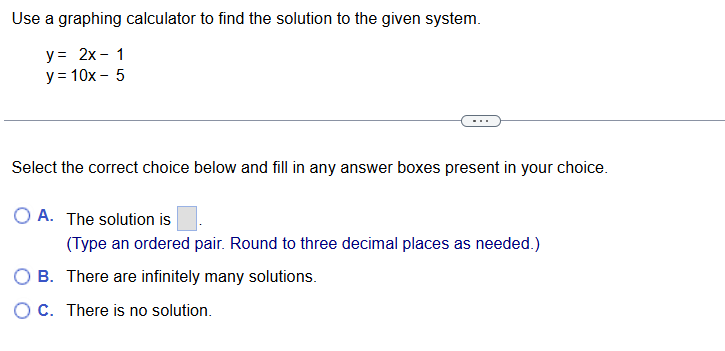
Q7. Use a graphing calculator to find the solution to the given system.
y = 2x - 1 y = 10x - 5
Background
Topic: Solving Systems of Equations Graphically
This question tests your ability to solve a system of equations by finding the intersection point of two lines using a graphing calculator.
Key Terms and Formulas:
Intersection point: The solution to the system is where the two lines cross.
Graphing calculator: Tool to plot both equations and find the intersection.
Step-by-Step Guidance
Enter both equations into your graphing calculator.
Graph the equations and use the calculator's intersect function to find the intersection point.
Record the and values of the intersection, rounding as needed.
Try solving on your own before revealing the answer!
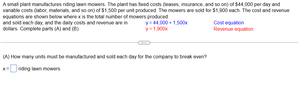
Q8. A small plant manufactures riding lawn mowers. How many units must be manufactured and sold each day for the company to break even?
Background
Topic: Break-Even Analysis with Linear Equations
This question tests your ability to use cost and revenue equations to determine the break-even point, a key application in business algebra.
Key Terms and Formulas:
Break-even point: The number of units where total cost equals total revenue.
Cost equation:
Revenue equation:
Step-by-Step Guidance
Set the cost equation equal to the revenue equation.
Solve for , the number of units at which the company breaks even.
Interpret the meaning of the break-even point in the context of the problem.
Try solving on your own before revealing the answer!