 Back
College Algebra Syllabus and Course Overview – Dallas College MATH 1314
Study Guide - Smart Notes
 Tailored notes based on your materials, expanded with key definitions, examples, and context.
Course Overview
Introduction to College Algebra
This syllabus outlines the structure, expectations, and content for College Algebra (MATH 1314) at Dallas College. The course provides an in-depth study of fundamental algebraic concepts, focusing on functions, equations, and mathematical modeling, preparing students for further studies in mathematics and related fields.
Course Description and Learning Outcomes
Course Description
Study and application of polynomial, rational, radical, exponential, and logarithmic functions.
Solving equations using matrices and systems of equations.
Additional topics may include sequences, series, probability, and conic sections.
State-Defined Learning Outcomes
Demonstrate and apply knowledge of properties of functions, including domain, range, operations, compositions, and inverses.
Recognize and apply polynomial, rational, radical, exponential, and logarithmic functions and solve related equations.
Apply graphing techniques and evaluate all roots of higher degree polynomial and rational functions.
Recognize, solve, and apply systems of linear equations using matrices.
Additional Instructor-Defined Learning Outcomes
Use appropriate symbolic notation and vocabulary to communicate, interpret, and explain mathematical concepts.
Define, represent, and perform operations on real numbers, applying numeric reasoning to investigate and describe quantitative relationships and solve real-world problems.
Use algebraic reasoning to solve problems involving ratios, rates, percentages, and proportions using multiple representations.
Manipulate expressions and equations to solve real-world problems.
Analyze, interpret, and compare data sets using graphs, tables, and technology.
Construct and use mathematical models in verbal, algebraic, graphical, and tabular form to solve problems and make predictions.
Texas Core Objectives
Critical Thinking Skills: Creative thinking, innovation, inquiry, analysis, evaluation, and synthesis of information.
Communication Skills: Effective development, interpretation, and expression of ideas through written, oral, and visual communication.
Empirical and Quantitative Skills: Manipulation and analysis of numerical data or observable facts resulting in informed conclusions.
Teamwork: Ability to consider different points of view and work effectively with others.
Personal Responsibility: Connecting choices, actions, and consequences to ethical decision-making.
Social Responsibility: Intercultural competence, civic responsibility, and engagement in communities.
Course Schedule and Topics
Weekly Topics Overview
Week | Topics |
|---|---|
1 | Introduction to Graphing, Functions and Graphs |
2 | Increasing, Decreasing, and Piecewise Functions; Algebra of Functions; Composition of Functions |
3 | Symmetry; Transformations |
4 | Complex Numbers; Quadratic Equations, Functions, and Zeros |
5 | Analyzing Graphs of Quadratic Functions; Rational and Radical Equations |
6 | Absolute Value Equations and Inequalities; Polynomial Functions |
7 | Graphing Polynomial Functions; Polynomial Division; Remainder and Factor Theorems |
8 | Theorems about Zeros of Polynomial Functions; Rational Functions |
9 | Polynomial and Rational Inequalities; Inverse Functions |
10 | Exponential Functions and Graphs; Logarithmic Functions and Graphs |
11 | Properties of Logarithmic Functions; Solving Exponential and Logarithmic Equations |
12 | Exponential Growth and Models; Systems of Equations; Introduction to Matrices |
13 | Sequences and Series |
14 | Binomial Theorem |
15 | Final Exam Review |
16 | Final Exam |
Grading Policy
Assignment Type | Percentage of Grade |
|---|---|
Chapter Exams | 60% |
Homework | 10% |
Final Exam | 30% |
Percentage | Letter Grade |
|---|---|
90-100% | A |
80-89% | B |
70-79% | C |
60-69% | D |
0-59% | F |
Course Policies and Support
Attendance: No attendance grade, but missing class may result in missing important information or quizzes.
Late Work: No makeup exams; late exams incur a 10-point deduction per day (up to 4 days). The final exam can replace the lowest exam grade if higher.
Proctoring: Controlled assessments are required for course integrity. Exams may require webcam proctoring or in-person testing.
Support: Free tutoring, success coaching, and student resources are available. Technical support is provided for eCampus and other college technology.
Required and Optional Materials
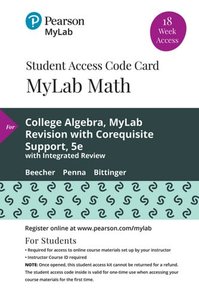
Required: MyLab Math with Pearson eText Access Code for College Algebra (Beecher, 5th Edition)
Optional: Calculator (graphing calculators such as TI-83 or TI-84 Plus are recommended; CAS software is not allowed)
Optional: Computer camera for at-home exams

Key Topics Covered in College Algebra
Graphs, Functions, and Models
More on Functions
Quadratic Functions and Equations; Inequalities
Polynomial Functions and Rational Functions
Exponential Functions and Logarithmic Functions
Systems of Equations and Matrices
Conic Sections
Sequences, Series, and Combinatorics
Additional info: This syllabus provides a comprehensive overview of the course structure, expectations, and resources for success in College Algebra. Students are encouraged to utilize all available support services and adhere to course policies for optimal learning outcomes.
