 Back
BackCollege Algebra Test #2 Review – Step-by-Step Guidance
Study Guide - Smart Notes
 Tailored notes based on your materials, expanded with key definitions, examples, and context.
Q14. Begin by graphing the standard absolute value function . Then use transformations of this graph to graph the given function .
Background
Topic: Graphing Absolute Value Functions with Transformations
This question tests your understanding of how to graph absolute value functions and apply transformations such as shifts, stretches/compressions, and translations.
Key Terms and Formulas:
Absolute Value Function: is a V-shaped graph with its vertex at the origin (0,0).
Vertical Stretch/Compression: stretches the graph vertically if and compresses it if .
Horizontal Shift: shifts the graph left by units if .
Vertical Shift: shifts the graph up by units if .
Step-by-Step Guidance
Start by sketching the basic graph of . This is a V-shaped graph with its vertex at (0,0).
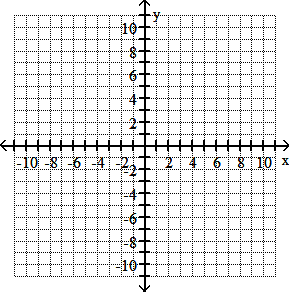
Apply the horizontal shift: shifts the graph 5 units to the left. The vertex moves from (0,0) to (-5,0).
Apply the vertical compression: The coefficient in front of the absolute value compresses the graph vertically by a factor of 4. This means the arms of the V are less steep.
Apply the vertical shift: Adding 6 to the function, , shifts the entire graph up by 6 units. The new vertex is at (-5, 6).
Try solving on your own before revealing the answer!
Final Answer:
The correct graph is shown in image_2. The vertex is at (-5, 6), and the graph is a vertically compressed V-shape.
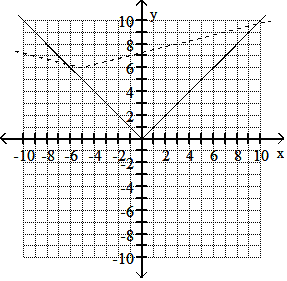
This matches the transformations described: left 5 units, up 6 units, and vertical compression by 1/4.
