 Back
BackCombining and Composing Functions: Operations, Domains, and Applications
Study Guide - Smart Notes
 Tailored notes based on your materials, expanded with key definitions, examples, and context.
Combining Functions
Operations on Functions
When two functions f(x) and g(x) are both defined, we can create new functions by adding, subtracting, multiplying, or dividing them. These operations are defined as follows:
Sum:
Difference:
Product:
Quotient:
The domain of each combined function is the set of all real numbers for which both f and g are defined (and, for the quotient, where g(x) ≠ 0).
Examples and Applications
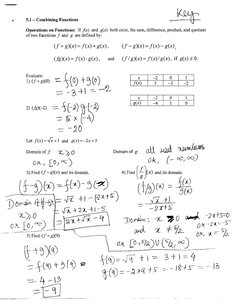
Evaluating Combined Functions: To find , add the values and .
Tabular Representation: Functions can be represented in tables, where each input value corresponds to an output for f and g. Operations are performed entry-wise.
Domain Considerations
Sum and Difference: The domain is the intersection of the domains of f and g.
Product: The domain is also the intersection of the domains of f and g.
Quotient: The domain is the intersection of the domains of f and g, excluding values where g(x) = 0.
Example: If and , then the domain of is and .
Evaluating Functions Using Graphs and Tables
Graphical and Tabular Evaluation
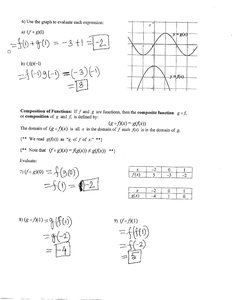
Functions can be evaluated using their graphs or tables. For a given input, locate the corresponding output on the graph or in the table, then perform the required operation.
Example: If and , then .
When using a graph, read the y-value for the given x-value.
Composition of Functions
Definition and Notation
The composition of two functions f and g is written as or . This means you first apply g to x, then apply f to the result.
Formula:
Domain: The domain of is all in the domain of such that is in the domain of .
Example: If and , then .
Evaluating Compositions with Tables and Graphs
To evaluate using a table, find first, then use that output as the input for .
When using a graph, trace the output of and use it as the input for .
Domain of Composite Functions
Finding the Domain
To determine the domain of a composite function :
Find the domain of .
Find the domain of .
Restrict the domain of to values for which $g(x)$ is in the domain of .
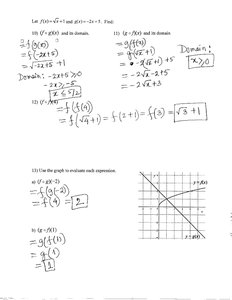
Example: If and , then , and the domain is .
Summary Table: Operations and Domains
Operation | Formula | Domain |
|---|---|---|
Sum | Intersection of domains of and | |
Difference | Intersection of domains of and | |
Product | Intersection of domains of and | |
Quotient | Intersection of domains of and , | |
Composition | All in domain of such that is in domain of |
Additional info: These notes cover foundational skills for combining and composing functions, which are essential for understanding more advanced topics in algebra and calculus. Mastery of these concepts is critical for solving equations, modeling real-world scenarios, and analyzing mathematical relationships.
