 Back
Complex Numbers: Concepts and Operations (College Algebra Study Notes)
Study Guide - Smart Notes
 Tailored notes based on your materials, expanded with key definitions, examples, and context.
Equations and Inequalities
Complex Numbers
Complex numbers extend the real number system to allow solutions to equations that have no real solutions, such as . This section introduces the basic concepts, notation, and operations involving complex numbers, which are fundamental in College Algebra.
Basic Concepts of Complex Numbers
Definition: A complex number is any number of the form , where and are real numbers and is the imaginary unit defined by .
Parts: In , is the real part and is the imaginary part.
Equality: Two complex numbers and are equal if and only if and .
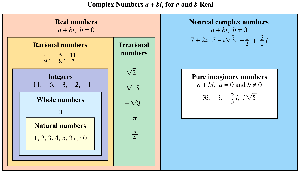
Subsets: If , is a real number. If and , the number is a pure imaginary number. Numbers with both and are nonreal complex numbers.
Standard Form: Complex numbers are written in the form (or ).
Operations on Complex Numbers
Operations such as addition, subtraction, multiplication, and division are defined for complex numbers, often using properties of real numbers and the imaginary unit .
Addition/Subtraction: ;
Multiplication: (using )
Division: To divide by a complex number, multiply numerator and denominator by the conjugate of the denominator.
Conjugate: The conjugate of is . The product of a complex number and its conjugate is always a real number: .
Examples of Operations
Example (Addition):
Example (Multiplication):
Example (Division): Multiply numerator and denominator by the conjugate :
Simplifying Powers of i
Cycle: The powers of repeat every four terms:
Any power of with an exponent that is a multiple of 4 has value 1. .
Example:
Properties and Cautions
Radicals: When working with negative radicands, use the definition for before applying other rules.
Product Rule for Radicals: is valid only when and are not both negative.
Quotient Rule for Radicals: is valid only when and are not both negative.
Summary Table: Classification of Numbers
The following table summarizes the classification of numbers, including real, rational, irrational, and complex numbers.
Type | Examples | Description |
|---|---|---|
Natural Numbers | 1, 2, 3, ... | Counting numbers |
Whole Numbers | 0, 1, 2, 3, ... | Natural numbers plus zero |
Integers | -2, -1, 0, 1, 2, ... | Whole numbers and their negatives |
Rational Numbers | , , | Numbers that can be written as fractions |
Irrational Numbers | , | Numbers that cannot be written as fractions |
Real Numbers | All rational and irrational numbers | Numbers on the number line |
Complex Numbers | Numbers with real and imaginary parts | |
Pure Imaginary Numbers | Numbers with zero real part | |
Nonreal Complex Numbers | , , | Numbers with both real and imaginary parts |
Additional info: The classification table and image visually reinforce the relationships between real, rational, irrational, and complex numbers, as well as the subset structure of these number types.
