 Back
BackComplex Numbers: Definitions, Operations, and Examples
Study Guide - Smart Notes
 Tailored notes based on your materials, expanded with key definitions, examples, and context.
Complex Numbers
Definition and Fundamental Concepts
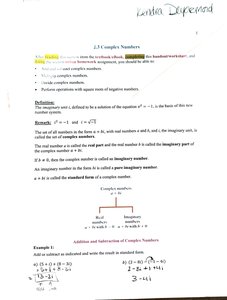
Complex numbers are an extension of the real number system, allowing for solutions to equations that do not have real solutions. The standard form of a complex number is a + bi, where a and b are real numbers, and i is the imaginary unit defined by .
Real part: The value a in the expression a + bi.
Imaginary part: The value b in the expression a + bi.
Imaginary unit: is defined such that .
Standard form: Any complex number can be written as a + bi.
Example: is a complex number with real part 3 and imaginary part 4.
Addition and Subtraction of Complex Numbers
To add or subtract complex numbers, combine the real parts and the imaginary parts separately.
Addition:
Subtraction:
Example:
Multiplication of Complex Numbers
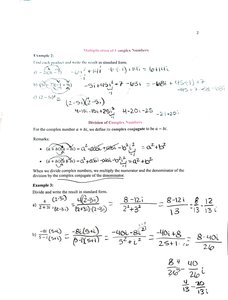
Multiplying complex numbers uses the distributive property and the fact that .
Formula:
Since ,
So,
Example:
Division of Complex Numbers
To divide complex numbers, multiply the numerator and denominator by the conjugate of the denominator to eliminate the imaginary part from the denominator.
Conjugate: The conjugate of is .
Formula:
(since )
Example:
: Multiply numerator and denominator by :
Numerator:
Denominator:
Result:
Summary Table: Operations with Complex Numbers
Operation | Formula | Example |
|---|---|---|
Addition | ||
Subtraction | ||
Multiplication | ||
Division |
Additional info: The notes provide foundational operations with complex numbers, which are essential for solving equations and understanding advanced algebraic concepts.
