 Back
Comprehensive Study Notes: Quadratic and Power Functions, Domain & Range, Function Transformations
Study Guide - Smart Notes
 Tailored notes based on your materials, expanded with key definitions, examples, and context.
Quadratic Functions
Standard Form of Quadratic Functions
Quadratic functions are fundamental in algebra and are typically written in the standard form: , where a, b, and c are constants and . The graph of a quadratic function is a parabola.
Quadratic term: ; the coefficient a determines the direction and width of the parabola.
Linear term: ; affects the slope and position.
Constant term: ; the y-intercept of the graph.
If , the parabola opens upward; if , it opens downward.
Example: models the height of a thrown baseball, where indicates the parabola opens downward.
Factored and Vertex Forms
Quadratic functions can also be written in other forms to reveal different properties:
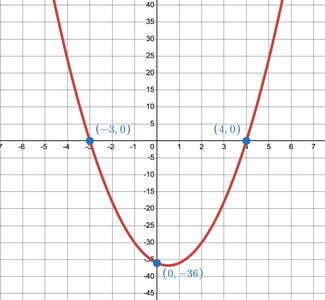
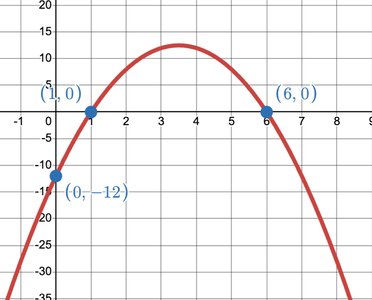
Factored form: , where and are the zeros (x-intercepts).
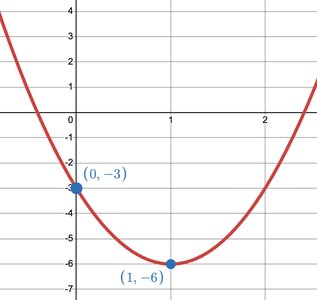
Vertex form: , where is the vertex of the parabola.
Example: shows zeros at and . has vertex at .
Graphical Interpretation
Key features of quadratic graphs include zeros, vertex, and y-intercept. The vertex represents the maximum or minimum value depending on the sign of a.
Solving Quadratic Equations
Quadratic equations can be solved by factoring, completing the square, or using the quadratic formula:
Quadratic formula:
The discriminant determines the nature of the solutions:
If , two real solutions.
If , one real (double) solution.
If , no real solutions (complex roots).
Power Functions
Positive Exponents
A power function is any function of the form , where and is a real number. The graph's shape depends on the exponent:
Quadratic (): U-shaped parabola.
Cubic (): Chair-shaped curve.
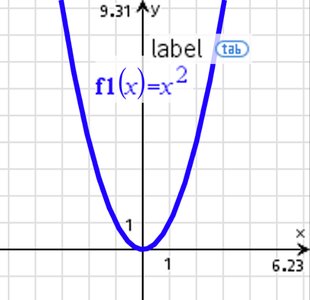
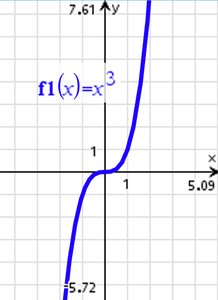
Example: The depth of a falling ball: .
Applications of Power Functions
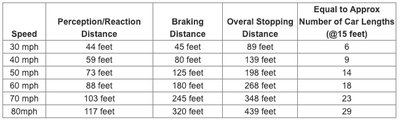
Power functions are used in modeling real-world phenomena, such as stopping distances for vehicles.
Speed | Perception/Reaction Distance | Braking Distance | Overall Stopping Distance | Approx. Car Lengths (@15 ft) |
|---|---|---|---|---|
30 mph | 44 ft | 45 ft | 89 ft | 6 |
40 mph | 59 ft | 80 ft | 139 ft | 9 |
50 mph | 73 ft | 125 ft | 198 ft | 14 |
60 mph | 88 ft | 180 ft | 268 ft | 18 |
70 mph | 103 ft | 245 ft | 348 ft | 23 |
80 mph | 117 ft | 320 ft | 439 ft | 29 |
Negative and Fractional Exponents
Power functions with negative exponents, such as , have vertical and horizontal asymptotes. Fractional exponents, such as , represent root functions.
For , approaches zero as and is undefined at .
For , increases slowly as increases.
Domain and Range
Domain of Functions
The domain of a function is the set of all possible input values (x-values) for which the function is defined. Restrictions may occur due to division by zero or taking the square root of a negative number.
For rational functions, exclude values that make the denominator zero.
For root functions of even order, restrict to values where the radicand is non-negative.
Range of Functions
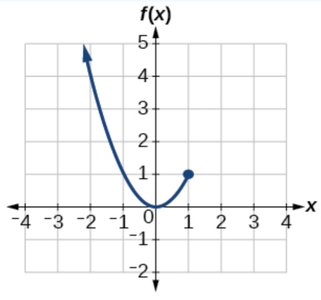
The range is the set of all possible output values (y-values). The range can be determined algebraically or by analyzing the graph.
For quadratic functions, the range depends on the vertex and direction of opening.
For root functions, the range is typically for even roots, unless shifted.
Function Transformations
Vertical and Horizontal Shifts
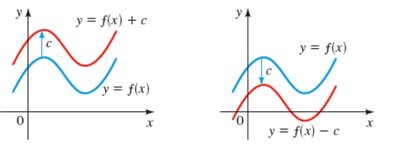
Transformations change the position and shape of a function's graph. Vertical shifts move the graph up or down, while horizontal shifts move it left or right.
Vertical shift: shifts up by units; shifts down by $c$ units.
Horizontal shift: shifts right by units; shifts left by $c$ units.
Vertical Stretch, Compression, and Reflection
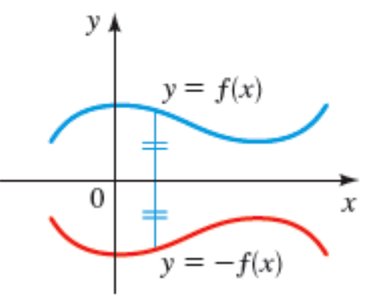
Multiplying the function by a constant stretches or compresses it vertically. Reflecting the function over the x-axis changes the sign of all y-values.
Vertical stretch: , stretches; compresses.
Reflection: reflects over the x-axis.
Composition and Inverse Functions
Composition of Functions
Composition involves applying one function to the result of another: . The inside function is , and the outside function is .
Example: Converting Celsius to Fahrenheit: can be viewed as composing two functions.
Inverse Functions
An inverse function "undoes" the action of the original function. If and are inverses, then and for all in the domain.
To find the inverse, swap and in the equation and solve for $y$.
Factoring Quadratic Expressions
Factoring Methods
Quadratic expressions can be factored using sum-product, grouping, or special formulas:
Sum-product: For , find two numbers that multiply to and add to .
Perfect square:
Difference of squares:
Example: Factor
Summary Table: Quadratic Forms
Form | Equation | Key Features |
|---|---|---|
Standard | Vertex, y-intercept, direction | |
Factored | Zeros (x-intercepts) | |
Vertex | Vertex , max/min value |
Additional info: Academic context was added to clarify the relationship between forms, transformations, and applications of quadratic and power functions, as well as domain and range concepts.
